
The night the dead come knocking: How Halloween travelled from Celtic fires to the whole world


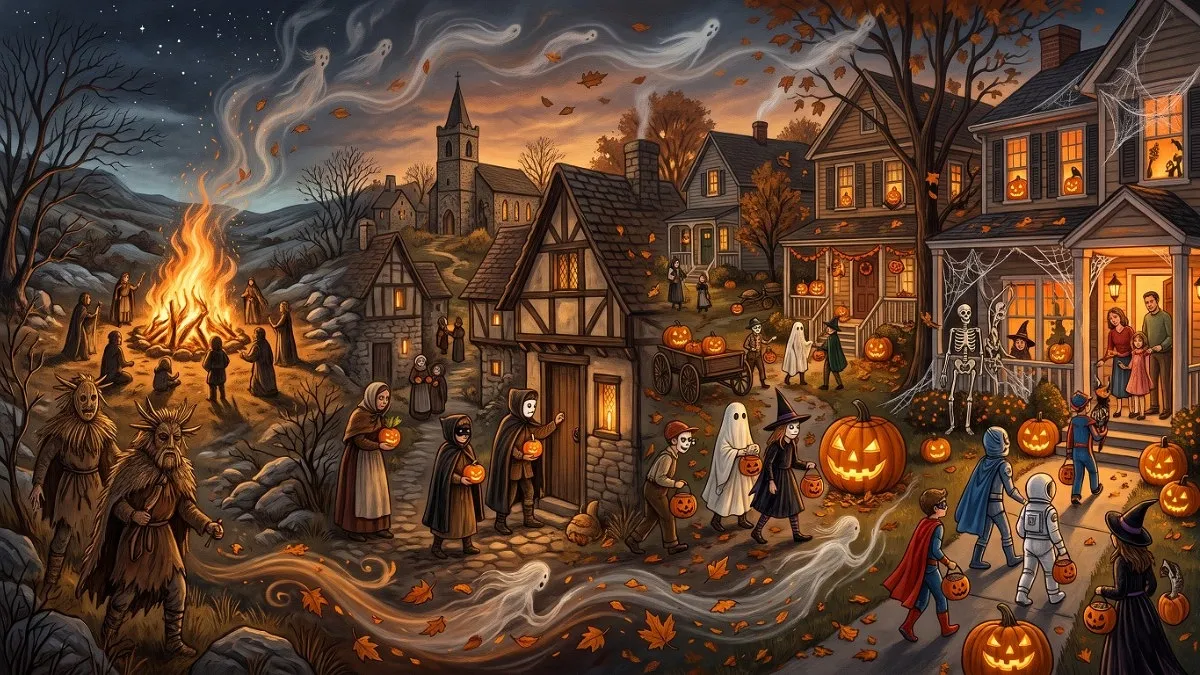
Generated by AI
Every year, as October runs out, something strange happens in ordinary neighborhoods. Porches that stayed plain for eleven months suddenly glow orange. Children who would never open a stranger’s door march up driveways in capes and plastic masks. Grown adults spend real money on fake cobwebs. A carved pumpkin with a candle inside sits on a doorstep like a small, grinning guard.
It is easy to treat all this as harmless fun, a night of candy and costumes. But Halloween is one of the oldest surviving conversations between the living and the dead, and it has been changing its clothes for roughly two thousand years. To understand why a modern child in a superhero outfit is knocking on your door, you have to go back to a cold hillside in ancient Ireland.
Fires on the hill: The Celtic roots
The story usually begins with Samhain, pronounced something like “sow-in,” a festival of the Gaelic peoples of Ireland, Scotland and the Isle of Man. It marked the end of the harvest and the start of the dark half of the year. Around the end of October and the first day of November, the cattle were brought down from summer pastures, animals were chosen for slaughter before winter, and families took stock of whether they had enough food to survive the cold months.
For farming people, this was not a cheerful moment. Winter meant hunger, and sometimes death. So, it is not surprising that Samhain carried a feeling of uncertainty. Early Irish stories describe it as a time when the boundary between this world and the Otherworld grew thin. Spirits, fairies and the restless dead were believed to move more freely. Great bonfires were lit, and people gathered around them for protection, for company and for ritual.
A word of honesty is needed here. Popular books often describe Samhain in dramatic detail, with robed priests and elaborate sacrifices. Most of that comes from later writers who guessed, borrowed or simply imagined. The written sources we actually have come from medieval Irish monks, centuries after the festival began, and historians still argue about how much of the original practice survived. What seems solid is the core idea: a turning point in the year, a gathering of the community, fire against the dark, and a feeling that the dead were close.
The Church steps in
When Christianity spread across Britain and Ireland, the Church faced a familiar problem. People loved their old festivals and were not going to give them up easily. A common solution across Europe was not to ban such celebrations outright but to place a Christian meaning on top of them.
The Church already had a day to honor saints and martyrs. Over the centuries, that commemoration settled on November 1 and became known as All Saints’ Day, or All Hallows. “Hallow” is an old English word meaning holy, and the evening before the feast was called All Hallows’ Eve. Say that phrase fast enough, over enough generations, and it shrinks into Hallowe’en, and finally Halloween.
Around the year 1000, a church leader named Odilo of Cluny encouraged a further day, November 2, for praying for the souls of all the faithful dead. This became All Souls’ Day. So by the late Middle Ages, a three day stretch of Hallows, Saints and Souls had formed, all about remembering those who had died.
Out of this period came customs that look surprisingly familiar. Poor villagers went from house to house on All Souls’ Day, offering prayers for the dead of the household in exchange for small square “soul cakes.” This practice, called souling, is often seen as an early cousin of trick or treating. In Scotland and Ireland, young people went “guising,” dressing up in disguise and performing songs, poems or jokes at doors in return for food or coins. Disguises had a spiritual logic too. In some places people believed that wandering spirits could be fooled by a costume, so you wore a mask to avoid being recognized by the dead.
Meanwhile the games and foods of autumn gathered around the date. In Ireland, a fruit loaf called barmbrack was baked with small objects hidden inside, each predicting something about the year ahead: a ring for marriage, a coin for wealth. Young people played games of divination, trying to learn who they would marry by peeling apples or roasting nuts on the fire. Apple bobbing, still alive at school parties today, belongs to this world. Some historians connect it to older Roman harvest traditions, though the link is debated.
The lantern and the long journey west
The jack o’ lantern has its own story. An Irish folktale tells of a clever, greedy man named Stingy Jack who tricked the devil more than once. When Jack died, heaven refused him because of his sins, and hell refused him because he had cheated the devil. He was left to wander in the dark with a single burning coal, which he carried inside a hollowed turnip. People came to call this wandering figure “Jack of the lantern.”
In Ireland and Britain, people carved scary faces into turnips, beets and mangelwurzels, and set a candle inside to ward off bad spirits. Anyone who has tried to carve a turnip will tell you it is hard work, and that detail matters for what happened next.
In the middle of the 1800s, the Great Famine in Ireland pushed more than a million people to leave their homeland, and many crossed the Atlantic to the United States. They brought their songs, their stories and their autumn customs with them. In America they discovered the pumpkin, large, soft, cheap and wonderfully easy to carve. The humble turnip lantern was quietly replaced, and the pumpkin became the face of the holiday.
Halloween was not an instant hit in America, though. Many early colonists, especially the Puritans in New England, disapproved of festivals tied to old beliefs. In other parts of the colonies, harvest gatherings, ghost story evenings and fortune telling parties were more common. As waves of Irish and Scottish immigrants settled in towns and cities during the 1800s, the customs blended together, and by the end of the century Halloween was a recognized, if sometimes rowdy, part of American life.
From pranks to candy
Here is a part of the story that surprises many people: for a while, Halloween was mainly known for trouble. In the early 1900s, the night became a time for mischief. Young people tipped over outhouses, unhooked gates, soaped windows and stole farm wagons. During the hard years of the Great Depression in the 1930s, the pranks sometimes turned into real vandalism, and towns began to worry.
Community leaders, schools and parents decided to steer the energy somewhere safer. Parties, parades and organized events were promoted, and the holiday started to move toward children and families. Out of this effort came the practice we now call trick or treat. The phrase appeared in print in the 1920s in North America, and by the 1930s the custom of children demanding sweets in exchange for not causing mischief had spread widely. Candy was the peace treaty. Give them a treat, and they will not play a trick.
The Second World War interrupted things. Sugar was rationed, and for several years trick or treating faded. When the war ended, the timing was perfect. Families were moving into new suburbs, with lots of houses close together and lots of children on the same street. Trick or treating fit this world beautifully. A child could visit twenty doors in an hour and still be home for dinner. Candy companies noticed. Television and cartoons noticed. Charities noticed too, and in 1950 a group of children in Philadelphia began collecting coins for UNICEF as they went door to door, giving the holiday a generous side.
Costumes changed with the times. In the early days, many were homemade: a bedsheet ghost, a witch from an old dress. By the 1950s and 1960s, manufacturers were selling ready-made outfits, often with a thin plastic mask and a smock printed with a cartoon or movie character. Parents bought them in boxes. The imagination moved from the sewing table to the shop shelf.
The fear that never quite went away
Every popular holiday collects its myths, and Halloween has some famous ones. In the 1970s and 1980s, rumors spread that strangers were hiding razor blades in apples or poison in candy. Parents grew anxious, hospitals offered to X ray treats, and some neighborhoods stopped trick or treating altogether. Researchers who later studied the reports, including sociologist Joel Best, found no confirmed case of a stranger killing a child with tampered Halloween candy. The one widely known poisoning case from that era involved a father who harmed his own son. The danger people feared was largely a story, though the fear itself was very real and reshaped how the holiday was practiced.
Out of that anxiety came new traditions. Churches and community groups began holding “trunk or treat” events, where children collect sweets from the open trunks of decorated cars in a parking lot. Parents learned to check candy, walk with their kids and choose well-lit streets. In more recent years, the Teal Pumpkin Project has encouraged households to offer nonfood treats so that children with food allergies can join in safely. The holiday, once again, has adjusted itself to people’s worries.
Meanwhile the darker side of Halloween found a home in entertainment. The 1978 film “Halloween” turned the date itself into the title of a horror franchise. Haunted houses grew from a few churches’ basement displays into huge seasonal businesses with actors, special effects and tickets that sell out. Horror stopped being something you whispered about and became something you could queue for.
Where Halloween stands today
So, what is Halloween now, in the middle of the 2020s? Mostly, it is big business and big fun, and for many people it has become the second most important season for home decoration after Christmas. In the United States, annual spending on Halloween has been reported at well over ten billion dollars in recent years, covering costumes, candy, decorations and even costumes for pets. Giant skeletons stand in front gardens. Streaming services release scary movies on schedule. Coffee shops launch pumpkin flavored drinks as soon as the weather allows.
It has also stopped being only for children. Adults now treat Halloween as a night out, with costume parties, bar crawls and parades. New York’s Greenwich Village parade, which began in the 1970s as a small neighborhood gathering, grew into one of the largest in the country. Social media has pushed the trend further, because a clever costume is also a photograph, and a photograph travels.
The holiday has spread well beyond the countries that shaped it. In Japan, crowds in Tokyo’s Shibuya district fill the streets in elaborate costumes, though local authorities have had to manage the scale. In South Korea, the night became popular among young people, and the tragedy in the Itaewon area of Seoul in October 2022, when a crowd crush killed more than 150 people, was a painful reminder of what happens when a festival grows faster than the planning around it. Across Europe, Halloween has gained ground even in places where it was once seen as an American import, sometimes sitting beside older local traditions for remembering the dead.
It is worth noting that these older traditions have not disappeared. In Mexico, Día de los Muertos on November 1 and 2 is a separate, deeply rooted celebration with its own history, in which families build altars and welcome their ancestors with flowers, food and music. It is often confused with Halloween, but it is a different festival with a different tone. It treats death not as a monster but as part of the family.
In Bangladesh, Halloween is not part of the traditional calendar, and its presence is modest. In some circles in Dhaka, among certain private schools, cafes, university groups and young people who follow global trends online, you may find costume parties and themed posts. It has also drawn criticism from people who see it as a foreign custom that does not belong to local culture or religious values. This pattern of enthusiasm in some places and resistance in others plays out in many countries, and it tells us something: Halloween travels easily, but it never arrives without an argument.
The debates around the pumpkin
Indeed, the holiday faces serious conversations today. Religious groups in several countries object for different reasons. Some Christian communities worry about its pagan associations, and some respond with alternatives like harvest festivals or “Reformation Day” events. Some Muslim scholars and community leaders advise against taking part, seeing it as tied to beliefs and practices outside their faith. Others, of all backgrounds, simply see it as a children’s party with no deeper meaning, and join in without a second thought.
Costumes have raised another set of questions. Outfits that mock a culture, a religion or a group of people cause real hurt, and many schools and workplaces now publish guidelines asking people to think before they dress up. Critics also point out the pressure on young women, who often find the costume aisle filled with revealing versions of every character. Others raise environmental concerns. Many costumes are cheap plastic worn once and thrown away. Millions of pumpkins are carved, left to rot and wasted every year, when they could have been eaten. Some families now swap costumes, sew their own or buy secondhand, which, in a funny way, brings the holiday back to its homemade roots.
How it keeps evolving
If there is one lesson in Halloween’s long history, it is that the festival survives because it keeps changing. It began as a fearful pause at the edge of winter, with fires lit against the dark. It became a Christian remembrance of the saints and the dead. It turned into a night of pranks, then a children’s candy tradition, then a billion-dollar season, and now a global social media event. At each stage, people took the shape of the holiday and filled it with what they needed most: protection, prayer, play, belonging or simply a good story.
Even now, it is moving again. Digital costumes and online parties appear alongside real ones. Home haunts, built by hobbyists with fog machines and projectors, compete in creativity. Communities are reviving older customs, such as lantern walks and ancestor remembrance evenings, as a counterweight to the commercial rush. And a growing number of people are looking for the quiet meaning under the noise, using the night to talk about family members who have died.
That may be the deepest reason Halloween has lasted. Beneath the plastic fangs and the candy wrappers is a very old human instinct: when the days grow short and the air turns cold, we light a small flame, gather our neighbors and admit, half laughing and half serious, that the dead are never completely far away.
The next time a small witch or astronaut rings your bell and holds out a bag, remember that you are taking part in a ritual that began on a windswept hill, crossed an ocean in the pockets of poor migrants, and ended up on your doorstep. Give them a treat. The tradition has earned it.
