
The man who refused to look away

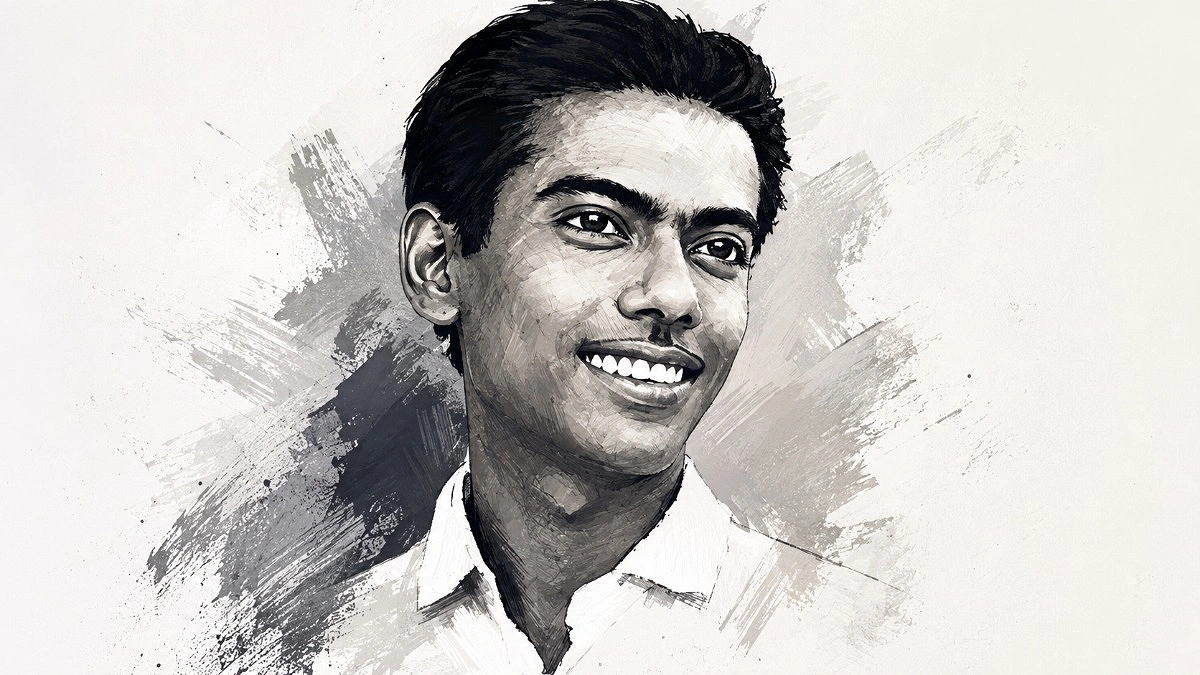
Graphics: Generated By AI
Ninety-one years ago today, on August 19, 1935, a boy named Mohammad Zahirullah was born in the small village of Majupur, in the Sonagazi area of what was then Noakhali district in undivided Bengal. Nobody in that household could have guessed that this child would grow up to change the shape of Bengali storytelling twice over, first with his pen and then with his camera, before vanishing into the chaos of a newborn nation and never being found again. The world remembers him as Zahir Raihan: novelist, journalist, filmmaker, freedom fighter, and one of the most haunting unfinished stories in Bangladesh’s cultural history.
To mark his birthday is to mark a strange kind of anniversary. It celebrates a beginning while never quite letting go of an ending that was never properly written. Zahir Raihan disappeared on January 30, 1972, weeks after Bangladesh’s independence, while searching for his elder brother. He was thirty-six years old. Between that first day in Majupur and that last, unresolved day in Mirpur, he packed in enough work, enough courage, and enough restless reinvention for several lifetimes.
A Childhood Between Two Worlds
Zahirullah’s early years were split between Bengal and beyond. His father taught at the Alia Madrasah in Calcutta, and it was there that young Zahirullah received his first schooling, at Mitra Institute and later at the madrasah itself. The Partition of India in 1947 upended that world overnight. The family moved back to their ancestral village in Feni, and the boy who had grown up amid the noise and intellectual churn of Calcutta now had to remake his footing in a newly drawn country.
He finished his matriculation from Amirabad High School in 1950, the same year he took his first tentative steps into journalism, writing for a paper called Juger Alo. It was an early sign of a pattern that would define his whole life: he rarely did just one thing. He studied, he wrote, and he watched the world around him with the eye of someone already gathering material for stories he had not yet learned how to tell.
He briefly enrolled in medical college after completing his intermediate examination at Dhaka College in 1953, but medicine could not hold him. He left it behind for literature, eventually earning his Bachelor of Arts with honours in Bengali from the University of Dhaka in 1956, followed by a Master’s degree in 1958. Along the way, his name itself changed. Drawn into the underground currents of the Communist Party during a period when the party had been banned and its leaders forced into hiding, the young man served as a courier, carrying messages between comrades who could not risk being seen together. It was the underground leaders who gave him the name Raihan, and Zahirullah became, from that point on, Zahir Raihan.
A Voice Forged in the Language Movement
Anyone trying to understand Zahir Raihan’s later work, the ferocity of it, the tenderness of it, has to start with February 21, 1952. He was present at the historic gathering at Amtala on the Dhaka University campus that day, part of the movement demanding that Bengali be recognized as a state language of Pakistan. He was among the very first people arrested when the crackdown began. That single afternoon, and the deaths of student protesters that followed, would echo through nearly everything he made afterward. The Language Movement was not, for him, a historical footnote to be referenced from a safe distance. It was a lived wound, and it shaped both his politics and his art for the rest of his life.
Journalism remained his early anchor. He wrote for a string of publications, including Khapchhara, Jantrik, and Cinema, and in 1956 became editor of a magazine called Probaho. But fiction was pulling at him too. His first collection of short stories, Suryagrahan, appeared in 1955, a young writer testing the weight of his own sentences.
The Novelist Who Wrote Bengal’s Wounds
By 1960, Zahir Raihan had published his first novel, Shesh Bikeler Meye, and from there his literary output arrived in a steady, urgent rhythm. He wrote Hajar Bachhar Dhore, a novel that captured the stubborn, unhurried rhythms of rural Bengali life with a clarity that still gets assigned in classrooms today. He wrote Arek Falgun, set against the memory of the Language Movement itself, one of the earliest and most significant Bengali novels to fictionalize that history while it was still fresh enough to bleed. He wrote Trishna, Baraf Gala Nadi, Ar Kata Din, and Kayekti Mrityu, each one extending his reputation as a writer unafraid to look directly at social injustice, communal tension, and the private costs of public upheaval.
What set his fiction apart was not just subject matter but restraint. He did not need melodrama to make a reader feel the ache of history. He let ordinary lives, a village girl, a struggling family, a set of neighbours pulled apart by circumstance, carry the full weight of the political moment. It is part of why his novels have outlived the decade in which they were written.
Behind the Camera, a Second Career Begins
If literature had been Zahir Raihan’s first calling, cinema became his second, and he pursued it with the same restless ambition. He made his directorial debut in 1961 with Kokhono Asheni. Three years later, in 1964, he directed Sangam, which became the first colour film made in what was then Pakistan, a genuine technical milestone for the region’s film industry. The following year he pushed further, completing Bahana, the first Bengali film shot in CinemaScope.
His filmography from that decade reads like a director determined to prove that Bengali cinema could hold its own against any industry in the world: Kancher Deyal, for which he won the Nigar Award for direction in 1964, Behula, Agun Niye Khela, and Jibon Theke Neya among them. Jibon Theke Neya in particular carried unmistakable political weight. Made under a government reluctant to tolerate dissent, the film used the metaphor of a troubled household to speak, unmistakably, about the state of Pakistan and the suppression of Bengali identity. Audiences understood exactly what he meant, even when censors did not fully grasp it in time to stop them from watching.
His personal life moved in step with his professional one, often entangled with the same industry that gave him his films. He married the actress Sumita Devi in 1961, and the couple had two sons, Bipul and Anol. That marriage ended in 1968, the same period in which he married another leading actress of the time, Kohinoor Akhter, known to audiences as Suchonda. They had a son together, Topu. Two of Bangladesh’s most recognisable film families, including Suchonda’s sisters Bobita and Champa, trace directly back through this period of Zahir Raihan’s life.
Turning the Camera on a Genocide
When war came in 1971, Zahir Raihan did not retreat from it. As Pakistani forces launched a brutal crackdown on East Pakistan and the Liberation War began, he moved to Kolkata and threw himself into using film as testimony. The result was Stop Genocide, a documentary that stands as one of the most important visual records of the atrocities committed during the war. It was not a film made for festivals or applause. It was made to force the world to look at what was happening to his people, at a moment when very few outside cameras were allowed anywhere near the truth. The documentary remains the single work for which he is most widely remembered, a filmmaker turning his craft into an act of witness and resistance at real personal risk.
A Disappearance That Bangladesh Has Never Stopped Mourning
Bangladesh’s independence came on December 16, 1971, but the reckoning with what the war had cost was only beginning. In the war’s final and most brutal weeks, a coordinated campaign targeted the country’s intellectuals, writers, doctors, professors, and journalists whose voices had helped shape Bengali nationalist thought. Among those seized was Shahidullah Kaiser, Zahir Raihan’s elder brother, an acclaimed writer in his own right, taken from his residence at the University of Dhaka.
Weeks later, in January 1972, someone brought Zahir Raihan word of a possible location where his brother might be found, an address in Mirpur, then still a tense and dangerous pocket of the city. He went to search for him. He never came home. January 30, 1972 is the date recorded as his disappearance, and to this day his fate remains unresolved. No body was ever recovered. No definitive account of his final hours has ever been established. Bangladesh lost, within the same terrible stretch of months, both brothers, one seized by those trying to silence a nation’s voice, the other lost while trying to bring him back.
What Remains
Recognition came, as it so often does, after it was too late for him to receive it in person. He was posthumously awarded the Ekushey Padak in 1977 and the Independence Day Award in 1992, two of the highest civilian honours Bangladesh bestows, alongside the Bangla Academy Literary Award given the year of his disappearance, in 1972. His films have continued to receive recognition at the National Film Awards long after his death, and Hajar Bachhar Dhore was itself adapted again for the screen decades later by Suchonda, who directed it and won a national award for the effort, carrying her former husband’s literary legacy forward into a new generation of filmmaking.
But awards are a thin measure of what Zahir Raihan actually left behind. He gave Bengali literature some of its most enduring portraits of rural and political life. He gave Bengali cinema its first colour film and its first CinemaScope production, proof that ambition did not have to wait for permission from bigger industries. He gave the world Stop Genocide, a document that refuses to let the events of 1971 be forgotten or minimised. And he gave his own life, in the most literal sense, trying to save his brother’s.
Every August 19, Bangladesh pauses, however briefly, to remember a man who moved between three professions, journalist, novelist, filmmaker, and one unfinished cause, the search for his brother, with the same fierce, unwavering commitment. He was born into a country still under colonial rule, came of age fighting for the right to speak his own language, and died, or disappeared, in the earliest days of the independent nation he had helped imagine into being through his stories and his films. Ninety-one years on, his work still insists that ordinary Bengali lives, their griefs, their politics, their quiet dignity, deserve to be looked at directly, without flinching. That insistence was Zahir Raihan’s whole career, and it remains his clearest legacy.
Sources: Wikipedia, Banglapedia, IMDb
