
Three hearts, blue blood, and a day of its own


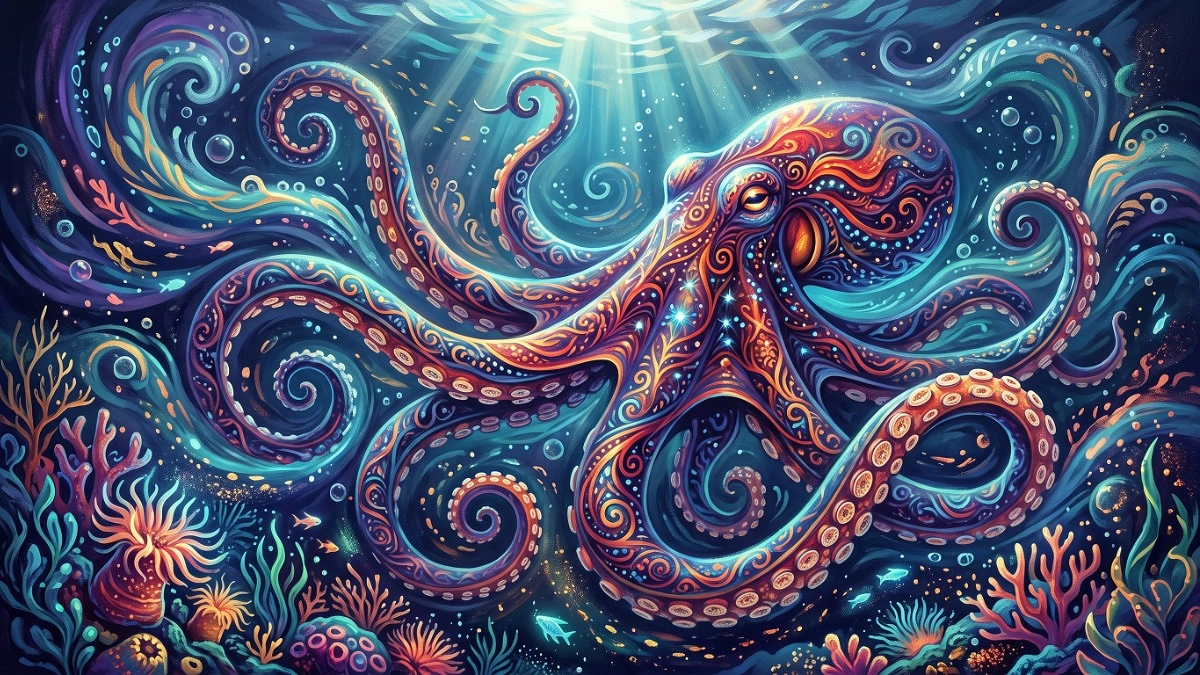
Graphics: Agamir Somoy
Somewhere off a rocky coast tonight, an octopus is easing out of a crevice no wider than a coin slot. It has no skeleton to stop it. It has three hearts, blue blood, and a nervous system spread through its body like a committee with no chairperson. It tastes the seafloor with its skin, changes color faster than a thought, and may be solving a problem that would stump a toddler. Then, for most of its life, it vanishes again into the dark.
Today, October 8, is the day people stop to notice. World Octopus Day is not a United Nations observance and has no headquarters, charter or founding president. It is something stranger and more modern, a day that grew out of curiosity, wordplay and the internet’s fondness for a creature that seems almost designed to be adored.
A holiday without a birth certificate
Anyone hoping for a tidy origin story, with a named founder, a signing ceremony and a first official event, will be disappointed. The honest answer is that nobody can point to one. The sources that document the day agree on the broad outline. It was first celebrated in the early 2000s by marine biology enthusiasts and ocean conservationists, and another account describes it as growing out of grassroots marine awareness campaigns. Beyond that, the trail goes cold. No single institution claims authorship, and no official global theme is announced each year.
That vagueness is part of the character of the day. Many of the world’s best loved awareness days begin with a government resolution. This one began, as far as anyone can tell, with people who simply loved the animal and wanted a date on which to say so. Aquarists, divers, teachers, marine students and hobbyists passed the idea along, and it spread the way a good fact about octopuses always does, from one amazed person to the next.
Why the eighth of October
The choice of date is the one part of the story that is easy to explain, and it is charmingly literal. October was picked because its name sounds the most like the word “octopus,” and the 8th because the animal has eight appendages. The word itself comes from Greek, roughly meaning “eight foot,” although as marine educators like to point out, those eight limbs are not feet at all. They are arms, lined with suckers that can grip, grasp, and taste.
The calendar even helps the joke along. In many places the tenth month, October, carries the Latin root for eight in its name, a leftover from the old Roman calendar in which it was once the eighth month. So, the day sits at the meeting point of two eights: the eighth day of a month whose name still whispers the number. One account adds that the day is also tied to an “Octopus Week” series of events, running from October 8 to 12, devoted to cephalopods.
The ancient relationship
The octopus was an object of human fascination long before anyone dreamed of awareness days. Minoan potters on Crete painted sprawling octopuses across their vases more than three thousand years ago, the arms curling around the curves of the clay as if the animal were still moving. Aristotle studied octopuses carefully in the fourth century BCE and wrote about their habits, their eggs, and their remarkable ability to change color. Fishermen around the Mediterranean and in Japan have hunted them for centuries, and the animal has long been a fixture in kitchens from Galicia to Osaka.
Folklore was less kind. Sailors told of the kraken, a monstrous tentacled terror that dragged ships to the bottom, a legend likely fed by glimpses of giant squid. Victorian illustrators and later filmmakers cast the octopus as a grasping villain. For a long time the animal sat in the human imagination somewhere between delicacy and nightmare.
What changed was not the octopus but the quality of our attention.
From monster to marvel
The shift began in laboratories and aquariums. Scientists who set out to study the octopus kept running into behavior that did not fit what they expected from an animal with a lifespan of only a year or two and no parents to teach it anything. Octopuses opened jars from the inside. They learned by watching. They recognized individual human keepers, and some aquarium staff reported that certain animals squirted water at people they disliked.
One of the most famous cases is Otto, an octopus at the Sea Star Aquarium in the German town of Coburg. Staff reported that he rearranged the objects in his tank, juggled hermit crabs, and was blamed for a short circuit after he apparently squirted water at an overhead lamp. The story circled the world in 2008 and did a great deal for the animal’s reputation as a mischievous personality rather than a simple sea creature.
Then came a landmark moment in the scientific record. In 2009, researchers documented veined octopuses in Indonesian waters carrying halved coconut shells across the seabed and later assembling them into shelters. This was reported as evidence of tool use, something once thought to be the preserve of primates and a few birds. Almost overnight, the octopus moved from curiosity to subject of serious comparison with the cleverest animals on land.
The ones that got away, and the one that predicted football
Pop culture did the rest. In 2010, an octopus named Paul, who lived at a Sea Life center in Oberhausen, Germany, became a global celebrity by appearing to predict the results of football matches at the World Cup. Presented with two boxes of mussels marked with national flags, he chose one, and his picks were followed by millions. Whether it was luck or not hardly mattered. Football fans from Dhaka to Buenos Aires learned his name, and a generation of people who had never thought about cephalopods suddenly cared about one.
In 2016, an octopus called Inky became a folk hero in New Zealand. According to widely reported accounts, he slipped out of his tank at the National Aquarium in Napier, crossed the floor, squeezed into a drainpipe, and disappeared into the sea. Aquarium staff said the lid had apparently been left slightly ajar. The internet declared him a hero of freedom.
Both stories reinforced a growing sense that these were not ordinary animals, and that a day in their honor was overdue.
The documentary that opened the floodgates
If the early 2000s planted the seed, the 2020s watered it. In 2020, the documentary film My Octopus Teacher followed Craig Foster, a South African filmmaker who spent a year visiting a single wild octopus in a kelp forest off the Cape coast. The film won the Academy Award for Best Documentary Feature in 2021 and reached an audience far beyond the usual circle of nature viewers.
What made it work was intimacy. Viewers watched an octopus learn to trust a human, hunt sharks’ attention, and eventually die, as most octopuses do, soon after reproducing. Audiences cried over an invertebrate. For many people it was the first time they had thought of an octopus as an individual with something like a life story. Interest in World Octopus Day, and in octopuses generally, rose with it. Aquariums began planning events around the date, and schools picked up the theme.
What science now says
The science behind the affection has grown too. Octopuses belong to the cephalopods, a class of mollusks that also includes squid and cuttlefish. Their lineage stretches back hundreds of millions of years, and they are, remarkably, relatives of snails and clams. Yet their brains are extraordinary. An octopus has hundreds of millions of neurons, and roughly two thirds of them sit not in the head but in the arms. Each arm can, to a degree, make decisions on its own, tasting and testing and reaching without waiting for instructions.
In 2015, scientists published the genome of the California two spot octopus, the first of its kind for a cephalopod, and found a genetic landscape unlike almost anything else in the animal kingdom. It was large and complex, with a surprising number of genes related to neural development. Some researchers have described the octopus as the closest thing we have to an intelligent alien, evolved on a path so different from ours that its mind may be a genuinely separate invention of intelligence.
The physical details sound like fiction. They have three hearts, two pumping bloods through the gills and one circulating it through the body. Their blood is blue because it uses copper rich hemocyanin rather than iron rich hemoglobin to carry oxygen, which works well in cold, low oxygen water. They have no bones, so a Giant Pacific Octopus weighing many kilograms can pass through any opening larger than its beak, the only hard part of its body. Their skin holds thousands of color changing cells, and they can alter both color and texture in a fraction of a second, even though they are thought to be colorblind in the usual sense.
The lives of octopuses are brief and often bittersweet. Most species live only one to a few years. After mating, males decline quickly, and females guard their eggs without feeding until they die. In 2014, researchers using a deep-sea vehicle off California watched a female deep-sea octopus brood her eggs for four and a half years, the longest known brooding period of any animal. When the eggs hatched, she was gone.
A day with a purpose
That brings us to why the day matters beyond sentiment. Octopuses are caught for food in large numbers, and demand has pushed some fisheries toward trouble. As wild catches have come under pressure, companies have explored farming octopuses, a plan that has alarmed scientists and animal welfare advocates. They argue that octopuses are solitary, curious, and sensitive, and that confining them in tanks would cause suffering on a scale difficult to justify. Several jurisdictions have responded with legislation. In 2022, the United Kingdom passed the Animal Welfare (Sentience) Act, which recognizes cephalopods as sentient beings, following a government commissioned review of the evidence. In the United States, Washington and California moved in 2024 to ban octopus farming.
Climate change adds another layer. Octopuses are sensitive to temperature and ocean chemistry, and warming seas are already shifting where some species can live. Plastic pollution, bottom trawling and coastal development threaten the reefs and seabeds where many of them hide and breed. Because octopuses are so short lived, a single bad breeding season can ripple through a population in ways that long lived animals might survive.
This is why the loose, volunteer shaped nature of World Octopus Day has turned out to be useful. Conservation groups, marine educators and ordinary admirers can hang their efforts on a single memorable date without waiting for an official body to bless it.
A view from the Bay of Bengal
For readers in Bangladesh, the day is a reminder that the sea at our doorstep is far richer than most of us ever see. The Bay of Bengal is home to a wide web of marine life, including cephalopods, and the health of its coastal waters matters to millions who depend on fishing for food and income. Rising sea temperatures, overfishing, and plastic waste affect everything from the smallest crustacean to the largest fish, and the creatures that live in the shadows of the seabed are rarely counted in the headlines. An awareness day centered on a single animal is a small doorway into a much larger conversation about how we treat the water.
The day also offers something rarer than a lesson: a reason for wonder. Much of modern news deals with loss and conflict. A day dedicated to an animal that opens jars, builds coconut houses, and slips down drainpipes to freedom is a gentler kind of story, and a necessary one.
How people mark it
Aquariums and marine centers around the world tend to use the day for talks, feeding demonstrations, and special exhibitions. Schools set up classroom projects, with children drawing octopuses, counting arms, and learning why the plural is octopuses, not octopi, since the word is Greek rather than Latin, though octopodes is also correct. Social media fills with photographs, short videos and facts, some of them delightful and some of them wrong. Conservation groups use the occasion to raise funds and push for stronger protections. Divers post their best encounters, and home cooks, unsurprisingly, have mixed feelings about the whole thing.
There is something fitting about a holiday that has no official owner. The octopus itself is an animal of improvisation, making do with what it finds, borrowing shells, squeezing through gaps, changing shape to suit the moment. World Octopus Day works the same way. It has no rulebook and no fixed form, just a date, a creature, and a shared sense that something this strange deserves our attention.
The last word belongs to the octopus
By tomorrow, the day will be over, and the octopus off that rocky coast will not know it was honored. It will be hunting crabs at dusk, or sleeping in its den behind a wall of stones, or guarding eggs it will never see hatch. It will go on living its short, brilliant life without any idea that millions of people spent a day thinking about it.
Perhaps that is the real point of the day. Not to celebrate the octopus on its behalf, but to remind ourselves how much of the living world remains unseen, unmeasured, and astonishing, and how much of it depends on whether we choose to look.
