The Dhaka
of 2091 is no longer the Dhaka of old. One day the waters of the Bay of Bengal
slipped quietly into the lanes of the city, the way a guest walks in without
asking, and then never left. People were angry at first, then they wept, and
then one day they learned to keep house with the water. Bengalis have always
been children of the river. When the river itself came and stood at the door,
it seemed easier to bring it inside than to turn it away.
On the
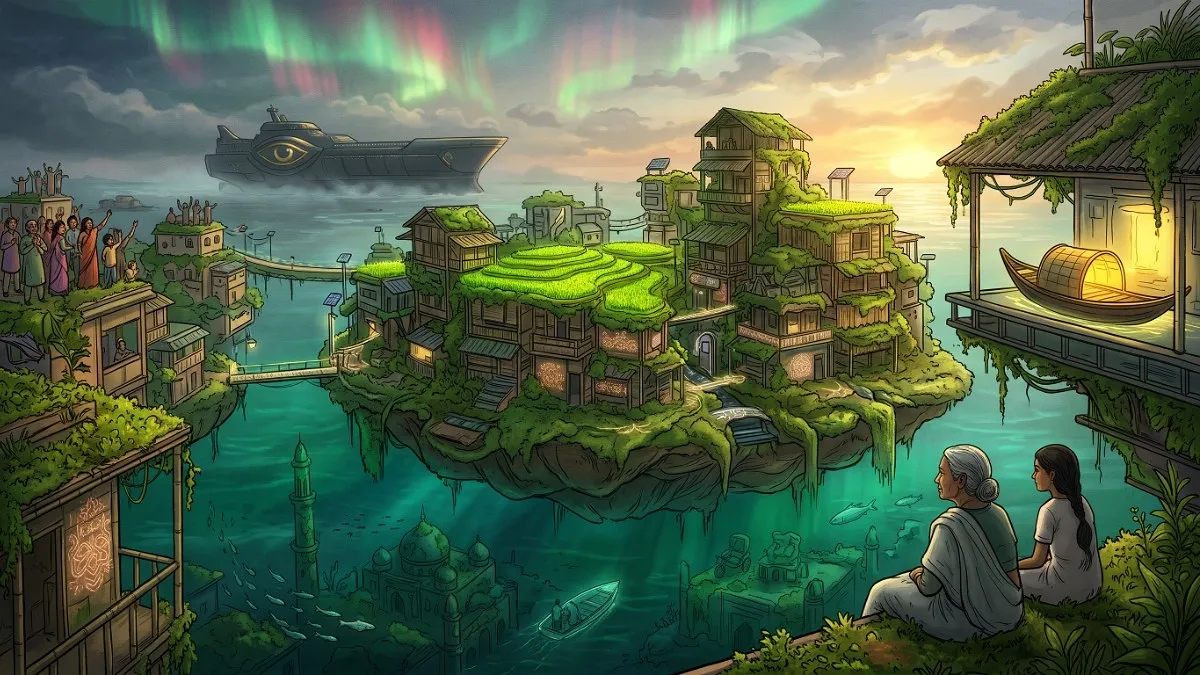
breast of the Buriganga now floats Nilanjana, a vast floating city. Its
foundation is a living platform made of moss and silt, which rises with the
tide and sinks with the ebb, like the breathing of a sleeping giant. On its
rooftops stand fields of solar rice, whose green shoots drink the sun and make
electricity, and that same electricity lights the evening alpona patterns on
the walls at dusk. Beneath the city, deep in the water, lies the old Dhaka,
drowned. The minarets of its mosques, the domes of its colleges, the rusted
skeletons of its rickshaws all stand still in the green water like an enormous
museum. Transparent glass boats glide through the sunken lanes, and passengers
lean over to look at the new neighborhoods of the fish, where once there were
tea stalls.
The people
of Nilanjana know that the water took much from them, and gave much too. They
know that a nation that can lose everything and still sing can never be
finished.
The oldest
memory scientist in the city was Dr. Rumana Haque. She was past sixty, with
silver threads in her hair and a patience in her eyes that belongs only to
those who have spent their lives mending the broken things of others. Her work
was strange and tender. She brought back the lost memories of people, using a
machine she had named the Smritinadi, the Memory River.
The
machine looked nothing like a machine. It was shaped like an old Bengali boat,
with a curved prow that seemed carved of wood, a canopy above, and under the
canopy a soft yellow light, like a lamp flame on an evening in the month of
Kartik. When a patient lay down in that boat, the machine gathered the broken
waves of the mind one by one, and stitched them together, and set the current
of lost days flowing again. Some people got back the sound of their mother’s
voice. Some got back the scent of a first love letter. Some heard once more the
first drops of rain falling on the courtyard of a home long left behind.
Rumana
believed that memory was not a dead thing. It was like a river. Sometimes it
dried up, sometimes it changed its course, but beneath the soil its current
never stopped entirely. One only had to know where to dig.
That
morning the glow of a solar storm lay across the sky. Ribbons of green and pink
swayed above the clouds, as if some invisible artist were drawing with a brush
on the canvas of the heavens. On mornings like this the people of Nilanjana
usually climbed to their rooftops to drink tea. Rumana stood at the window of
her lab watching the colors, and just then there came a soft knock at the door.
She opened
it and saw a girl standing there. She was perhaps seventeen. She wore a plain
cotton dress, her hair was wet, and there were water marks on her feet, as
though she had just swum up from somewhere. But when Rumana looked into her
eyes, something stirred in her chest. There was no fear in them, and no tears,
only a strange emptiness, like two deep wells whose bottoms no one knows.
“I do not
know my name,” the girl said. Her voice was calm, almost like a song. “I only
know that someone is looking for me.”
Rumana
asked no question. Over a long life she had learned that before a broken
person, questions are like stones, and silence is like a quilt. She only opened
the door wider and said, “Come in. Will you have some tea?”
The girl
nodded. As she sipped the tea, a curious look came over her face, as if she had
tasted this flavor many times and could not remember where. Rumana noticed it,
but said nothing.
In the
middle of the lab the Smritinadi waited. The girl looked at it and suddenly
said, “I know this boat.”
“Where
have you seen it?”
“I do not
know. But I know it.”
Rumana
laid her down inside the boat. She gently dimmed the light under the canopy.
The machine hummed, a fine tremor ran through its wooden body, and on the
screen before them a scene slowly appeared.
A village.
Betel nut groves at the edge of the rice fields, a canal beyond the groves, a
bamboo bridge across the canal. A mango tree in a courtyard, and beneath it an
old boatman sitting with a burning hurricane lantern in his hand, a gamchha
over his shoulder, and on his lips an ancient tune, a tune with the drawl of
Bhatiali in it, and also the longing of someone trying to come home.
Rumana’s
breath caught. “This is Dacope, in Khulna,” she whispered. “Near my grandmother’s
village. It sank seventy years ago. Now there is only water.”
But the
question hung in the air. The girl was seventeen. She could not remember
anything from seventy years ago. Then whose memory was this?
Rumana let
the current of the machine flow further downstream. Now image after image rose
on the screen, and each belonged to a different life. A mother lulling her
child to sleep in a house in Barguna. A boy flying a kite on a char in Bhola. A
bride in a red sari going to her in laws’ house by boat, along a canal in
Satkhira. An old woman watering the tulsi plant in her courtyard for the last
time, while behind her the roar of the sea drew closer and closer.
The images
came so fast, and were so varied, that Rumana grew weary. She tried to count
how many lives lay inside this girl. The count passed a thousand, then ten
thousand. The needle of the machine trembled, and at last stopped at twenty
thousand.
When
Rumana understood the truth, her hands had gone cold.
The girl
was not human, or at least not wholly. She was a “Seed.” Two decades earlier,
when the last villages of the coast were sinking beneath the water, a group of
unnamed scientists had undertaken a secret act of devotion. They had decided
that if people were to be lost, so be it, but the memory of the people would
not be lost. They went to twenty thousand people of the coast, asked each for a
memory, and threaded those memories one by one into a single living vessel,
which they called the Seed.
Every lost
home was kept there. The smoke of every extinguished hearth. Every mother’s
lullaby. The ululation of every wedding, the silence of every funeral prayer,
the clamor of every market day. In the body of one girl was held the soul of
the whole drowned Bengal. She was not a person but a living library, a walking
epic.
“Then who
am I?” the girl asked, sitting up in the boat. Tears glistened in her eyes, but
she was not crying. “Am I only an archive? A box?”
Rumana
took her hand. “No, child. A box never asks questions, never feels fear, never
tastes tea and tries to remember a flavor it has forgotten. You are more than
the sum of all the memories inside you. You carry those memories, and to carry
is already to love.”
The girl
was silent for a long time. Then she said slowly, “Someone is looking for me.
Now I know who it is. It is me. I came here to find myself.”
But in
that very moment, all the lights of Nilanjana flickered once.
Outside,
the sound of the tide changed. The sound that had always been like a mother’s
breathing became the rumble of some heavy machine. Rumana ran to the window.
And there she saw, tearing through the mist on the horizon, an enormous shadow.
It was a
ship, but no ordinary ship. Its metal body was like a black mirror, in which
the colors of the solar storm were reflected and looked sinister. On its hull
was carved the name “Meghdoot,” and beneath the name the emblem of a
corporation, a golden eye. These people hauled ancient data up from the sea
floor, stole the memory banks of drowned cities, and sold it all to the rich of
rich countries, who love to buy the pasts of others and pass them off as their
own.
“They have
found out,” Rumana said. Her voice was steady, but her hands trembled. “They
knew there was something out there that no one had yet found. The collective
memory of a people. Think of it. If someone owns this memory, they can write
history however they please. Who lived where, who has a right to what, who owns
which land. They could change all of it.”
The girl
came and stood by the window. The shadow of the ship fell across her face. “Will
they take me away?”
“They will
try.”
From the
Meghdoot an announcement drifted across the water, in a flat, lifeless voice. “Citizens
of Nilanjana are informed that an unauthorized data vessel is hiding among you.
Surrender it within ten minutes, or the city’s power supply will be severed.”
If the
power were cut, the solar rice would die, the glass boats would stop, the water
purification plants would shut down. A hundred thousand people would be in
danger.
Rumana
thought. Years of experience had taught her when to fight and when to withdraw.
She put her hand on the girl’s shoulder and said, “Come. We have somewhere to
go.”
They went
down through the back door of the lab to the lower dock. A small glass boat was
moored there. Rumana took the pilot’s seat, the girl beside her. The boat
dipped silently into the water.
Below lay
another world. Drowned Dhaka, filled with green light. Curtains of moss hung in
the windows of old buildings, and flowers of coral bloomed on the rooftops.
Roads that were once crowded were now pathways for fish. An enormous shoal of
hilsa swept past them like a river of silver.
The girl
laid her hand against the glass. Her eyes brimmed. “I know everything here,”
she whispered. “That house there, a teacher lived in it, who kept dried roses
between the pages of his books. At that corner there was a sweet shop, and
people stood in line for its rasgullas.”
“How do
you know that?”
“I do not
know. But someone inside me knows. Perhaps many of them together.”
As she
piloted the boat, Rumana came to a deep decision. This girl could not be hidden
away. To hide her would be to use her like a box, and that was exactly what the
Meghdoot wanted. Instead something had to be done so that her memories would no
longer be the property of any one person.
“Can you
call everyone who is inside you?” Rumana asked.
“What do
you mean?”
“Inside
you are the memories of twenty thousand people. What if you spread those
memories out to everyone, instead of keeping them in one? What if every person
in Nilanjana felt them in their own blood? Then you would no longer be a seed.
You would become a forest, and no one alone can cut down a forest.”
The girl
returned from the boat to the lab and stood again before the Smritinadi.
Outside, the sky over Nilanjana had turned black. Only one minute remained
before the Meghdoot’s final deadline.
She laid
both hands on the wooden prow of the Smritinadi. She closed her eyes.
The
machine blazed up with golden light. The light overflowed from beneath the
canopy, passed through the walls of the lab, and spread across the rooftops of
Nilanjana, over every shoot of solar rice. And in that moment, in every house
of the city, inside the sleep of every person, a strange song began to play.
It was the
tune of the boatman of Dacope. The drawl of Bhatiali, the longing to return
home.
One by one
the people woke. Some sat up in their beds, some ran to the windows, and some
began to weep without understanding why. Each of them felt that somewhere in
their blood a drowned village was still alive. In that village there was a
mango tree, there was a courtyard, there was rice served by a mother’s hand. A
man who had never seen Khulna suddenly remembered the scent of the Sundarbans
air. A woman who had never been to Barisal heard the rustle of coconut leaves.
Thousands
upon thousands of people ran up to the rooftops. None knew the others. None
knew why they had come. Yet all began to sing together. Old and young, teachers
and workers, fishermen and scientists, all in one voice. That united sound rose
toward the sky, as if millions of lamps had been lit at once against the dark.
The
Meghdoot was about to send the signal to cut the power. But suddenly its
instruments fell into disorder. For the waves of that song carried a frequency
no machine can understand and no lock can hold back. It was the frequency of a
people’s collective memory, with a thousand years of love and the pain of loss
inside it.
False
messages flashed across the ship’s screens. Its golden eye flared once, twice,
and then went dark. A noise rose from its metal body, as though a monster were
muttering in its sleep. The vast ship turned silently about, slowly began to
retreat, and at last vanished into the mist of the sea, the way a nightmare
vanishes in the first light of morning.
When all
was still, the first line appeared in the eastern sky. The sun rose red and
laid a golden road across the water. On the rooftops of Nilanjana the people
stood, some holding one another’s hands, some alone. There were tears in their
eyes, and smiles on their faces.
Rumana
climbed to the rooftop on tired feet. The girl was sitting there alone, her
legs dangling over the edge, gazing at the water. The emptiness was gone from
her eyes. In its place now shimmered countless stars.
Rumana sat
down beside her. “Are you all, right?”
“I have
never been so well,” the girl said. “The memories inside me no longer weigh me
down. They have spread to everyone, and I have become light.”
“What
shall I call you now?” Rumana asked. “You told me you did not know your name.”
The girl
looked at the water for a long time. The tide was rising slowly to the edge of
the rooftop, then sinking back, as if some invisible hands were over and over
returning something and taking it away.
“Joar,”
she said. “My name is Joar, the tide. Because the tide comes, and it also comes
back. Whatever is lost will one day return as a wave.”
Rumana
smiled. She knew that this was the right name.
Many years
have passed. Joar has grown up and is now one of the best loved people of
Nilanjana. She is not locked inside any machine, not shut inside any box. She
walks from rooftop to rooftop, plays with the children, sits and talks with the
old, and whenever someone comes to her speaking of something lost, she closes
her eyes and helps them find it.
The
children of Nilanjana now hear a new story before sleep. The story of a girl
who carried drowned Bengal in her breast and brought it to the future. Who was
alone, but did not stay alone. Who brought back everything that was lost, not
for herself, but for everyone.
And on
every night of high tide, when the water climbs to the edge of the rooftops,
the elders say in low voices, “Listen. They are coming back.”
And truly,
from the depths of the sea comes a faint tune, as if some boatman, from far
away, with a lantern in his hand, were showing us the way, and saying: do not
be afraid, I am here, we are all here. However high the water rises, however
many villages sink, a people who know how to sing are never lost.
A people
who carries memory stay afloat, even when they drown.