
Speakers at Press Conference
Those responsible for the climate crisis are also responsible for financing it

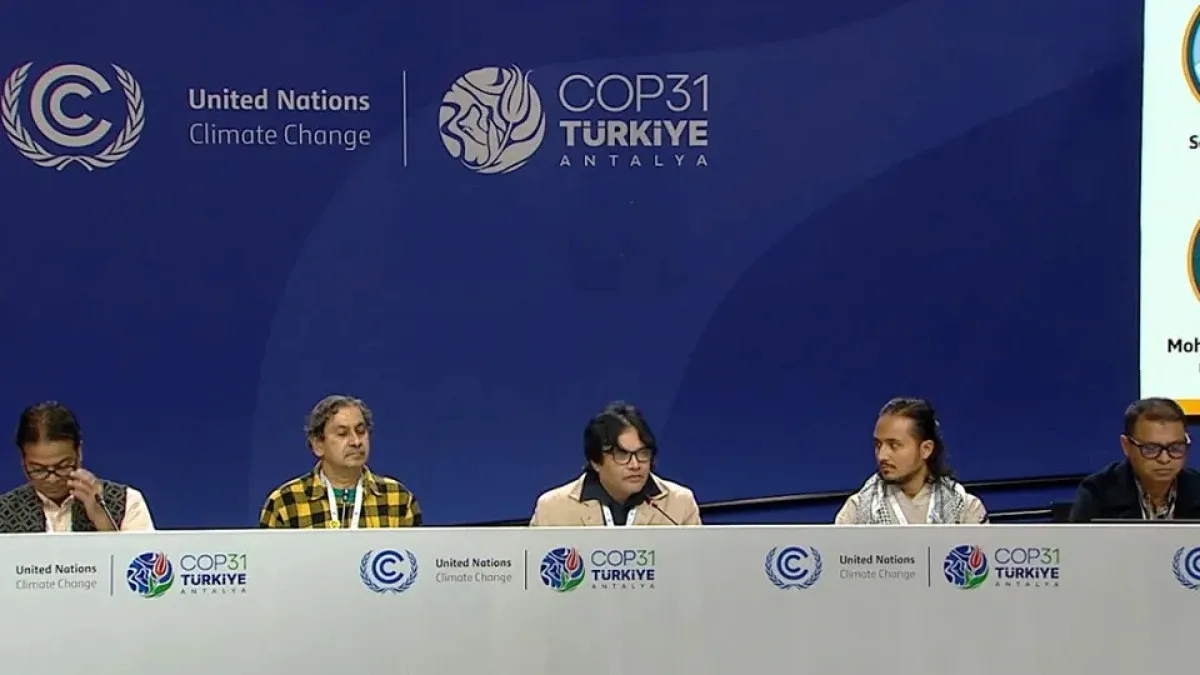
A press conference of Global South civil society at Antalya, Turkey. Collected photo.
Representatives of civil society from the Global South expressed concern, saying that although an initiative was taken to include the proposal to triple adaptation finance in a separate agenda at the COP-31 discussions, it was not adopted due to a lack of consensus among participating countries. Although discussions continue, no clear agreement has yet been established on the amount, source, timeline, and implementation framework of the financing. To implement the commitment to triple adaptation finance, a specific roadmap, measurable targets, a transparent financing system, and an effective accountability framework must be ensured starting from COP-31 itself.
Speakers came up with these observations at a press conference held on Saturday, in a conference room of COP-31 in Antalya, Turkey.
The press conference titled "Ensure implementation of the Paris Agreement and fulfillment of global climate finance commitments for climate-vulnerable populations" was organized by Coast Foundation, Bangladesh; Movement for Advancing Understanding of Sustainability and Mutuality (Mousam), India; and Leaders Bangladesh.
Speaking at the press conference were Soumya Dutta of Mousam, India; M A Hasan of Coast Foundation, Bangladesh; Prayas Adhikari of People's Movement for Climate Justice, Nepal; Thilak Kariyawasam of FIAN, Sri Lanka; Ajay Kumar of PAIRVI, India; and Mohan Kumar Mandal of Leaders Bangladesh.
The speakers said COP-31 must not be limited to yet another conference of pledges but must be turned into a conference of implementation and accountability. According to Article 9.1 of the Paris Agreement, developed countries must fulfill their obligation to finance climate actions in developing countries based on historical responsibility and economic capability. The Nationally Determined Contributions (NDCs) of major emitting countries must be aligned with the 1.5 degrees Celsius target. Alongside rapid and significant emission reductions, a fast, orderly, and just transition away from fossil fuels must be ensured.
At the same time, new and additional, adequate, predictable, and grant-based financing must be ensured to address loss and damage. Direct access to finance for affected countries and populations, rapid disbursement of funds, and a simple and transparent funding receipt process must be established.
Soumya Dutta of India said that South Asian countries are facing massive losses from catastrophic floods and other climate-induced disasters, the impacts of which are not confined to any single country. Although the losses from these disasters amount to billions of dollars, the announced grants are extremely negligible compared to the need. This reality makes clear the limitations of the international humanitarian assistance and financing system. Therefore, it is essential to ensure regional solidarity, mutual cooperation, and effective and adequate financing among the affected countries.
Prayas Adhikari of Nepal said, the main problem with the current system of climate finance is that it contains practices of colonial power and control. Countries of the Global South are suffering massive losses and displacement from droughts, floods, cyclones, and other climate-induced disasters. Yet they have to go through complex application, approval, and fund disbursement processes to get the necessary financing. Moving away from this colonial framework, adequate, easy, rapid, and direct financing must be ensured for the affected countries.
Ajay Kumar of India said that the climate finance gap in the Asia-Pacific region is more than 820 billion US dollars. Yet only a very small portion of global climate finance reaches this region. More than 80 percent of the financing received is concentrated in East Asia, while South Asia's share is extremely limited. This inequality is deepening the financing access crisis for climate-vulnerable countries. Therefore, fair, adequate, and direct climate finance must be ensured for South Asia.
Thilak Kariyawasam of Sri Lanka said that the main objective of the climate finance system should be to deliver direct support to vulnerable and marginalized populations. But despite financing commitments and various processes, funds are not reaching people at the grassroots level. Sri Lankan civil society is raising the question of how these systems will meet the needs of displaced people and populations deprived of healthcare. Therefore, justice must be ensured in climate finance, and an effective and direct flow of money to local communities must be ensured.
Mohan Kumar Mandal of Leaders Bangladesh said that climate-induced displacement must be prioritized in loss and damage discussions, and a specialized financing system must be built to address displacement. Human rights, safety, and human dignity must be ensured in planned resettlement and relocation. At the same time, regional cooperation and information exchange must be strengthened, and the financing system must be made effective so that pledged money is rapidly converted into concrete action.
M A Hasan of Coast Foundation, Bangladesh said that according to Article 9.1 of the Paris Agreement, developed countries have an obligation to finance climate actions in developing countries. This is not charity or voluntary assistance, but a responsibility recognized in an international treaty. At COP-31's Climate Finance Work Program, differences are emerging over the scope of this responsibility and the sources of financing. Our position is clear: private financing cannot replace the obligations of developed countries under Article 9.1.
