


Question Raised at Seminar
Why is government 'Secretive' about Padma Barrage Project?

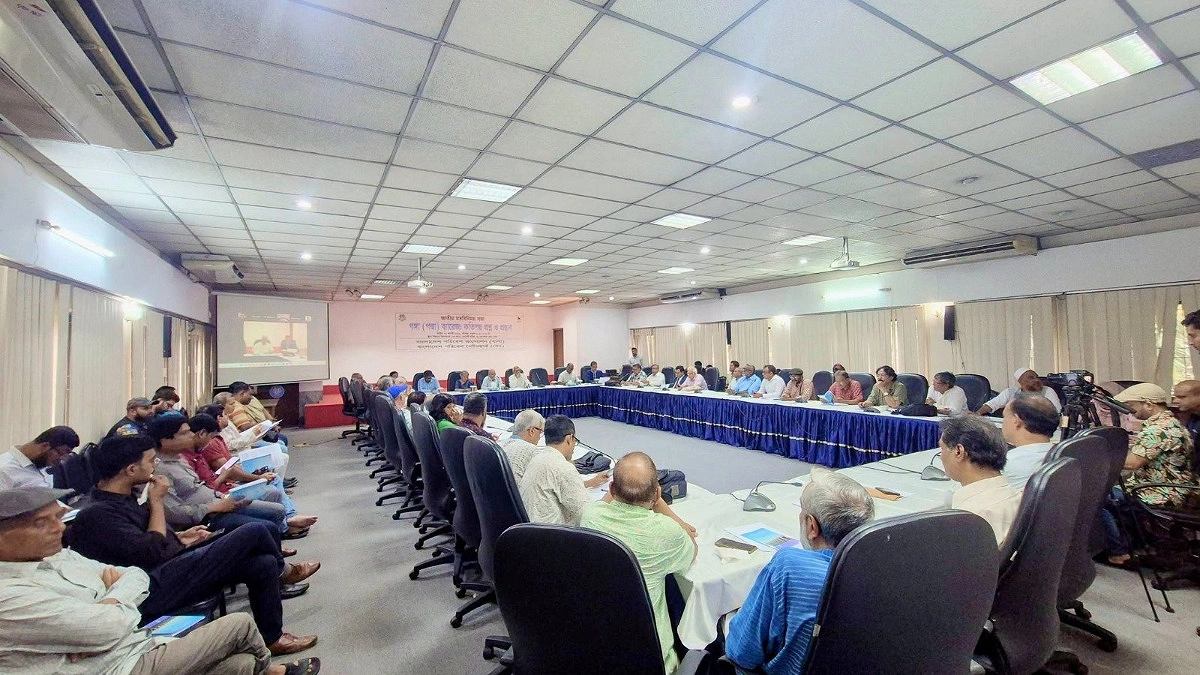
Collected Photo
Questions have been raised about the government's "secrecy" regarding the proposed Padma Barrage project by Professor Nazrul Islam, former head of UN development research and vice-president of the Bangladesh Environment Movement (BAPA). He also questioned the rationale behind naming the project "Padma Barrage."
He raised these questions at a seminar organized by BAPA and the Bangladesh Environment Network (BEN) on Saturday at the SIRDAP auditorium in the capital. At the event titled "Ganga (Padma) Barrage: Some Questions and Proposals," Professor Nazrul Islam and Professor Md. Khalekuzzaman, global coordinator of BEN and a professor at Commonwealth University in the USA, jointly presented a paper.
The session was chaired by BAPA President Professor Nur Mohammad Talukder and moderated by the organization's General Secretary Md. Alamgir Kabir.
Demand for Disclosure of Project Information
In his presentation, Professor Nazrul Islam said that according to available information, the proposed barrage would be 2.1 kilometers long and feature 78 spillways. Project officials believe that once constructed, it would be possible to maintain the water level of the Ganges in the Bangladesh section at 12.5 meters—from Pankha, the border point where the Ganges enters from India, all the way to Pangsha. This is expected to have a positive impact on the environment of Ganges-dependent areas and improve overall ecological conditions by increasing flow in the rivers.
However, he alleged that sufficient data and information about the project are not being made public. Demanding that the government swiftly release the information in its possession, Professor Nazrul Islam noted that the previous administration had shown comparatively greater transparency, publishing the project draft on a website and soliciting public feedback. He questioned why the current government is not similarly disclosing information.
Professor Nazrul Islam stressed that the public has a right to know about such a crucial project. He emphasized the need to publish detailed information about the project's potential benefits, drawbacks, costs, and long-term impacts.
10 Questions About the Proposed Barrage
Professor Nazrul Islam posed ten questions to the relevant government agencies regarding the proposed barrage. Among them were:
Why is there so much secrecy surrounding the project?
How realistic is the plan to use only monsoon-season water during the dry winter months through the barrage?
Where is the discussion on the potential impact of the barrage on downstream areas?
Why doesn't the monsoon water of the Ganges currently flow adequately into its distributary channels?
What considerations has the project made regarding the waterlogging problem in the country's southwestern region and its possible solutions?
He also raised further questions: how confident are the project's proponents about the risks of upstream sedimentation, flooding, and river erosion; how reliable are the estimates of the potential benefits of the barrage upstream of Pangsha; and whether the construction of the barrage would further weaken Bangladesh's position on the Ganges water-sharing issue.
Professor Nazrul Islam also questioned the project's reliance on outdated data and the necessity of implementing such an expensive and controversial project under the current fragile economic conditions.
Concerns Over Upstream Infrastructure
At the seminar, Professor Md. Khalekuzzaman noted that although only 4 percent of the Ganges basin lies within Bangladesh, nearly 37 percent of the country's total land area and 33 percent of its population are connected to this basin. As a downstream nation, Bangladesh therefore bears the brunt of both natural and man‑made activities occurring upstream.
In his view, the Ganges water‑sharing treaty did not adequately account for basin‑based realities. Apart from Farakka, India has at least 300 structures that disrupt the normal flow of the Ganges. With climate change and the potential construction of even more upstream infrastructure in the future, this flow is likely to face further obstruction.
Arguments For and Against the Barrage
During the seminar, S. M. Mahbubur Rahman, former executive director of the Institute of Water Modelling (IWM) and an official associated with the project, responded to the questions raised by Professor Nazrul Islam. He stated that the project had been sent to the government for implementation only after extensive research and review. He also mentioned that relevant parties in China and India had been consulted at various stages of the project.
Professor Md. Sirajul Islam of North South University observed that there are over 100,000 barrages worldwide, built in many countries for various economic needs, including food production. Bangladesh, too, has the potential to build barrages on the Padma and Teesta rivers. Despite environmentalists' objections, he argued, barrages hold economic significance, and therefore it is necessary to consider what alternatives might exist.
Geologist and Professor Ahad Chowdhury commented that the Padma Barrage should be regarded as a national development project. He said that if Bangladesh falls behind in engineering progress, the country will also lag behind. However, he stressed that development projects must be undertaken without destroying the natural flow of rivers and while keeping rivers alive.
Sheikh Rokon, general secretary of Riverine People, argued that the project should be named "Ganges Barrage" rather than "Padma Barrage." He contended that although it is connected to the Padma River, there is no justification for omitting the name of the main river, the Ganges.
At the seminar, BAPA General Secretary Md. Alamgir Kabir said that the Water Development Board's chairman had been requested to send a suitable representative to discuss the project. However, the chairman's office reportedly replied that there was no appropriate person available for such discussions—a response he found disappointing.

