
Major earthquake fear at Narsingdi's invisible epicenter

Agamir Somoy Image regenerated by AI.
It was Monday dawn; the capital Dhaka and its surrounding areas experienced a mild tremor. Although the shaking was gentle, (3 on richter scale) experts are taking it as a special warning.
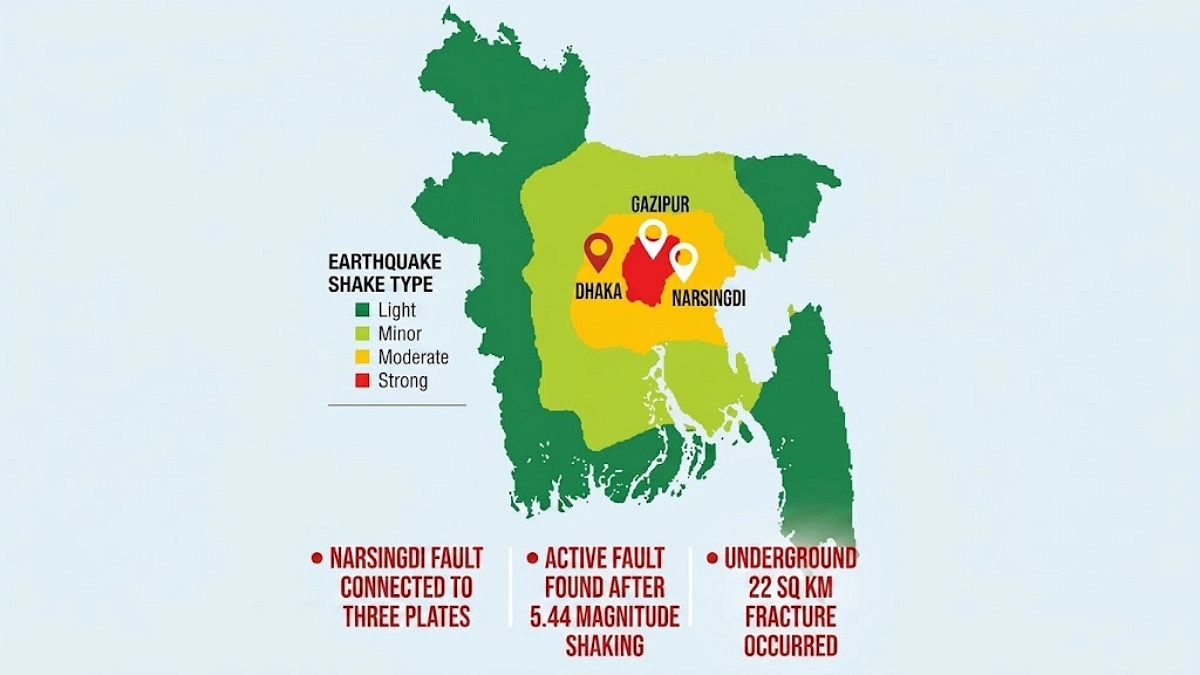
They have explained the reason. The earthquake's origin was in Shibpur, Narsingdi! Last year, on November 21, a tremor originating from that same Narsingdi shook Dhaka, Gazipur, Narayanganj, and vast areas of the country. Buildings swayed, and people in the city, gripped by panic, left their homes and took to the streets. The earthquake claimed 11 lives in Dhaka and Narsingdi and injured several hundred people.
Of course, Monday's mild tremor caused no significant damage. Nevertheless, the cause for major concern is that multiple of the 13 mild to moderate earthquakes that have occurred in the country this year originated in Narsingdi. This has brought several questions to the fore—Is there an active fault beneath Narsingdi's soil? Could this fault be the source of an even larger earthquake in the future? Initial findings from a recent study by the Department of Disaster Science and Climate Resilience at the University of Dhaka point towards this very apprehension.
Researchers say, The possibility of a major earthquake originating from this fault in Narsingdi cannot be entirely ruled out. However, they also advise not to anticipate such an earthquake imminently. They further stated that this earthquake in Narsingdi serves as a fresh warning. It is crucial to identify the sources of earthquakes lying beneath Bangladesh's surface. Additionally, the earthquake risk needs to be reassessed.
Earthquake Source 25 Kilometers Below the Surface: The research found that the November 21 earthquake originated approximately 25.5 kilometers deep from the earth's surface. The epicenter was about 16 kilometers southwest of Narsingdi town and roughly 21 kilometers northeast of Dhaka. Researchers believe the earthquake was caused by a reverse or thrust fault. In simple terms, pressure built up between two crustal blocks underground, causing one block to move over the other, thus generating the earthquake.
Professor Dr. Md. Zillur Rahman, leading the research from the Department of Disaster Science and Climate Resilience, told Agamir Somoy, "The most significant characteristic of this earthquake is that no visible signs of the fault were found on the ground surface. This is why we refer to it as a 'Blind Fault'."
Only Five Kilometers of the Fault Ruptured: According to the research data, during the magnitude 5.44 earthquake, the length of the rupture underground was approximately 5.43 kilometers. Its width was about 4.17 kilometers. The total rupture area was roughly 22 square kilometers.
Dr. Zillur Rahman said, "Perhaps only five kilometers of the fault ruptured during this earthquake. But the entire fault could be 30 kilometers or even longer." He elaborated that if a five-kilometer rupture produces an earthquake of a certain magnitude, then if a much larger segment ruptures all at once, the earthquake's magnitude could also increase significantly.
Could a Magnitude 7 Earthquake Occur from the Narsingdi Fault?
According to Dr. Zillur Rahman, it is not being claimed that a magnitude 7 earthquake will definitely occur from this fault in Narsingdi. However, he noted that there are records of large earthquakes in and around Bangladesh in the past. In 1885, a magnitude 6.9 earthquake struck. In 1918, an earthquake stronger than magnitude 7 occurred in the Srimangal area. The Great Indian Earthquake of 1897 had a magnitude of 8. Additionally, there are historical records of an earthquake in 1762. Therefore, it cannot be said that there is no risk of a magnitude 7 earthquake occurring within Bangladesh.
Narsingdi Fault Also Linked to Three Tectonic Plates
According to the research findings, the potential fault in Narsingdi runs east–west and is a south-dipping reverse or thrust fault. This is consistent with regional geological stresses. Bangladesh is situated near the Indian and Burma plates. The mutual pressure and movement of these plates have created earthquake risks in the region. Researchers believe that there are also some local faults within Bangladesh, outside the plate boundaries, and the Narsingdi fault is thought to be one of them.
According to Dr. Zillur Rahman, one of the main reasons for Bangladesh's earthquake vulnerability is its location near the junction and influence zones of several tectonic plates. The mutual pressure and movement of the Indian Plate, the Burma (Myanmar) Plate, and the Eurasian Plate in this region have been accumulating energy underground for a long time.
He said, "Due to the mutual pressure of these plates, various small and large faults or fractures have been created not only at the plate boundaries but also within Bangladesh's interior. The potential fault found beneath Narsingdi is also, we currently assume, related to that broader tectonic stress."
Faults Near Dhaka City as Well?
Dr. Zillur Rahman said, "The possibility of faults beneath or around Dhaka city cannot be ruled out either. However, they have not yet been properly identified." He gave an example: "In 2001, an earthquake occurred near the Buriganga river area. At that time, many people were injured trying to flee in panic from the central jail. Although records of small earthquakes around Dhaka over the last 100 to 200 years exist, detailed information about their sources is still insufficient. Therefore, it is crucial to determine whether there are any sources beneath or around Dhaka that could generate a large earthquake in the future."
The Geological Survey Must Take Responsibility
Dr. Zillur Rahman said, "In various countries around the world, such research on faults is conducted regularly. Detailed studies are carried out on what magnitude of earthquake a fault can produce, how many years later it might become active, and what magnitude of earthquake would occur if part of or the entire fault ruptures. Such research needs to be further intensified in Bangladesh as well."
The Need for Regular Drills, Training, and Preparedness
When asked about the potential scale of damage if a strong earthquake strikes Bangladesh, Dr. Zillur Rahman stated that if an earthquake of magnitude 7 or higher hits Dhaka and its surrounding areas, the possibility of hundreds of thousands of casualties cannot be ruled out. In addition, building collapses, infrastructural devastation, and shortages of pure drinking water could occur.
Small earthquakes occur regularly in Japan, the United States, northeastern India, Bhutan, Sikkim, and Myanmar. In many cases, these small tremors carry indications of larger geological sources.
He commented that merely purchasing equipment is not enough to deal with earthquakes. A culture of regular drills, training, and preparedness must be developed. Regular drills should be conducted in schools, colleges, residential areas, government and private institutions, and rescue organizations. The level Japan has reached today is the result of decades of consistent preparedness and practice.
