


Environmentalists Oppose Beach Project
Road on the Beach!

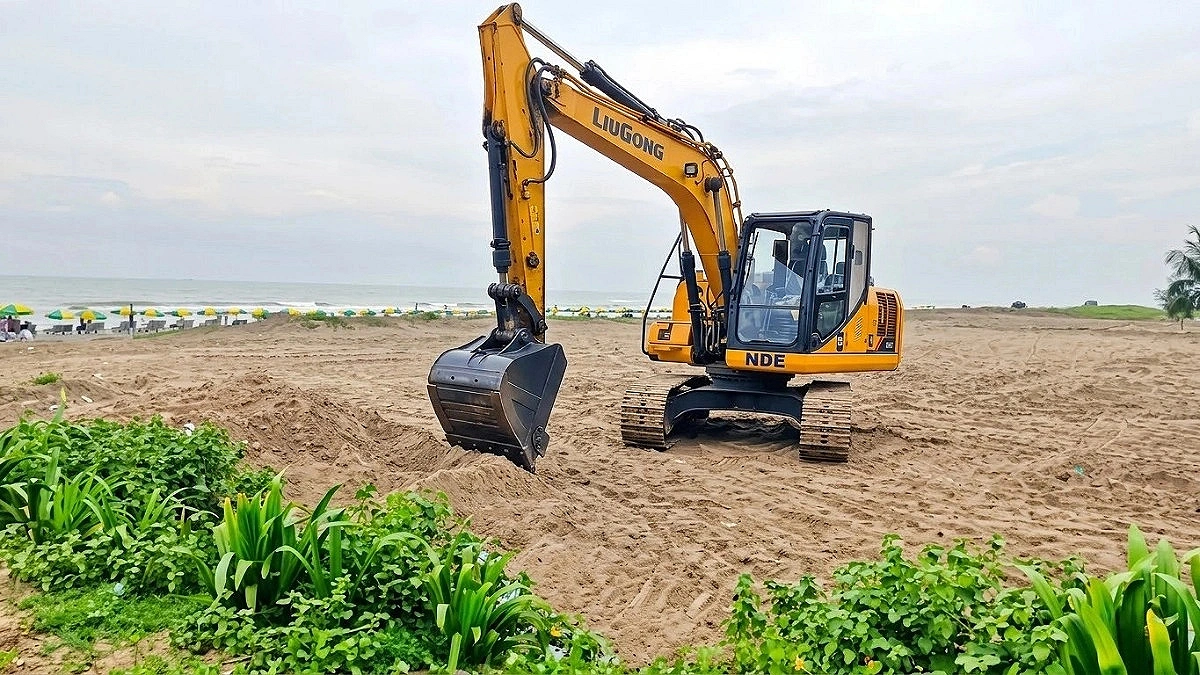
Photo: Agamir Somoy
The sand dunes of Cox's Bazar sea beach are not just piles of sand. They resist as natural protection and work as wall to withstand the onslaught of waves and storm surges, mitigate coastal erosion. Thus, it tackles the risks of sea-level rise caused by climate change.
The roots of sea various vines and other coastal plants grown in the sand, further strengthen natural protection system. Yet these very dunes are now being razed.
Inside the Ecologically Critical Area (ECA) of the sea beach, sand is being dumped to fill the land and construct a long road. As a result, sea vines are being cut and uprooted, naturally formed sand dunes are being flattened, and the habitat of red crabs is being damaged.
Environmentalists have alleged that despite the availability of alternative land nearby for road construction, the beach's natural defense system is being destroyed.
According to Cox's Bazar Municipality sources, around 1.6-kilometer-long and 28-meter-wide road, from Sugandha Point to Hotel Saimon, is being built under the "Urban Development and Urban Governance Project." On June 17, 2025, tenders were invited for the project. Later, National Development Engineers (NDE) secured the work for Tk 63.50 crore. The Japan International Cooperation Agency (JICA) is funding the project, while Cox's Bazar Municipality is implementing it. Construction is scheduled to be completed by October 5, 2027.
On the ground, it is seen that sand is being dumped over a vast area of the beach to raise and flatten the beach-front land. The road is being built over the filled portions. In some places, sand dunes have been cut down to make way for the road. Sea grape bushes have been uprooted along with the soil. One dune after another is being leveled.
Workers said they are doing the work on behalf of the contracting firm NDE.
According to environmentalists, the issue of protecting Cox's Bazar beach is now no longer limited to tourism or beautification. With climate change, the risks of sea-level rise, cyclones, storm surges, and coastal erosion are increasing. In this context, sand dunes and coastal vegetation are vital components of natural protection.
The roots of sea grapes hold sand together. Sand dunes help reduce the force of waves and storm surges. At the same time, these areas become habitats for various animals and plants. Therefore, the impact of removing this natural structure for constructing a road may not remain confined to just a few hundred meters around the construction site.
Bangladesh Poribesh Andolon (BAPA) Cox's Bazar's Organizing Secretary H.M. Nazrul Islam said that a part of these sand dunes was built a few years ago for coastal protection. In 2022, with funding from the United States, a private development organization worked to create sand dunes as a natural defense system to prevent erosion of Cox's Bazar sea beach and protect the environment and biodiversity. Now, parts of those very dunes are being removed for road construction.
According to him, under the Bangladesh Environment Conservation Act, Cox's Bazar sea beach is one of the country's 13 Ecologically Critical Areas (ECAs). In such areas, the construction of permanent or temporary structures that damage the environment and biodiversity, or activities that alter the natural characteristics of soil, water, and air, are prohibited.
Meanwhile, Khondoker Mahmud Pasha, Deputy Director of the Cox's Bazar District Office of the Department of Environment, said that no clearance from the Department of Environment was obtained for constructing this road from Sugandha to Kolatoli.
He said, "An officer has been assigned to visit the site and submit a report. Necessary action will be taken after receiving the report."
When asked about this, Mohammad Shahin Mia, Project Manager of the contracting firm NDE, said, "The Cox's Bazar Municipality can comment on whether environmental clearance was obtained."
Rumel Barua, Assistant Engineer of Cox's Bazar Municipality, said that the road is being constructed considering the beautification of the sea beach, protection of erosion-prone areas, and convenience for tourists.
Mujibul Haq, Chairman of the Cox's Bazar-based environmental organization Youth Environment Society (YES), said that countries such as the Netherlands, the United States, and New Zealand are spending vast sums of money to preserve and create natural sand dunes to combat the impacts of climate change, sea-level rise, and coastal erosion.
According to him, in Cox's Bazar as well, sand dunes were created with US funding to prevent beach erosion and protect biodiversity. However, despite the availability of alternative land nearby, this natural defense system is being destroyed in the name of road construction. He believes such activities need to be halted immediately.
Kalim Ullah, General Secretary of the Cox's Bazar district branch of Bangladesh Poribesh Andolon (BAPA), said that the High Court has directives against constructing any kind of structure on Cox's Bazar beach and for removing both permanent and temporary structures.
According to him, the Cox's Bazar Master Plan formulated in 2013 designates the first 300 meters from the beach adjacent to the high-tide/low-tide line within the municipal area as a "No Development Zone." No structure of any kind is permitted there. Yet, he commented that it is alarming that roads are being constructed by encroaching on the sand dunes.
Environmentalists fear that if the natural protection is weakened, the risk of coastal erosion from waves and storm surges may increase further in the future.

