


Four centuries of 'Adda' in Dhaka

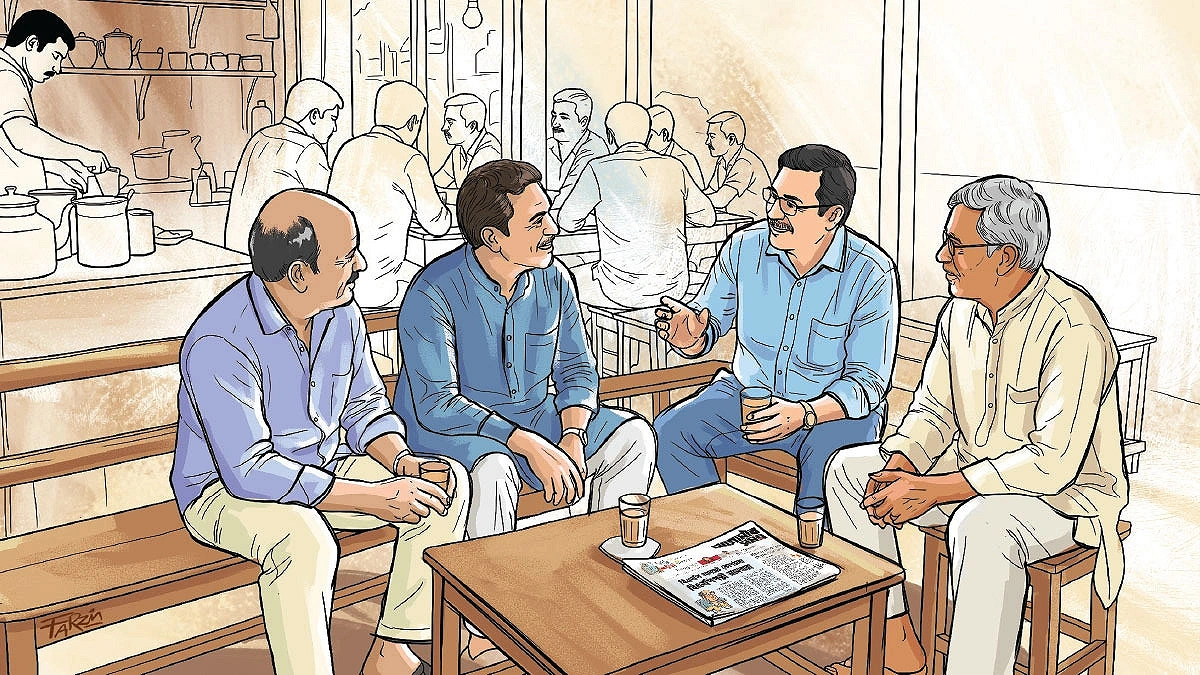
Graphics: Agamir Somoy
Dhaka was established as a capital city four hundred years ago with the initiatives of Subedar Islam Khan. Though the city has changed over the centuries, its vibrant culture of adda (leisurely social conversation) has remained unchanged. Over time, the venues of entertainment have shifted—from royal courts to corner tea stalls—but the passion of Dhaka's residents for adda has never faded. From the pages of history, Govinda Shil presents the story of Dhaka's traditional entertainment and adda culture.
Whether we describe it as adda, entertainment, amusement, or recreation, there is one point on which none of us can disagree: it is an essential component for the health of our body and mind. Thus, from ancient agrarian societies to the modern era, human society has continually sought new ways to keep the mind joyful.
Even before the founding of Dhaka, various forms of entertainment were prevalent in this region. In 1610, the Mughal Subedar Islam Khan Chishti formally established Dhaka by declaring the region the capital of Subah Bengal. It was named "Jahangirnagar" after Emperor Jahangir.
The Nawabs of Dhaka were known for their jovial nature. Their adda was mainly of two types. One was the formal political and social gatherings held at the court of Ahsan Manzil, and the other was assemblies for literary and cultural pursuits. These gatherings were quite different from the adda of common people. They could be described as aristocratic, lavish, and symbolic of specific social status. Besides politics, the Nawabs were also patrons of literature, music, culture, and education. These addas witnessed a blend of Mughal, British, and local Bengali cultures, creating a unique atmosphere.
Syed Mujtaba Ali, one of the prominent figures in Bengali literature, wrote in his book 'Panchatantra' in an essay on adda: "Though the 'palla' fish of Sindh, the 'madar' fish of Narmada, and the 'ilish' fish of the Padma are the same, their methods of cooking differ. Similarly, while adda exists worldwide, no one possesses the ability to savor it with as much relish as the Bengalis." Needless to say, Mujtaba Ali's writings on the adda of Cairo in Egypt, the adda of the French, and the adda of Bengalis created a huge stir. During his stay abroad, he was a regular visitor to Cairo's 'Café de Nile'.
This four-hundred-year-old city has a vast tradition of entertainment. Even before the Mughal era, Dhaka had practices of cockfighting, sologhunti (a traditional game), various fairs, Poush festivals, boat races, Sufi and Vaishnava songs, qawwali, physical exercises, and several other sports. However, during the Nawabs' time, the scale of music and assembly-centered entertainment grew significantly. History shows that the Nawabs were highly discerning about dance and music. At that time, female dancers (known as Kanchanis) used to visit Bengal from Lucknow, as the Nawabs paid them generous allowances. Common people were also particularly fond of classical music. It is known that at least 1,200 Kanchanis resided year-round in Old Dhaka, receiving monthly salaries. Historian Hakim Habibur Rahman wrote in his book Dhaka 'Pachash Baras Pahkle (Dhaka Fifty Years Ago) that beyond the Nawab estate in Nawabpur, there were many other gathering halls accessible to common people. He wrote: "This was a time when all the renowned singers, rubab players, and sitar players of Hindustan would repeatedly come here in hopes of gaining honor, stay for years, and become so enamored with Dhaka that individuals like Miththan Khan—a famous singer of Lucknow at that time—chose to remain in Dhaka for the rest of their lives."
We know that the British rulers used to distribute tea to Bengalis free of charge so that this beverage would later become a lucrative trade. In his book Dhaka-i Khabar O Khaddo Songskriti (Dhaka's Food and Food Culture), Saad Ur Rahman writes that in 1915, there were 444 tea shops in Kolkata, which increased to 1,124 by the end of the following year. In this Bengal, there is even a saying—"creating a storm in a teacup"—as adda enthusiasts would continue their conversations! During that time, the use of tea and hookahs was widespread. Regarding the popularity of Kashmiri tea in Dhaka, Hakim Habibur Rahman said: "The taste of salty Kashmiri tea, in particular, was of an astonishing kind. One type of tea was served at weddings, called 'Golamnebad.' The correct word is probably 'Golab Banat,' which was essentially a sherbet served at wedding gatherings."
Dhaka University's Madhur Canteen was established in 1921. The building that housed the canteen was previously used as the Nawabs' durbar hall and a skating rink. Over time, this aristocratic venue became the center of adda for ordinary students and teachers, and later became a witness to the most important political movements in Bengal's history.
Budding politicians, writers, and artists all frequented Madhur Canteen extensively. Figures like Sheikh Mujibur Rahman, Tajuddin Ahmad, poet Buddhadeb Bose, artist Zainul Abedin, writer Syed Waliullah, Fateh Lohani, and Sikandar Abu Zafar were regulars here. Debates and discussions on philosophy, literature, and international politics would take place here, and the planning for every major movement of 1948, 1952, 1969, and 1971 originated at the tables of this canteen.
The places where adda used to take place have now changed for various reasons. Earlier, adda would thrive at corner tea stalls, station tea shops, club rooms, ferry ghats in the old days, restaurants, around cinema halls, and at station bookstalls. In addition, licensed bars and the small shanties selling drinks from the local 'Keru and company,' as well as several other unauthorized spots, were popular for entertainment and recreation. In the old days, homeopathic clinics and the drawing rooms of the wealthy were prime locations for adda. Now, the open theater stages of public universities, Suhrawardy Udyan, Dhaka University's Teacher-Student Centre, the February book fair, winter music gatherings, Dhaka University's Hakim Chattar, Madhu's Canteen, Shilpakala Academy, Bengal Shilpalay, and Drik Gallery—in some cases—remain as some of the last surviving spaces for adda. Added to these are the billiards and bowling clubs, which are particularly frequented by the younger generation, especially students from private universities.

