
What was supposed to be the safest is becoming a risky city
- Deaths in fires, robberies on roads, muggings on beaches—resulting in loss of life
- Lack of oversight regarding unauthorized structures and high-risk recreational activities

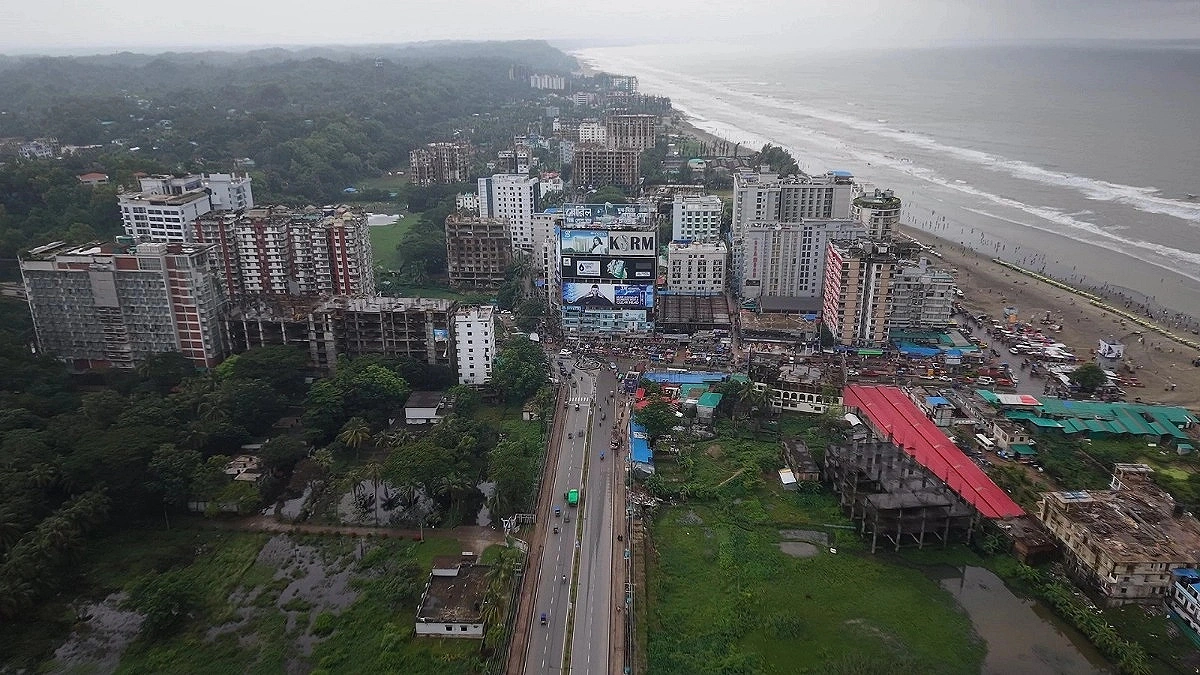
A bird-eye view of a part of Cox's Bazar beach city. Agamir Somoy.
Cox's Bazar is bustling with the footsteps of tourists. Drawn by the blue sea, long sandy beaches, hillocks and nature, 80 to 90 lakh people visit this city every year.
Some come to spend holidays with family, some to share joy with friends. For some, this trip is a long-cherished dream; for others, it is an occasion to spend a few days forgetting the fatigue of a busy life. But that dream trip sometimes turns into death by fire, sometimes into losing everything at gunpoint, and sometimes into losing one's life by drowning in a turbulent sea. The lack of safety in this tourism city is therefore no longer an isolated complaint; one incident after another is deepening that concern.
On October 17, the deaths of 10 people in a fire at TupTup Resto and Resort in the Patuartek area of Inani in Ukhiya brought that question forward cruelly. After the fire spread through the three-story wooden structure, not everyone inside could survive. The resort where people go in search of safe shelter, rest, and joy instantly turned into a deadly structure. It was later learned from administration information that the resort did not have fire safety approval. The matter of prior warnings or notices also came to light. A case has been filed against 23 people on charges of negligence in the fire. The resort manager has been arrested and remand has been sought.
But alongside investigation and legal steps, the big question remains: after a risky structure was identified, how was it possible for tourists to stay there? If business continues even after a notice is given, how effective is that warning in saving tourists' lives?
According to Abu Morshed Chowdhury Khoka, former president of the Cox's Bazar Chamber of Commerce, the number of hotels and resorts in various areas of the district with questions over approval and safety arrangements is not small. The matter of inspecting more than two hundred structures and issuing notices has come forward.
In his words, a transparent account is essential of how many structures followed the rules, how many were shut down, and how many had fire safety ensured. Because even if there is supervision on paper, if safety is not ensured in reality, it is tourists who face danger.
Before the grief of the deaths in the resort fire could fade, new concern spread on October 19 when two incidents of robbery occurred on the same day at Himchhari slope on the Eidgaon-Eidgah-Baishari road. In the morning, a mobile phone was snatched from a passenger of a CNG-powered auto-rickshaw. Later at noon, panic spread in the same area due to the activity of armed men.
According to the victims, money and valuables were looted from passengers of several vehicles. Some lost Tk 1 lakh 20 thousand, some Tk 1 lakh 50 thousand. Although there is a difference between the accounts of victims and police over how many vehicles were directly looted, such an incident in broad daylight has raised questions about the road's safety.
Police later said they conducted an operation, recovered the looted goods and domestic weapons, and detained two people. If people feel unsafe while traveling on roads in a tourism district, it is not unusual for panic to build among them from the very start of the trip.
Not only hilly roads, there are allegations of mugging and harassment of tourists in Cox's Bazar town. In an unfamiliar city, many tourists rely on auto-rickshaw and tomtom drivers to find hotels, go to the beach, or visit sightseeing spots. Taking advantage of this reliance, allegations have also come forward of taking someone to a secluded place or harassing them. Again, many do not complain to avoid trouble. As a result, it is difficult to get a full picture of how many tourists actually fall victim to such incidents.
However, according to information published based on district police statistics, in the eight months from January to August 2026, there were 14 cases of robbery, 23 of dacoity, and 160 of theft in Cox's Bazar district. In the same period of 2025, there were 16 robbery cases, 25 dacoity cases, and 157 theft cases. In other words, robbery and dacoity cases have decreased somewhat, but theft cases have increased. However, the full picture of tourist safety cannot be understood through the number of cases alone. Because out of fear of increased harassment, not all incidents of harassment, fraud, or mugging are recorded at police stations.
Cox's Bazar's main attraction is its sea beach. Yet tourists are losing their lives while bathing in this very beach. Due to strong currents, holes at the bottom of the sea, hidden channels, and ignorance about the behavior of waves, many find themselves in danger in an instant. Because rescue services are not equally available across all areas of the vast beach, the opportunity to get quick help after an accident is also limited.
According to information from Sea Safe Lifeguard, from January 2024 to September 2026, 40 people died by drowning in specific areas of Cox's Bazar city beach. Among them, 12 died in 2024, 20 in 2025, and eight died up to September 2026. During the same period, 478 people who fell into danger in the sea were rescued alive. According to the organization's count, from 2015 to September 18, 2026, 80 people died by drowning at Laboni, Sugandha, and Kolatoli points. At least 1,077 people were rescued.
Of the nearly 120-kilometer-long beach, rescue operations are conducted in about three kilometers of area at Laboni, Sugandha, and Kolatoli points. Among this, the area under lifeguard coverage for safe bathing is about one and a half kilometers. Sea Safe's 27 lifeguard workers perform duties in rotation. On holidays, festivals, and during the tourism season, when crowds flock to the beach, it is not possible to ensure the safety of a huge number of tourists with this limited manpower.
According to Saifullah Sifat, supervisor of Sea Safe Lifeguard, a coordinated system of quick rescue, first aid, and taking victims to the hospital is essential in moments of danger. Even a delay of a few minutes can cause death. Yet even as tourist pressure increases, if the scope of rescue services and manpower are not adequate, the risk remains.
Alongside the risks of bathing in the sea beach, entertainment activities such as parasailing are also raising concerns. On August 1, tourist Shouvik Roy of Khulna died after falling into the sea while parasailing at Darianagar beach. After the incident, the administration said parasailing was not authorized at that time. There were also allegations that it was operated in defiance of instructions to keep activities closed in adverse weather. Information has been learned that at least 19 tourists were injured in the past 10 years in parasailing activities of the same establishment. Some of them fell into the sea after ropes snapped, some got stuck in the casuarina forest, and others were injured after falling on the sandbar.
Mofizur Rahman, adviser to the Tour Operators Association of Bangladesh (TOAB), alleged that parasailing is being operated with inexperienced people without administrative supervision. According to Anwar Kamal, president of the organization, it is important to operate attractive entertainment like parasailing in compliance with international-standard safety measures.
Tourist safety is not limited only to hotels, beaches, or entertainment centers. The entire travel route must be safe from the start of the trip until reaching the destination and returning. There are also concerns about the safety of roads and railways in Cox's Bazar. According to inquiries, in 2025, 134 people were killed in 106 accidents on the district's highways. Up to September 2026, 74 people died in 61 accidents. In addition, information was found about 50 incidents of stone throwing on the railway. More than a hundred people were injured in these.
According to Karim Ullah Kalim, general secretary of the Cox's Bazar Hotel-Motel Guest House Officers Association, the impact of insecurity also affects the tourism business. After the fire in Inani, reports were received of reduced bookings at some resorts beside Marine Drive. On the other hand, there is also information of increased tourist presence in the city's hotels. In other words, the impact of one incident has not affected all establishments equally. However, if a negative impression about safety spreads, there is a risk that the reputation of the entire tourism destination will be damaged.
In his view, a tourist does not come only to see the sea; he also wants the assurance of staying safe, moving without obstruction, and enjoying entertainment without worry. If it fails to provide that assurance, although tourists may be attracted temporarily by natural beauty, it will be difficult to retain their trust in the long run.
HM Nazrul Islam, member-secretary of the Cox's Bazar Citizens' Movement, alleged that isolated operations or investigations after accidents are not enough to make tourism safe. It is essential to publish a list of unapproved and risky hotels and resorts, verify fire safety, take effective action if rules are violated, increase patrols on risky roads, and expand the scope of lifeguards on the beach. Alongside shutting down unapproved entertainment activities, information on the progress of investigations into each incident and the actions taken against those responsible should also be made public.
In his view, the district administration, Tourist Police, Fire Service, Cox's Bazar Development Authority, Department of Environment, and various tourism-related institutions are responsible for tourism management in Cox's Bazar. But even with so many agencies in charge, there is no scope to avoid the question of why safety gaps keep coming to the fore again and again. Without regular inspections, coordination among the agencies, and effective field-level monitoring, it is not possible to change the situation through instructions alone.
According to Nazim Uddin, general secretary of the social organization Amra Cox's Bazar Bashi, regular police patrols in tourism areas, effective CCTV monitoring in hotel-motel zones and secluded roads, security checkpoints on risky hilly routes, and adequate rescue workers on the beach must be ensured. At the same time, it is necessary to regularly verify the approvals and fire safety of hotels and resorts and to ensure the use of trained personnel and quality equipment in risky entertainment activities.
In his view, there should be arrangements so that tourists can easily know which hotels or resorts are approved, which entertainment activities are legal, where lifeguard assistance is available, and where to contact in case of danger. However, safety will not be ensured just by publishing warnings or hotlines. To respond quickly in emergencies, adequate manpower, vehicles, communication systems, and rescue services must be kept effective.
According to Karim Ullah Kalim, general secretary of the Hotel-Motel Guest House Officers Association, thousands of people's employment and livelihoods are tied to Cox's Bazar's tourism industry. The development of this industry strengthens the local economy and also makes an important contribution to the country's tourism sector. But safety gaps put tourists' lives at risk and, in the long run, can damage business and the destination's reputation.
District Commissioner Md. A. Mannan assured that priority is being given to reshaping Cox's Bazar's tourism management in such a way that no tourist who comes to see the beauty of the sea is forced to lose their life or return home with memories of panic.
