
Dry Fish Season Begins: Burden of debt on their heads and fear of pirates
- Last season, fishermen and boat owners had to pay lakhs of taka in extortion to the bandits
- Boat owners suffered losses amounting to crores of taka
- Many have been forced to shut down their fishing due to the burden of debt
- Fishermen and boat owners are demanding an end to banditry and guarantees for safe fishing
- The Coast Guard stands ready to ensure the safety of fishermen and boat owners.

Agamir Somoy Correspondent
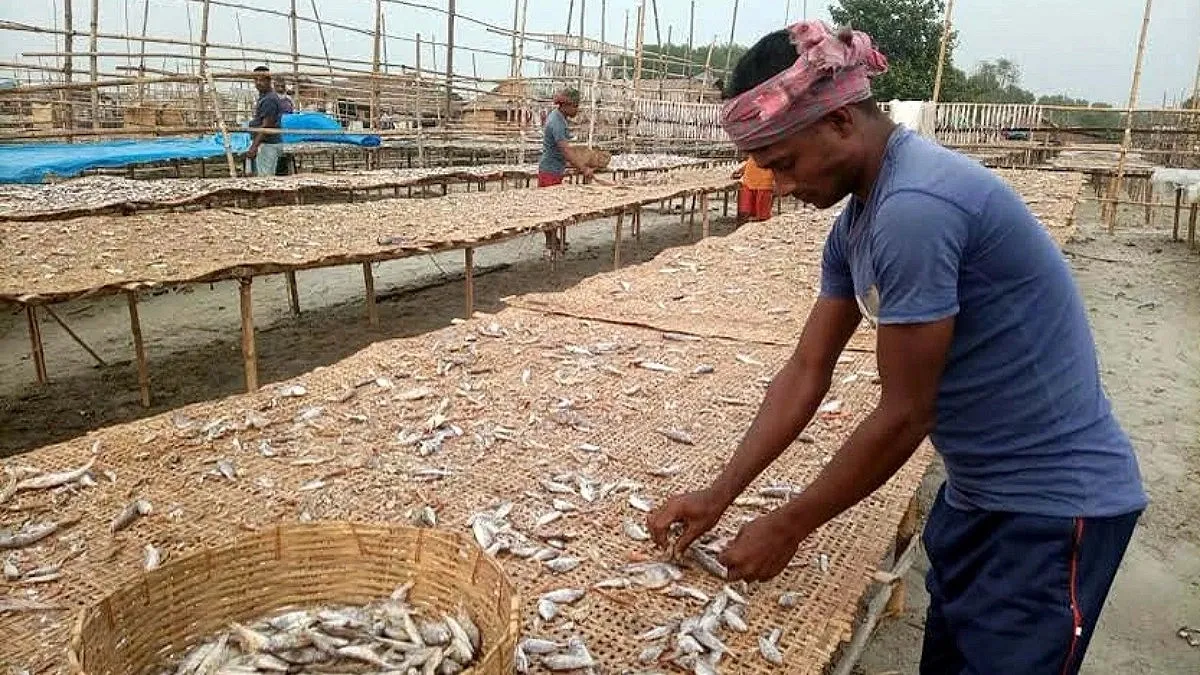
Fishermen will go out to catch fish risking their lives in the rough waves of the Bay of Bengal. Nets will bring up various species of fish including coral, lakshya, rupchanda, raitya, churi, and shrimp. Those fish will be dried in the sun to make dry fish. That delicious dry fish made from sea fish will change hands through traders and travel to various parts of the country. From there it will rise to the plates of food lovers. This trade of sea dry fish has been going on for about 100 years.
With that goal, as every year, this year too the five-month dry fish harvesting season is starting from October 30 at Dublar Char of the Sharankhola Range of the eastern Sundarbans. Fishermen and bahaddars (moneylenders) from various parts of the country have already completed preparations. They will set off for the dry fish village on October 29 with permits (passes) from the Forest Department.
However, alongside preparations for the new season, their minds are filled with fear of pirates, the risk of adverse weather, and a mountain-like burden of debt. In the last season, they were devastated by pirate extortion, abduction of fishermen and ransom demands, as well as one natural disaster after another. Many moneylenders could not even recover their invested money due to not being able to catch fish, fish spoiling in the rain, and having to pay extortion and ransom. Many have been forced to shut down their businesses. Some have sold land and property to repay loans.
Even with the losses of the last season and the burden of debt on their heads, many are again collecting capital this time through loans of lakhs of taka and high interest. Their hope is that if this year's business goes well, they will be able to repay the old loans. But will they be able to catch fish safely in the sea? Will they be protected from the hands of pirates? And whether they will be able to recover their investment and repay their loans—these are the questions now troubling them.
Loss of 15 lakh taka even after paying extortion
Md. Zakir Sheikh of Mongla in Bagerhat is the general secretary of the Rampal Fishermen's Association at Alorkol dry fish village. He is also a bahaddar. In the last season, he had to pay three lakh taka in extortion to pirates. Altogether his loss was about 15 lakh taka. Another 15 lakh taka of previous debt remains. Yet to keep the business going, he has prepared to go into dry fish production this time by taking a new loan of 40 lakh taka with interest. His association has more than two hundred trader members. Most of them were in loss in the last season.
Zakir Sheikh said that in the last season they had to pay lakhs of taka in extortion to pirates. On the other hand, due to adverse weather, fishermen often could not catch fish in the sea. This caused major losses in business. The previous loans could not even be repaid. Even so, they are being forced to enter business again by taking new loans. If there is a loss this time too, it will become difficult to turn things around.
Zakir Sheikh also highlighted the plight of other members of his association. According to the information he provided, dry fish trader Moazzem Sheikh is also a member of his association. In the last season he paid two and a half lakh taka in extortion to pirates. His loss was 10 lakh taka. There is another 10 lakh taka of previous debt. This time he is starting business with a new loan of 30 lakh taka.
Tayeb Ali Sheikh paid two and a half lakh taka in extortion. His loss was 20 lakh taka. This time he has again collected 40 lakh taka with interest. Latif Sheikh paid three lakh taka in extortion and suffered a loss of 20 lakh taka. This time he has taken another loan of 35 lakh taka.
Masum Sheikh is in the same situation. In the last season he had to pay two and a half lakh taka in extortion. His loss was 20 lakh taka. There is another 20 lakh taka of previous debt. This time he too is entering business with a new loan of 35 lakh taka.
In the Rampal area, Enamul Haque had to pay three lakh taka in extortion to pirates in the last season. His loss was 20 lakh taka. He still owes 10 lakh taka. This time he has taken a new loan of 40 lakh taka. Zia Sheikh of the same area paid three lakh taka in extortion and is in loss of 30 lakh taka. He has a previous debt of 20 lakh taka. This time he has again taken a loan of 45 lakh taka.
From these accounts it is clear that many moneylenders who suffered losses in the last season are entering business with the burden of new loans on their heads before even repaying the old ones. Mozam Gazi of Mongla is being forced to shut down his business and flee to escape the pressure of loans.
Every one of 300 moneylenders is in debt
Abdur Rauf Member, a resident of Ashashuni area in Satkhira and president of the Chakla Fishery Cooperative Society at Alorkol, was saying, "In our association, 90 percent of the more than three hundred bahaddars are in debt. Last time I suffered a loss of 12 lakh taka. I sold 11 katha of land to pay the wages of fishermen and workers. This time I have taken 12 lakh taka from BRAC and another 8 lakh taka with interest, taking a total loan of 20 lakh taka." Member Mubarak Sana of their association is in loss of 20 lakh taka. This time he has taken another loan of 20 lakh taka.
According to his information, trader Nur Mohammad Sheikh, having suffered losses last time and being unable to repay debts even after selling nets and boats, sold one bigha of land. Like him, 17 traders of the Chakla association, including Yusuf Khan, Nur Nabi Mekh, Rafiqul Dhali, Bablu Dhali, and Ahammad Sheikh, have had to shut down their businesses due to the burden of debt.
In the last season, every one of them had to pay extortion to pirates. The pirates set extortion of 50-60 thousand taka per boat and trawler for each gon. Those traders who paid extortion regularly had their fishermen able to catch fish somewhat safely. But those who did not accept the pirates' extortion card had their fishermen abducted. Later they had to bring them back by paying lakhs of taka in ransom.
Abdur Rauf said that due to the pirates' activities, fishermen could not catch fish properly. As a result, every ordinary trader suffered losses of 10 to 15 lakh taka. For some big traders, the loss was 20 to 25 lakh taka. Everyone has a burden of debt and interest of 15 to 20 lakh taka on their heads. Being unable to repay that debt, they are now being forced to enter business again with new loans.
If the pirates' reign of terror is not stopped this time too and an environment for catching fish in the sea is not ensured, it will not be possible for many to keep their businesses afloat. There will be no option but to shut down businesses after suffering losses again and again. Abdur Rauf Member expressed such fears.
Burden of debt grows while trying to repay debt
According to the bahaddars involved in the dry fish business at Dublar Char, they usually run their business by taking loans from various local associations and moneylenders centering on the five-month season. With that money, they procure the costs of fishing boats and trawlers, fishermen's wages, fuel, food, nets, and equipment needed to make dry fish. At the end of the season, they repay the principal along with a share of the profit by selling fish and dry fish.
But for the past two to three years, due to piracy, extortion, and adverse weather, they have not been able to balance their accounts. Everything is going haywire. Income is decreasing due to not getting the expected fish. On the other hand, expenses are increasing due to paying extortion and ransom. Added to this is the loss of fish spoiling in the rain. As a result, they are being forced to take new loans without repaying the old ones.
Traders fear that if this cycle of losses and debt continues, it will at some point become difficult for small and medium moneylenders to survive in the dry fish business. This will not only harm the moneylenders but also put thousands of fishermen and workers who depend on them at risk of losing their jobs.
The sea unsafe amid pirate fears
Masum Sheikh is in the same situation. In the last season he had to pay two and a half lakh taka in extortion. His loss was 20 lakh taka. There is another 20 lakh taka of previous debt. This time he too is entering business with a new loan of 35 lakh taka.
In the Rampal area, Enamul Haque had to pay three lakh taka in extortion to pirates in the last season. His loss was 20 lakh taka. He still owes 10 lakh taka. This time he has taken a new loan of 40 lakh taka. Zia Sheikh of the same area paid three lakh taka in extortion and is in loss of 30 lakh taka. He has a previous debt of 20 lakh taka. This time he has again taken a loan of 45 lakh taka.
From these accounts it is clear that many moneylenders who suffered losses in the last season are entering business with the burden of new loans on their heads before even repaying the old ones. Mozam Gazi of Mongla is being forced to shut down his business and flee to escape the pressure of loans.
The burden of debt grows while trying to repay debt
According to the bahaddars involved in the dry fish business at Dublar Char, they usually run their business by taking loans from various local associations and moneylenders centering on the five-month season. With that money, they procure the costs of fishing boats and trawlers, fishermen's wages, fuel, food, nets, and equipment needed to make dry fish. At the end of the season, they repay the principal along with a share of the profit by selling fish and dry fish.
But for the past two to three years, due to piracy, extortion, and adverse weather, they have not been able to balance their accounts. Everything is going haywire. Income is decreasing due to not getting the expected catch. On the other hand, expenses are increasing due to paying extortion and ransom. Added to this is the loss of fish spoiling in the rain. As a result, they are being forced to take new loans without repaying the old ones.
Traders fear that if this cycle of losses and debt continues, it will at some point become difficult for small and medium moneylenders to survive in the dry fish business. This will not only harm the moneylenders but also put thousands of fishermen and workers who depend on them at risk of losing their jobs.
Bir Muktijoddha Md. Kamal Uddin Ahmed, president of the Dublar Char Fishermen Group, said that dry fish has been produced at Dublar Char for about 100 years. The dry fish here has a traditional reputation at home and abroad. Those involved in this profession fight against nature and enter business with the calculation of profit and loss in mind.
However, at present, due to the pirates' activities, this business has become quite risky. Fear prevails among the fishermen who go to sea to catch fish. There are reports of new pirate gangs being organized centering on the dry fish season. In the last season, traders had to pay lakhs of taka in extortion. If they refused to pay, fishermen were abducted and tortured. Later they had to be brought back by paying ransom.
He said that dry fish production at Dublar Char is not just the business of a few moneylenders. The livelihood of a large fishing community is involved with it. During the dry fish season, more than 10,000 people are directly employed. Besides, several thousand more people are directly and indirectly involved in fishing, transportation, food supply, boat repair, dry fish processing, and marketing.
Kamal Uddin Ahmed further said that if the pirates' reign of terror is not stopped, traders will suffer major losses this time too. As a result, many will be forced to shut down their businesses. From the start of the season, our Fishermen Group has already spoken with the district administration, Superintendent of Police, SRB, and Coast Guard to launch a strict crackdown against the pirates. We have demanded safe fishing in the sea and ensuring the safety of fishermen. I hope this season will be safe.
Dublar Char, the major source of the country's dry fish production
According to Forest Department sources, about 80 percent of the country's total dry fish production comes from the dry fish villages centered on Dublar Char. In these four dry fish villages—Majher Killa, Alorkol, Narkelbaria, and Shyala Char—under the Sharankhola Range at the edge of the Bay of Bengal south of the Sundarbans, a massive operation of sea fish harvesting and dry fish production takes place every year during the winter season.
For the five months of the season, fishermen and bahaddars from various districts of the country, including Cox's Bazar, Chattogram, Bagerhat, Pirojpur, Khulna, and Satkhira, come here and set up temporary settlements. They remain involved in various tasks, from fish harvesting to dry fish production and marketing.
According to Forest Department instructions, no forest resources of the Sundarbans may be used in building fishermen's houses, depot houses, and fish-drying racks. All necessary construction materials must be brought from their respective areas. House construction in the dry fish villages is scheduled to begin on October 30. At the same time, sea fish harvesting and dry fish production activities will also begin. The season will continue until April 30 next year.
Revenue target was not met last time
Md. Shariful Islam, Assistant Conservator of Forests (ACF) of the Sharankhola Range of the Eastern Sundarbans Division, said that in the last season fishermen suffered losses due to adverse weather and pirates. This had an impact on dry fish production and revenue collection. In the last 2025-26 fiscal year, a revenue target of eight crore taka was set from the four dry fish villages of Dublar Char. But due to adverse weather and the pirates' raids, fishermen could not fish regularly, so the target was not met. Amid various adversities, 5,431.7 metric tons of dry fish were produced last time. From that, revenue of seven crore 37 lakh 22 thousand 493 taka was collected. In the current season, the revenue target has been set at seven and a half crore taka.
ACF Shariful said that this time the Forest Department, Coast Guard, and other law enforcement agencies are active to ensure the safety of fishermen and suppress piracy. Necessary measures will be taken in coordination with the relevant forces so that fishermen can harvest fish without hindrance.
What the Coast Guard says
Lieutenant Commander Sabbir Alam Sujan, media officer of the Bangladesh Coast Guard, said that centering on the upcoming dry fish harvesting season, the Coast Guard West Zone will take special security measures to ensure the overall protection of fishermen. To ensure the overall protection of fishermen, Coast Guard ships, boats, and special patrol teams will conduct round-the-clock patrol operations in Dublar Char, Alorkol, Katka, and surrounding rivers and channels of the Sundarbans.
The Coast Guard is always active in preventing forest pirates' extortion and abduction, and in ensuring that fishermen and moneylenders can safely harvest fish and conduct business. In addition, it has been requested to contact the Coast Guard emergency service number 16111 to get quick assistance in the event of any piracy incident or security problem.
