


Khoai dam breaks again, 7,000 families affected by flood

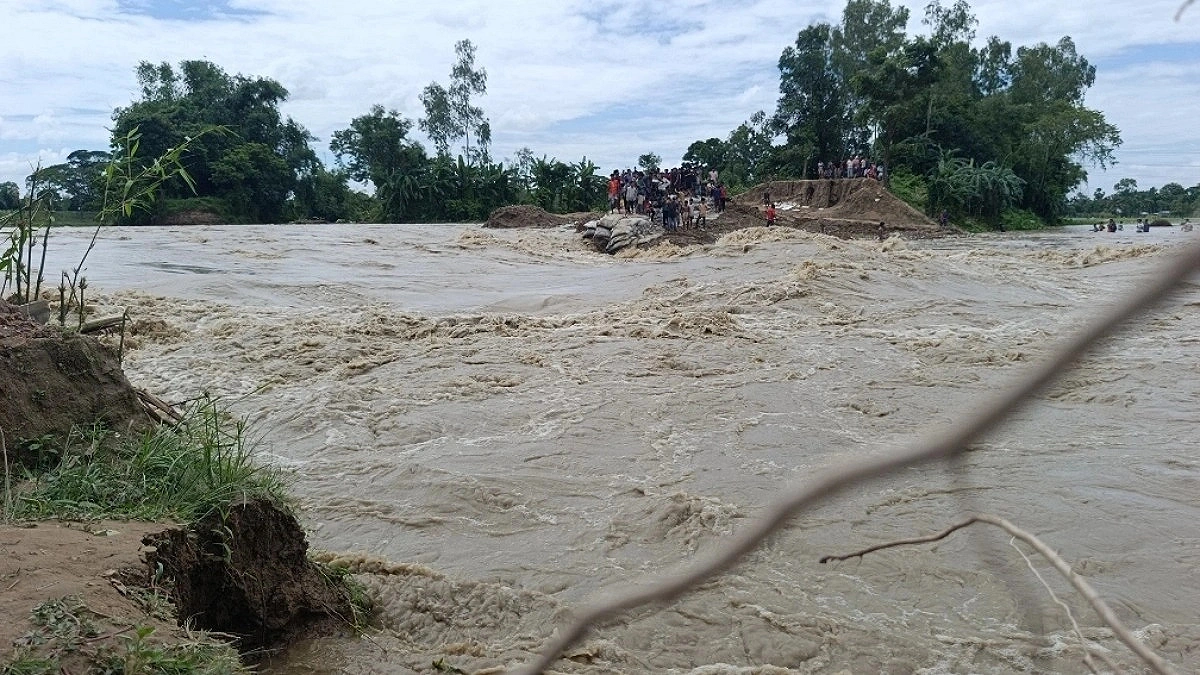
Khoai dam goes broke again affecting 7,000 families. Agamir Somoy.
The flood wounds of 7,000 families across 20 villages have not yet healed properly. Within just a gap of one and a half months, the Khoai River dam in the Kaliganj area of Habiganj has broken once again.
This Sunday morning, village after village was inundated anew. Water entered homes, and courtyards and roads went underwater. Men and women are abandoning their homesteads, taking their livestock and household belongings with them.
According to experts, unregulated sand and soil extraction has damaged the riverbed of the Khoai River over the past few years. The river's water-holding capacity has decreased. As a result, even with less water than before, the river swells up, increasing the risk of dam breaches.
On the night of July 9, water in the Khoai River rose above the danger level, breaching approximately 100 feet of the dam in the Kaliganj area. Repair work on the dam was ongoing at a cost of 80 lakh taka. Not even 50% of the work had been completed when the dam broke again on Sunday.
By noon, at least 20 villages in Laskarpur (under Habiganj Sadar upazila) and Mirpur Union (under Bahubal upazila) were flooded. Water entered nearby villages including Noabad, Charhamua, Adyapasha, Bongaon, Kaliganj, Sughar, and Kotiad. Many took shelter on the embankment and higher ground with their livestock.
Saheb Ali, a member of Ward No. 5 of Laskarpur Union Parishad, said, "The repair work on the houses damaged in the previous flood hasn't even been completed. Most of the people are day laborers. With their homes damaged again by the flood, their debt burden will only increase further."
The former president of the Habiganj Journalist Forum, Mortuza Imtiaz, also has his in-laws' home in Kaliganj. His family members have taken refuge with relatives, bringing their livestock. Water inundated their home, damaging furniture, a refrigerator, a television, and other essential belongings. In his words, "Almost every affected family is in the same situation."
"We spent a week on the Union Parishad veranda with my paralyzed son after the last flood. We had nothing to eat or drink. Now our homestead is floating in floodwater again. I don't know what to do or how to manage. O Allah, please look after us!"
Saying these words, 80-year-old Sayeda Banu broke down in tears. She has now taken shelter at someone else's house with her paralyzed son, Abdul Aziz (40). When water suddenly rushed in during the afternoon, locals helped her bring her son to a shelter. Her elderly husband, Uddat Ali, is trying to move household belongings one by one to higher ground.
Like Sayeda Banu, at least 10 families, including Mustura Begum, Arzat Ali, and Arab Ali, have taken shelter in others' homes. Some of them did not even get the chance to rescue their belongings. Women with children have moved to shelters, while men are standing waist-deep in water trying to save their household goods. They are bewildered by the second wave of flooding within just a month and a half.
According to the Habiganj Water Development Board, in 2017, water from the Khoai River flowed 282 centimeters above the danger level due to flash floods from India. At that time, the dam in the Habiganj area did not break. However, this time, the dam broke when water rose just 130 centimeters above the danger level, inundating a vast area.
Siddiqui Harun, General Secretary of the Bangladesh Environment Movement (BAPA) in Habiganj, said, "Unregulated sand and soil extraction has damaged the riverbed. This has reduced its water-holding capacity. As a result, even though the water level is 152 centimeters lower than in 2017, the river still swells up and breaches the town-protection dam."
Syedur Rahman, Executive Engineer of the Habiganj Water Development Board, said, "Repair work on the dam was ongoing at a cost of 80 lakh taka. Over the past few days, heavy rainfall in Tripura, India, and the opening of sluice gates have caused the Khoai River to flow 130 centimeters above the danger level. The section under repair has collapsed again. Once the water recedes, repair work will resume. The contractor will have to carry out the work a second time at the same cost."
He added, "Unless unplanned sand extraction is stopped, preventing the Khoai River dam from breaking will be very difficult. Everyone must be made aware of this issue."

