
Halda River loses biodiversity, fish species face spawning crisis

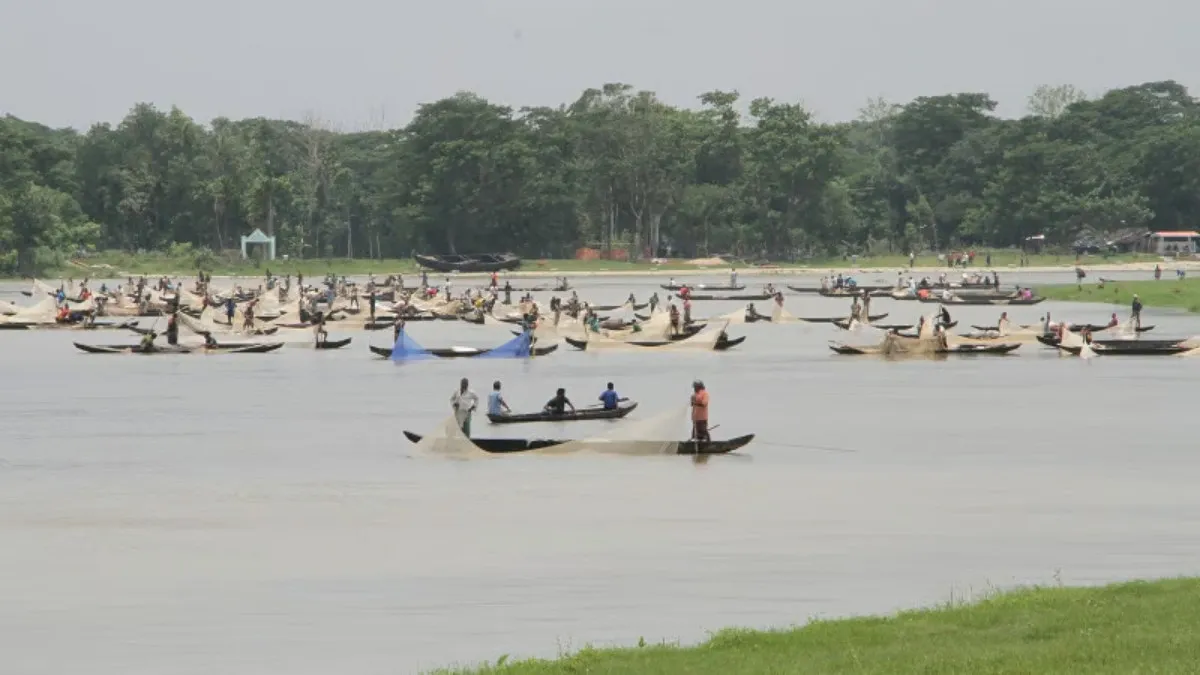
BSS photo.
Halda River loses biodiversity, fish species face spawning crisis
Halda River, the only natural spawning ground for major carp species in South Asia, is gradually losing its fish, its food chain and its ability to breed.
Researchers said 26 of the Halda's 76 fish species are no longer found in its natural breeding ground.
A 2009-2016 study by the Department of Fisheries and Chattogram University's Halda River Research Laboratory confirmed that at least five species have gone extinct: Chital, Bani Koksa, Ghor Poia, Guijja Ayer and Meni (Bheda). Many others have also disappeared, including Gani Chapila, Lilsa, Telipasa, Koti, Dhela, Chepchela, Boali Pabda, Tengra, Shillong, Ghaura, Batasi, Gajra, Nona Baila, Chiring and Chewa. The same research linked habitat destruction to a sharp fall in fish egg production.
A deadlier method of illegal fishing has now emerged. Over the past seven to eight months, seven large brood fish, including Katla, Mrigal and Ayr, weighing 2 to 20 kg, have been found dead in Hathazari and Raozan. Some had hook or sharp-object marks, but research by Professor Dr. Md. Manjurul Kibria of Chattogram University's Zoology Department found toxic chemical residues in their bodies.
Fishermen are reportedly using "Nitro," a pesticide that combines Chlorpyrifos and Cypermethrin. It is normally used on rice and vegetable fields and is sold easily in local pharmacies and grocery stores. It is applied mostly late at night, during the stagnant water between high and low tides, in the 17 branch canals feeding the Halda, including Dhurung, Sarta, Kagatia, Sonai and Madari. Oxygen depletion brings fish and shrimp to the surface within minutes, where they are easily taken.
Dr. Sheikh Ahmad Al Nahid, former Dean of Fisheries at CVASU, said that the poison eventually flows into the main river. Halda Researser Dr. Mohjurul Kibria warns that continued use could leave parts of the Halda without enough oxygen for any aquatic life. "Pesticide fishing has also been seen in canals of the Sundarbans and has no approval from the Department of Fisheries. The dead brood fish are only the visible part of the problem," he added.
Dr. Kibria stresses that the destruction of phytoplankton and zooplankton, the base of the food chain, goes unnoticed. "If the food chain is disrupted at its root," he warned, the whole ecosystem could collapse.
He said poison is only the latest threat. Researchers also blame industrial and solid waste dumping, salinity, sand extraction, and sluice gates and dikes on the banks. Dr. Kibria calls unplanned sluice gates a main cause of species loss, because dams reduce water flow and wipe out food sources such as benthos.
"Between Sattarghat and Madunaghat, the brood fish habitat, food is severely scarce, yet fish maturation needs clean water and plenty of food. A field visit on October 27 found dark, toxic water flowing from industrial areas, including Mohara's tannery zone, through the Krishnakhali canal and the Buri Char area into the Halda. Locals say farmland there has gone uncultivated for years and no insects are seen along the flow," he said.
Dr. Kibria added that household waste, effluent from dyeing factories and chemicals are still discharged directly into the river through at least 19 canals in Chattogram.
Fisherman Kamal uddin told BSS that his family has fished the Halda for generations: "We have seen the river lose many species over the last 10 years. Nowadays, we do not even find enough fish eggs," he added. The 40 km sanctuary has left about 2,000 fishermen jobless, and some now pull rickshaws or work as day labourers.
Officials said fish-poisoners often finish within 10 to 20 minutes, and some guards appointed by the Upazila administration are accused of colluding with offenders and leaking raid information.
UNO Mohammad Abdullah Al Mumin told BSS that mobile courts, net seizures, fines and awareness campaigns are underway to protect the halda river.
Hathazari Senior Fisheries Officer Mohammad Shawkat told BSS that Department of Fisheries conducts operations to protect the heritage site and the brood fish breeding environment, with surveillance in Raozan and Hathazari during the April-July breeding season.
Dr. Kibria told BSS that researchers have repeatedly mapped pollution routes and submitted recommendations, with little implemented.
He said the government declared the Halda a "Fisheries Heritage Area" with 17 restrictions, including bans on catching fish, sand mining, heavy motorised vessels, industrial dumping, habitat destruction, tobacco cultivation on the banks and harmful pesticides on nearby farmland.
Dr. Kibria called this the government's most significant legal measure, recognising the Halda as a natural breeding ground for carp and a habitat for the Ganges river dolphin.
He said the conditions that took effect with the gazette include a ban on fishing in the 17 connected canals during the breeding season (February to July), a prohibition on new rubber or concrete dams in the river and its connected canals, and a requirement to keep water flow unobstructed so fish can migrate before breeding.
Dr. Kibria urges stopping pollution first, then enforcing the law against illegal sand extraction, stopping brood fish theft, upstream rubber dams, tobacco farming and motorised boats. He said local people, the river's main beneficiaries, must lead its protection. His specific recommendations include strict monitoring and mandatory Effluent Treatment Plants (ETPs) for textile and industrial units along the Halda and its connected canals, controls on plastic dumping in the Karnaphuli River, and waste traps at major canals where urban runoff enters the Halda.
He also calls for curbs on single-use plastic disposal and the replacement of synthetic fishing gear waste along the riverbanks in Hathazari, Raozan and Fatikchhari. Without decisive action, the Halda risks becoming a fishless river, he added.
Dr Monjurul Kibria also suggested that all relevant state bodies, including the Department of Environment, Development Authority and other government departments and administrative agencies, must work together to tackle the problems that threaten it, especially encroachment and pollution.
