
Low-lying Areas Flooded
Farmers Struggle to Save Semi-ripe Paddy

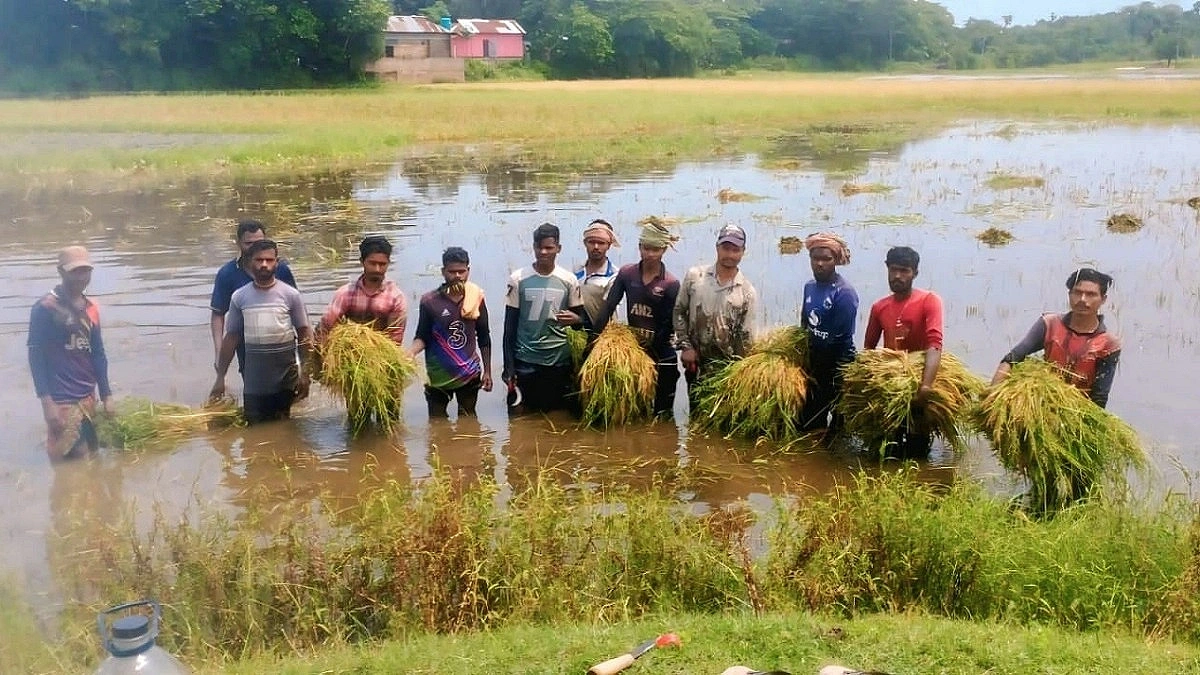
Photo: Agamir Somoy
Continuous rainfall and the onrush of mountain runoff from upstream have flooded the low-lying areas along the Hakaluki Haor in the Barlekha Upazila of Moulvibazar.
Afraid of a complete submersion of their Boro crops, farmers have already harvested semi-ripe paddy from nearly 80% of the land. However, the remaining 20% of ripe and semi-ripe crops have been submerged by excessive rain and runoff, leaving thousands of marginal farmers facing significant financial losses.
Amid the adversarial weather, farmers are harvesting paddy while standing in knee-to-waist-deep water. Many are transporting the harvested crops home by boat. However, drying the paddy has become extremely difficult due to persistent rain and waterlogging, with seedlings even beginning to sprout from the wet grains in some areas.
According to the Upazila Agriculture Office, Boro was cultivated on 5,625 hectares of land in Barlekha this season. Of this, 3,695 hectares are within the Hakaluki Haor area and 1,930 hectares are in non-haor areas. Continuous rain began just as the plants were heading. Consequently, farmers in the haor region prematurely harvested semi-ripe paddy from about 3,000 hectares. Over the last few days, most of the remaining 500+ hectares have been partially or fully submerged.
On-site visits on Thursday and Friday showed farmers harvesting paddy in deep water in areas such as Kamilpur in Dakshinbhag Dakshin Union, Maijumjuri in Daser Bazar, Dwitiyardehi and Noagaon in Borni, and Kotali Beel in Sujanagar.
Abdul Motlib, a farmer from Kutaura village, mentioned that his two bighas of paddy were nearly ripe. While he planned to harvest a few days ago, the haor flooded due to the rain. He fears the crops will rot if the water level does not recede soon.
Another farmer, Rahim Uddin, said, "We are struggling to cut the paddy in water and bring it home by boat. But because of the rain and waterlogging, we can't dry it. This is reducing the yield, and the market price is also unsatisfactory."
A labor shortage has also emerged. Farmers reported that since working in the water is risky, laborers are demanding double wages, yet are still difficult to find.
Many farmers had stored previously harvested paddy in open threshing floors (khola), but the rising water has begun to submerge those stocks as well. Attempts to cover them with tarpaulins have provided little relief.
According to locals, a large portion of the affected farmers cultivated their land using NGO loans, and many are sharecroppers. Consequently, the crop failure has created uncertainty regarding debt repayment.
Upazila Agriculture Officer Monowar Hossain stated that farmers were advised to harvest quickly following warnings from the Meteorological Department. While this led many to harvest early, it did save some from total loss.
He noted that about 90% of the paddy harvesting in the haor areas is complete. While some of the remaining land is partially or fully submerged, farmers are still trying to bring the crops home. So far, approximately 35 hectares have been affected by the disaster, including 6 hectares partially damaged and 5 hectares completely lost.
He added that there are plans to provide three months of government assistance or incentives for the affected farmers.
Meanwhile, on Thursday afternoon, UNO Mahbub Alam Mahbub and Agriculture Officer Monowar Hossain visited various areas along Hakaluki Haor, advising farmers to harvest quickly and instructing relevant officials to provide full cooperation in managing the potential disaster.
