
Dhaka: Daily extortion from buses reaches Tk 5.2 million
- This money is collected under the guise of running transport companies
- If all transport services are taken into account, the extortion amount in Dhaka would exceed Tk 2 crore.

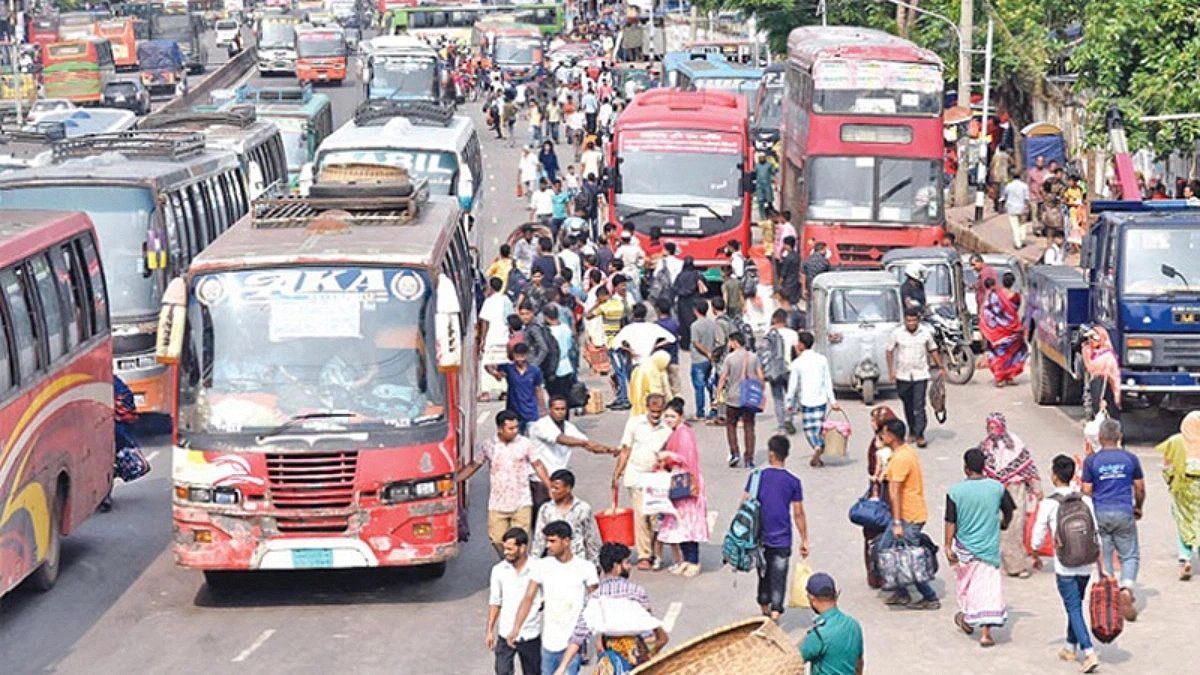
Collected Photo
There are several designated stops and spots in the city which are used for toll collections from various bus companies.
For instance, at Signboard, Tk 120; Shonir Akhra, Tk 200; Bouddha Mandir, Tk 1,170; Khamarbari, Tk 40; Radio Colony, Tk 70; and Baipail, Tk 50—these are the places and amount of toll money a bus operator is paying to the extortionists. This is an estimate of one-way collection.
On the return trip, the amounts are Tk 40 at Baipail, Tk 70 at Radio Colony, Tk 40 at College Gate, Tk 50 at Mouchak, Tk 70 at Bouddha Mandir, and Tk 200 at Shonir Akhra. This is the route from Signboard to Baipail, passing through Dhaka, and these are the amounts collected from a typical bus operated by Labbaik Paribahan, one of the many bus services running on the route every day.
Every time a Labbaik bus stops at one of these locations, it must pay a fixed amount before continuing to its next destination. The amount collected on the first trip is higher than that on the second.
A bus has to pay extortion money at six locations on the outbound journey and another six on the return. A Labbaik bus pays Tk 1,650 to travel from Signboard to Baipail and Tk 480 on the return journey. On its next outbound trip, it pays Tk 550, while the return-trip payment remains Tk 480. Over two round trips a day, a bus makes payments at a total of 24 points. Altogether, Tk 3,160 is collected from each Labaid bus daily.
Of this amount, Tk 692 is spent on the operating board and the salaries and allowances of those involved in collecting the money. Labbaik Paribahan operates around 70 buses. This means Tk 221,200 is collected daily in the name of company operating expenses. The company's actual daily expenses, including tolls, amount to Tk 48,440.
That is just one bus operator. According to the Dhaka Road Transport Owners Association, around 6,000 buses are suitable for operation in Dhaka, of which an average of 4,000 to 4,500 take to the streets each day. All buses have to pay varying amounts in extortion money to operate. The minimum payment can be as low as Tk 500 per bus. On average, however, Tk 1,250 is collected from each bus.
Assuming that an average of 4,200 buses operate daily, the total amount collected in extortion money comes to at least Tk 5.25 million a day.
Asked about the collection of money from Labbaik Paribahan's buses, the company's managing director, M. A. Hasan, declined to comment. “I will not speak about this. You can make your own inquiries,” he said.
Saiful Alam, general secretary of the Dhaka Road Transport Owners Association, acknowledged the practice without hesitation.
“About Tk 5 million could be collected a day. Transport owners collect this money in the name of running their companies. But they should collect only what is necessary to cover operating expenses. The amount Labbaik is collecting is abnormal,” he told Agamir Somoy.
He said the association had no involvement in the collections, adding that it neither collected the money nor received any share of it.
“A large portion of the money is also paid to the police by the owners. Otherwise, they claim, the police issue cases carrying higher fines. I tell the owners to make sure everything is in order so the police have no grounds to file cases against them,” he said.
Mohammad Anichur Rahman, additional commissioner (traffic) of Dhaka Metropolitan Police, rejected the allegation that a large share of the extortion money went to the police.
“There is no basis for the claim that a large portion of the extortion money is being paid to the police. Tell them to stop paying money everywhere. If their vehicle documents are all in order, I will see how the police can file cases against them,” he said.
Extortion could exceed Tk 20 million a day across all transport services in Dhaka
When collections from all other passenger vehicles and freight carriers, both large and small, are added to those from buses, the total amount of extortion money collected in Dhaka exceeds Tk 20 million a day.
There are 95 types of terminals and stands of various sizes in Dhaka and its surrounding areas, including 66 within the Dhaka metropolitan area. These locations serve as hubs for passenger and freight transport.
The facilities include 37 leguna stands, seven local bus stands, five pickup-truck stands, four stands for local and inter-district buses, four auto-rickshaw stands, three inter-district bus terminals, three additional auto-rickshaw stands, two truck stands and one minibus stand.
According to the Roads and Highways Department, Tk 22.1 million is collected in extortion money every day from 53 transport terminals and stands in Dhaka. Of this amount, Tk 11.7 million is collected in the name of transport owners' associations. The rest is collected under various pretexts, including fees for city corporations and terminal authorities, counter and terminal operating expenses, and charges for workers, line supervisors, cleaners and security guards.
On March 5, 2024, Transparency International Bangladesh (TIB) published a research report stating that at least Tk 10.5937 billion is collected annually through extortion and irregularities in the country's private bus and minibus sector. Of this amount, approximately Tk 9.0059 billion goes to Bangladesh Road Transport Authority (BRTA) officials and employees as bribes for various services, including vehicle registration, fitness certificates and renewals.
In addition, Tk 249.7 million is collected by individuals or groups with political affiliations, Tk 875.7 million by traffic and highway police, Tk 334.8 million by city corporation and municipal representatives, and Tk 127.6 million through excess collections by transport owners' and workers' organizations.
Guidelines on collections also being ignored
In 2020, transport owners' and workers' organizations jointly formulated the Guidelines on Operating Expenses/Service Charges for Road Transport Organizations to curb the long-standing practice of extortion on roads and highways. The guidelines specify where, how and how much can be collected from each vehicle to cover operating expenses. They also explicitly prohibit collecting money by stopping vehicles on roads or highways, collecting payments more than once in 24 hours, or collecting money outside designated locations.
Under the guidelines, the Bangladesh Road Transport Owners Association or the Dhaka Road Transport Owners Association may collect a maximum of Tk 20 from each bus or minibus operating in metropolitan Dhaka, while the relevant terminal owners' association may collect up to Tk 30. This means the maximum permissible collection from a bus is Tk 50.
For buses operating from Gabtoli, the Bangladesh Bus-Truck Owners Association may collect up to Tk 40, the terminal owners' committee Tk 10, and the relevant organization Tk 30. The total collection in this case cannot exceed Tk 80.
Different rates apply to workers' organizations at Dhaka's four bus terminals. The relevant workers' union may collect Tk 30, the terminal workers' committee Tk 10, and the Bangladesh Road Transport Workers Federation another Tk 10. An additional Tk 10 may be collected to support community policing at bus terminals, leased collection points and intersections.
The guidelines also call for legal action against any owners' or workers' organization that forcibly collects money or charges more than the prescribed rates. They explicitly prohibit collecting money on roads and highways under labels such as “extortion,” “welfare fund,” “unemployment benefits” or any other name.
Only genuine transport workers may become members of workers' unions, and employers are not allowed to contribute money to union funds through collections from vehicle owners.
Transport workers' leader Mohammad Hanif Khokon has called the guidelines illegal, questioning the authority of those who drafted them.
“Labor laws and the Road Transport Act do not allow extortion outside terminals. Yet leaders of various associations joined together to draw up guidelines in an attempt to legitimize extortion. That practice continues to this day. They are not even following their own guidelines. The rules allow collection only once, but they collect money 30 times a day,” he said.
“Extortion will not stop unless the government takes a firm stance and brings party leaders under control,” he added.
