
Bogura hospitals dump untreated medical waste into rivers, drains

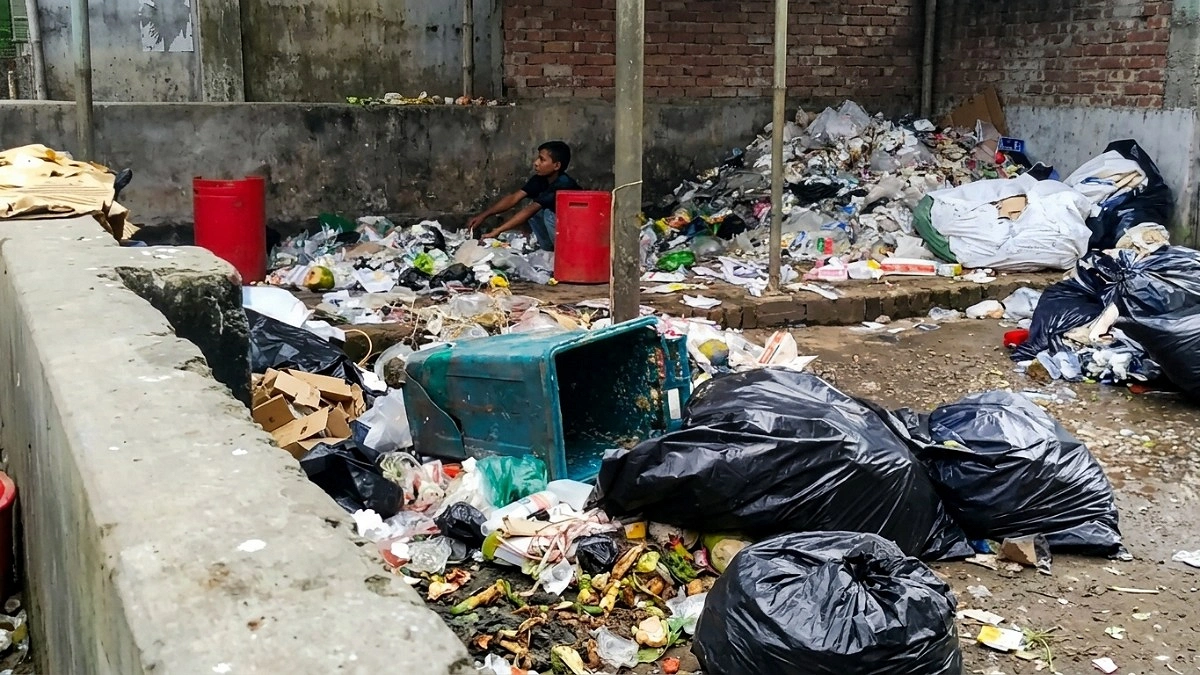
Photo: Agamir Somoy
Health risks are rising in Bogura due to hospital waste, as government and private hospitals in the district lack effective liquid waste treatment facilities.
Medical waste is mixing directly into rivers, drains, and water bodies without any treatment, severely polluting the environment and elevating public health risks. Although initiatives such as holding meetings, issuing notices, and preparing lists have been undertaken to ensure waste management, there has been no visible improvement in the actual situation.
According to the Department of Environment, no public or private hospital in the district possesses a functional liquid waste treatment plant or Effluent Treatment Plant (ETP). Liquid waste discharged from various departments, including hospital operation theaters, spreads untreated into surrounding water bodies through drains and pipelines.
Abdul Momin, who came for medical care at the emergency department of Bogura Shaheed Ziaur Rahman Medical College Hospital (SZMCH), said, “If medical waste toxicifies water and the environment, then where will we go? Children are growing up in this polluted environment and getting afflicted with various diseases. Even taking medication is not working.”
The district’s two major government healthcare facilities, SZMCH and the 250-bed Mohammad Ali Hospital, also lack treatment systems. Liquid waste from SZMCH flows into the Karatoa River via sewerage lines, while waste from Mohammad Ali Hospital is dumped into the pond of the adjacent Nursing Hostel. Waste from private clinics and diagnostic centers discharges into rivers and water bodies through drains.
SZMCH Deputy Director Monjur A Murshed said following directives from the Directorate General of Health Services (DGHS) in August, the District Health Engineering Department inspected the facility regarding the installation of an ETP.
However, he claimed that pollution requiring the operation of an ETP does not occur at the hospital. On the other hand, Hospital Superintendent Majidul Islam noted that although waste treatment facilities are required by law, installing an ETP through their own funding is impossible for them.
He expressed hope that an ETP or waste treatment plant will be established at the government level.
Experts warned that such uncontrolled disposal of medical waste poses a long-term threat to the environment and public health.
Abu Sayeed, assistant professor of the Department of Geography and Environment at Government Azizul Haque College, emphasized that medical waste is far more hazardous than ordinary household waste. Discharging this waste directly into rivers damages aquatic life and the ecosystem, and he warned that polluted water could lead to long-term severe health impacts on humans.
Data from the Civil Surgeon Office reveals that there are 425 private clinics and diagnostic centers in Bogura, among which only 76 hold environmental clearance from the Department of Environment, leaving the vast majority without clearance.
Under the Medical Waste Management Rules of 2008, waste is required to be sorted at the source into yellow, red, green, and black containers. However, officials noted that this rule is not being properly followed, creating a high risk of infectious and sharp waste mixing with general waste.
Cleaners face severe occupational hazards due to these waste management deficiencies; Azibor Rahman, a worker at SZMCH, shared that their hands often get cut while separating syringes, injection needles, and saline packets, forcing them to handle hazardous waste with bare hands.
Despite repeated urges from the Department of Environment to establish waste treatment plants, no effective progress has been made. Department guidelines specify that institutions gathering over 500 people daily must install a Sewage Treatment Plant (STP) or an integrated wastewater treatment plant alongside an ETP.
While the private TMSS Medical College Hospital has an ETP, its license renewal is lacking. Since 2025, the Department of Environment has issued notices to several institutions, including Doctor’s Clinic, Shamsun Nahar Clinic, Health City Specialized Hospital, Islami Hospital, and Ibn Sina Diagnostic Center.
In response, Showkat Islam, manager of Ibn Sina Diagnostic Center, claimed that following instructions from the Department of Environment, their head office has initiated a plan to set up an ETP and directives have been received.
Meanwhile, discussions with the district administration and city corporation are ongoing, though effective implementation remains in process.
Bogura Deputy Civil Surgeon SM Nur E Shadid, said, “Meetings regarding the installation of ETP have been held at the Deputy Commissioner’s office and the city corporation. The concerned departments are jointly preparing a list of institutions.”
Bogura Department of Environment Assistant Director Mahathir Bin Mohammad mentioned that awareness initiatives are being conducted, warning that if these prove ineffective, formal warnings and legal action will be taken.
