
Flash floods bury Sunamganj homes as sand and silt rise

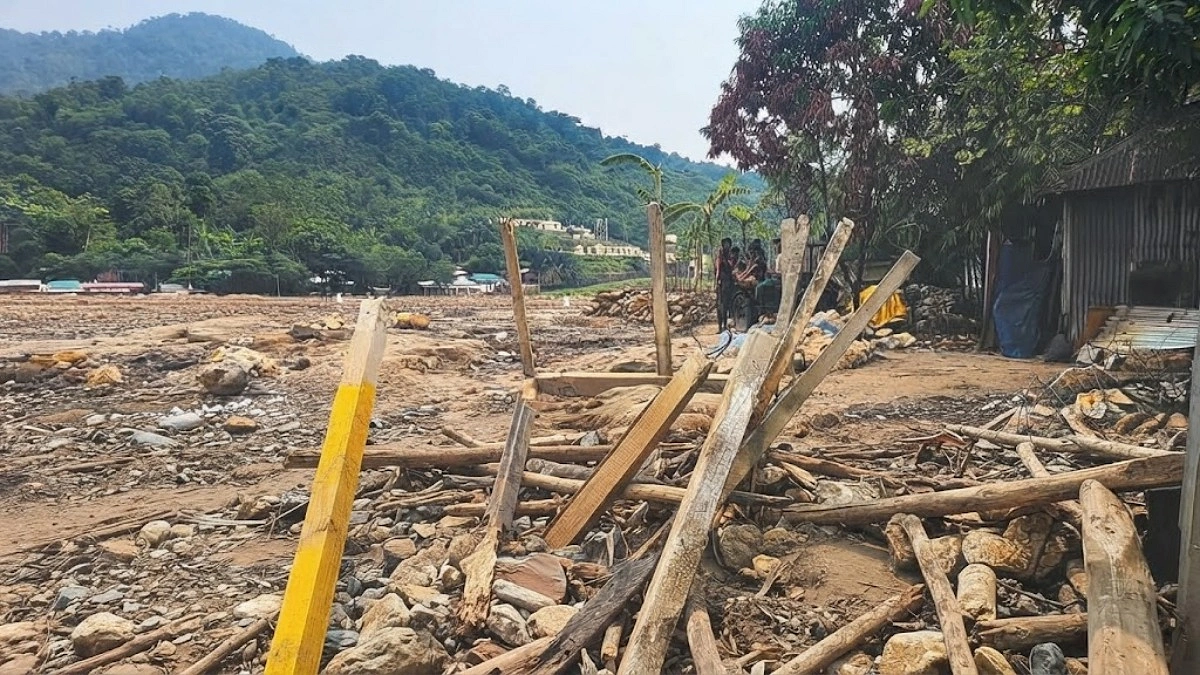
Photo: Agamir Somoy
More than 100 homes at Charagaon in Tahirpur, Sunamganj were damaged in flash flood.
According to locals, the silt brought down by the flood elevated many homestead yards by several feet. In some places, houses were buried under sand, while elsewhere, cropland was destroyed alongside homesteads.
Even though the disaster has subsided, the suffering of the affected families has not diminished. Mountain flash floods have struck several villages many times this year. Although the September flash flood caused the most damage, loss of lives and homes due to flood currents had occurred prior to this as well.
Locals alleged that the tendency of sand and silt runoff is higher in areas upstream where mountains are cut to extract limestone and coal. Because the mountains are damaged by runoff, loose soil and sand descend with rainwater and accumulate in border rivers, canals, and settlements.
As a result, water flow is obstructed on one hand, while on the other, major flash floods occur within a short period. Although systems exist for early warning forecasts in disasters like floods, storms, or storm surges, local people receive no such effective early warning for border mountain flash floods. Many people do not realize anything until the flash flood arrives. Due to the sudden surge of current, there is no time to move to safety.
Mountain flash floods have claimed lives in this region previously as well. On 22 June, a man died in Tahirpur after being submerged along with his house in the current of a mountain flash flood. In June 2023, Durlabh Rani was swept away and died along with her two children while crossing a road in Shalla due to flash flood currents. The following year, more than 50 homes and shops were lost in Dowarabazar.
Deputy Commissioner’s office was contacted to inquire about the damage and relief assistance regarding the flash flood. Deputy Commissioner and President of the District Disaster Management Committee Mohammad Minhajur Rahman declined to comment as he did not have information on the matter.
However, experts believed that providing aid only after damage occurs is not the solution to this problem.
Md Anwarul Islam, associate professor of the Department of Geography and Environment at Shahjalal University of Science and Technology, said, “The issue of mountain flash floods is a transboundary problem. In areas of India where stone or minerals are extracted by cutting hills, the soil becomes loose, causing massive amounts of soil and sand to wash downstream with rain. This escalates the extent of damage in the border areas of Bangladesh.”
He added that to minimize damage, initiatives must first be taken to stop hill cutting. Information regarding rainfall amounts in India and the corresponding volume of flash flooding expected must be shared between the two countries. By analyzing data and issuing early warnings to people in border regions, it is possible to reduce loss of life and property from sudden flash floods.
