


Mere Twice a Day: No relief on 'Pink' buses

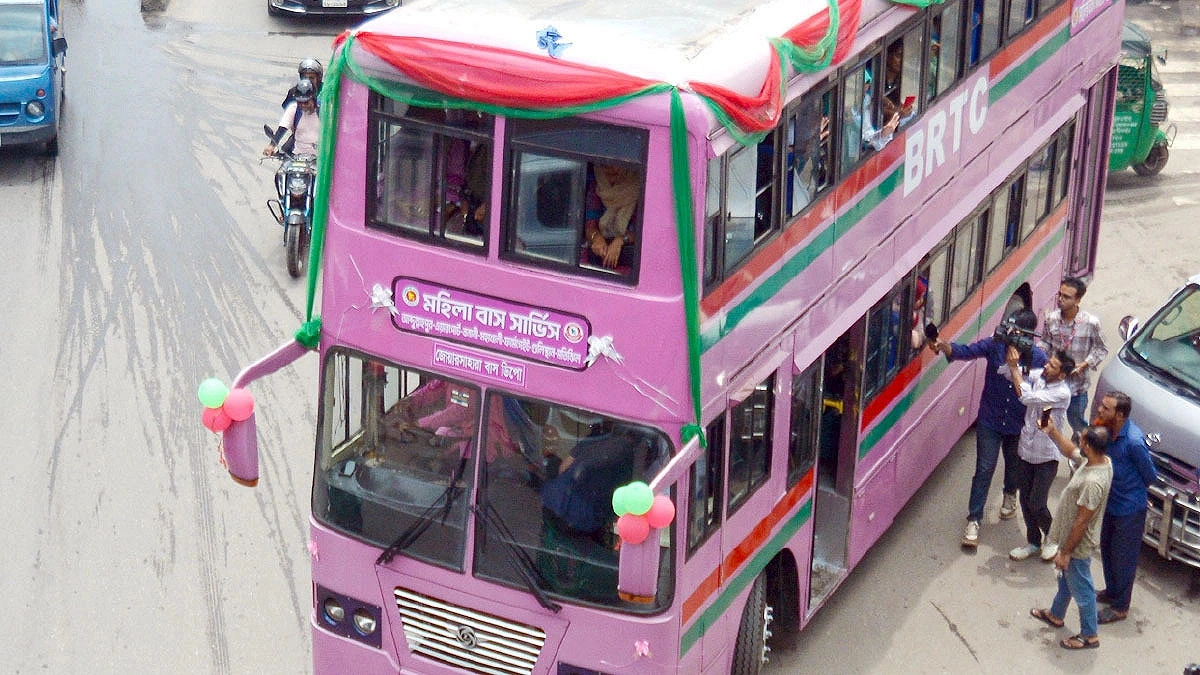
Photo: Ashiqur Rahman.
Pushing, shoving, not getting a seat, and the jabs of elbows from male co-passengers—these are everyday miseries for women using public transport on Dhaka's streets. The hope of avoiding this ordeal and reaching their destinations a little more safely also seems like a pipe dream for the women of Dhaka. To bring a sliver of comfort to that dream, the 'Pink Bus' service, specially designated for women, began its journey. Yet, after standing for two consecutive days at bus stops in the sweltering city, it became clear that these Pink Buses are hardly a source of relief; rather, they are a 'pink farce' on the city's roads.
In the capital, where thousands of women desperately try to cling to the doors of moving buses every day, the Pink Buses roam the streets largely empty. The wheels of these special buses for women turn, but they fail to attract passengers. Meanwhile, women wait at stops but can't catch the bus. This peculiar paradox is the essence of Dhaka's 'Pink Bus' service. In name only, each bus makes just two trips a day—one in the morning and one in the afternoon. According to the Bangladesh Road Transport Corporation (BRTC), there are no passengers during midday, so the buses don't run. But in a busy city bustling all day long, only two trips for women—is this truly a service or merely a mockery? That's the question on many minds.
The BRTC's 'Pink Buses' for women have no fixed stopping times at designated stops. As a result, even if spotted from a distance, many women cannot get on. Yesterday, around 5 PM at Motijheel RAJUK Avenue, the women's bus was seen with no passengers at that time. The bus, which goes from the Secretariat to Taltala, departs at 5:10 PM. Yesterday, it left at that same time. At that moment, the double-decker bus had a total of 14 passengers on the lower deck and only 3 on the upper deck. However, the bus contains 32 seats downstairs and 45 upstairs. The number of passengers on the lower deck increased as it reached Motijheel. The female driver, S K Fahima Sanza, refused to talk, citing BRTC's restrictions on speaking to the media. However, her assistant, Hanufa, spoke. She mentioned that she has been working on BRTC buses designated for women since 2009. Even while talking, he kept an eye on everyone. As a pregnant woman boarded, she immediately called out, "She's pregnant, please let her sit."
Several passengers shared their thoughts. One was Jannat, a resident of the Mugda area, who had come with two companions to see the 'Pink Bus'. Another passenger, who works at Janata Bank, said that although women's buses existed before, they weren't distinguishable due to their red color. Now, with a different color, it's easier to identify them. She expressed that having such buses nationwide would be beneficial.
However, even with separate buses, women are not free from harassers. As a 'Pink Bus' passed by, a driver of Gazipur Transport bus hurled a sarcastic remark at the female driver. Such verbal abuse is a constant occurrence for the Pink Bus driver, her assistant, and the passengers as they navigate the roads.
This bus service for women was launched on August 18th last year. Currently, 10 buses are operating in Dhaka, making a total of 20 trips. Passengers consider this woefully inadequate.
Urban planner Professor Dr. Akhtar Mahmud told Agamir Somoy, "If the number of buses on the road is low, this project will inevitably fail. If a bus makes only one trip on a route, surely a woman won't wait for hours on the street for that bus. She too is in a hurry to get home. She will board whichever bus she gets in front of her. Furthermore, if the bus stops and timings aren't fixed, this service will lose its appeal. Later, BRTC will use the excuse of a lack of passengers to shut it down again. This is nothing but a deception."
When questioned about the number of buses, BRTC Chairman Abdul Latif Molla said, "The number of buses is low, which is why they are rarely seen on the road. Once passengers become aware of this service, the ridership will gradually increase." Regarding only two trips per bus, he said that the number of trips would be increased once passengers become accustomed to the service. He also added that there are no passengers on the roads during midday, so running trips then would mean operating empty buses.

