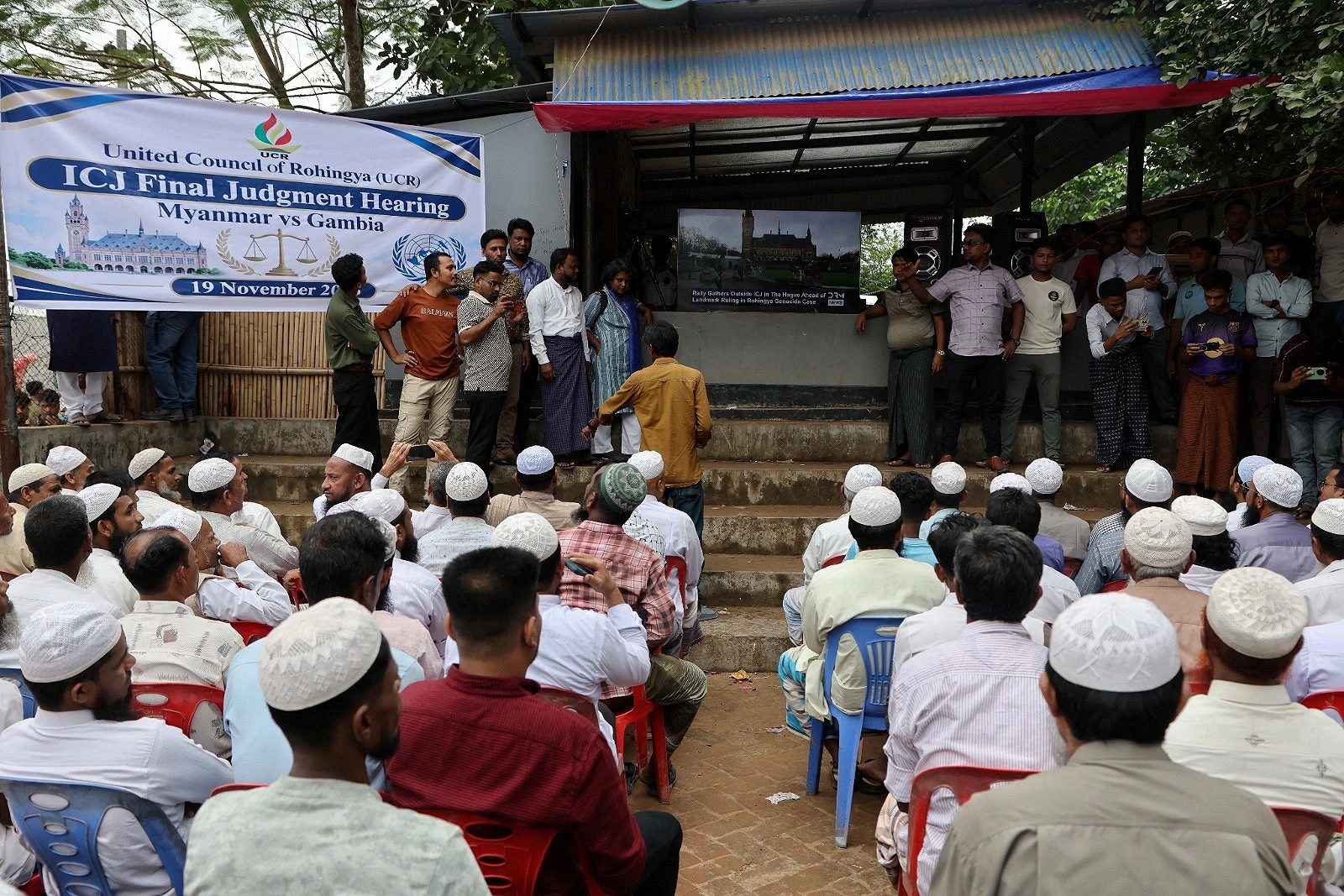
'Justice served to the blood of our relatives'— Rohingyas on Hearing the Verdict

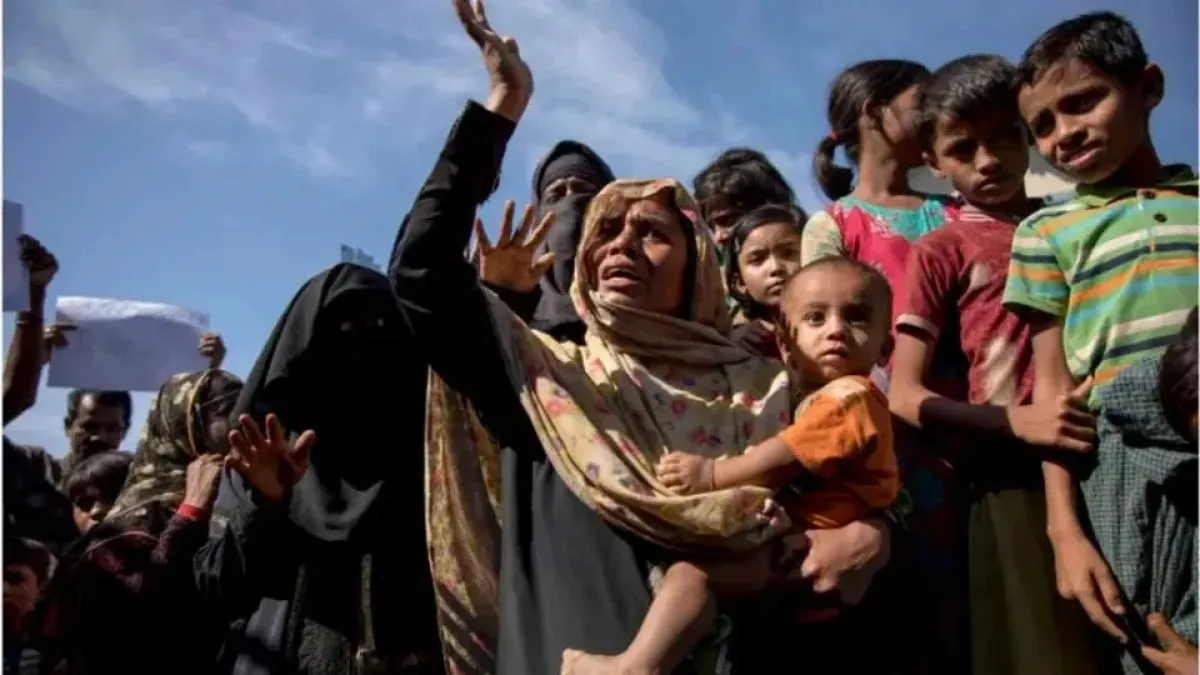
More than 1.3 million Rohingya have taken shelter in Bangladesh. File photo.
It was August 2017. If any Rohingya person closes his or her eyes, he or she can still hear the sounds of gunfire, burning houses and chaos in their homeland of Rakhine, Myanmar.
They clearly can see in their memories the lifeless bodies of loved ones. Some lost their parents, some their children, some their husbands or brothers. Loved ones were killed before their very eyes. Nearly a decade has passed, yet the wounds festering in their hearts have still not healed. Carrying those horrific memories and the grief of losing relatives, at least 1.5 million Rohingyas are spending their days in the refugee camps of Cox's Bazar.
On Thursday (Nov 19), after the International Court of Justice (ICJ) ruled in favour of the genocide allegations against Myanmar, those old wounds seemed to have been stirred again. Relief, emotion, and the hope for long-awaited justice spread through the camps. Many had tears in their eyes. They had one thing to say: "The world has finally heard us. The blood of our relatives has been served with justice."
Rohingyas at a camp hear the ruling that Myanmar legally obliged to take them back. Agamir Somoy photo.
At the Peace Palace in The Hague, Netherlands, ICJ judge Yuji Iwasawa began reading the verdict at 3 pm Bangladesh time on Thursday. The ruling was adopted by a 15-judge court with a 9-6 vote. After seven years of judicial proceedings in the case filed by Gambia, Myanmar was held responsible for genocide against the Rohingyas. With this verdict, the international court held a state responsible for genocide for the first time.
The ruling said that before the 2017 military operation, about 815,000 Rohingyas lived in northern Rakhine State. Myanmar's security forces deliberately carried out violent acts with the intent to destroy a significant portion of them.
'That Night Has Still Not Ended'
Master Abdul Jabbar, a resident of Leda Camp in Teknaf, was asked for his reaction to the verdict. Rummaging through his memories, he said, "That night of 2017 has still not ended. Waking up to the sound of gunfire late at night, people screaming all around, the blazing flames of fire—everything is still vivid in my memory."
According to him, Myanmar soldiers entered the village and opened indiscriminate fire. Houses were set on fire. Many could not survive even though they tried to flee. Some were shot dead before their families' eyes, others were taken away and tortured. Women were subjected to sexual violence. Some fled clutching their children to their chests, others were forced to leave behind their elderly parents. Thousands of families were torn apart in an instant.
Like Abdul Jabbar, Rohingya Saiyad Alam also escaped that horror. He too shared those memories.
According to him, those who survived had no path but to flee the country to save their lives. They had to walk for days on end, crossing hills, jungles, and rivers, to reach Bangladesh. On the way, some lost their relatives, some fell ill from hunger and thirst, and others never reached safe shelter.
Even though they found shelter in Bangladesh, they never got back their lost homes, land, or the good memories of their loved ones. Nearly a decade has passed in the camps of Cox's Bazar. Now, to them, the ICJ verdict is not just a court decision but recognition of justice for the people they lost.
Soldiers Bound Young Women's Hands and Feet and Sexually Abused Them
The memories of those days in '17 are still raw in the eyes of Amin Khatun, a Rohingya woman from Leda Camp. She says she witnessed the persecution of her relatives with her own eyes while living in Maungdaw.
Her allegation is that soldiers took young women away, bound their hands and feet, and sexually abused them. They were later burned to death.
Tears roll down Amin Khatun's eyes as she speaks of those old memories. In a tearful voice, she said, "Many young women among my relatives were taken away and subjected to inhuman torture before my eyes. When I remember these things, my heart breaks. I was mentally devastated for almost a year. The moment I close my eyes, those scenes float before me. We want a proper trial of these tortures and killings. Thousands of women like me have been victims of the same kind of abuse."
On the day the ICJ verdict was announced, that expectation seemed to come to the fore anew. Another camp resident, Saiyadul Amin, said, "This verdict may not bring any big change in life right now. But international recognition of our long-standing suffering is also a big thing."
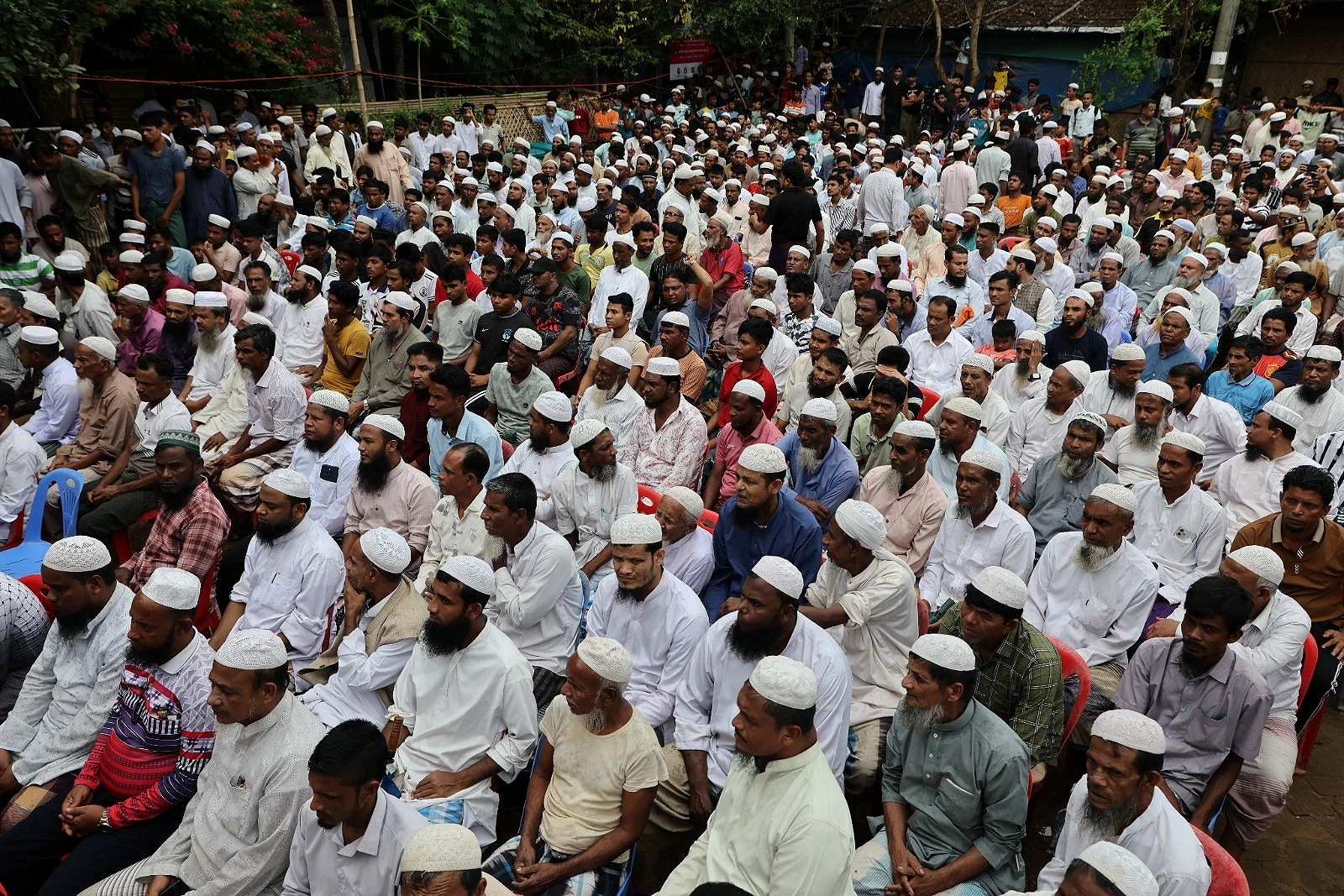
A group of Rohingyas, prior to the ICJ ruling, sitting patiently to hear judgement. Photo: Agamir Somoy.
"The United States has already acknowledged the genocide against the Rohingyas in Myanmar. Now the International Court of Justice's decision is important for them. He hopes that after this verdict, the process of bringing the perpetrators under accountability will move further forward," thinks Rohingya youth Abdul Hafiz.
Rohingya youth Sadia Jahan hopes they will get justice. "The world's influential countries will come together and ensure that the perpetrators are tried under international law."
Rohingya leaders also see the ICJ verdict as international recognition of the persecution and an important opportunity to ensure accountability. In the words of Saeed Ullah, founding president of the United Council of Rohingas (UCR), "We have been waiting for nearly a decade in the hope of justice. The court's decision will bring positive results."
'Moral Pressure to Hold Myanmar Accountable Will Increase'
Mohammad Jubayer, chairman of the Arakan Rohingya Society for Peace and Human Rights, hopes that the court's verdict will strengthen the path toward international recognition of the atrocities committed against the Rohingyas as genocide. At the same time, it will increase moral pressure on UN member states to ensure Myanmar's accountability.
According to him, the biggest part of the Rohingyas' expectations still lies in their homeland. They want to return to Myanmar. But that return is tied to guarantees of security, citizenship, and basic rights.
What Is in the ICJ Verdict
The ICJ verdict gave importance not only to the killings and torture but also to the destruction of evidence of genocide. Judge Yuji said many bodies were burned or removed. Areas where "clearance operations" were carried out were later burned and bulldozed. This obstructed effective investigation into what exactly happened in 2017.
The court's observations also revealed that nearly 10,000 Rohingyas were killed in that operation. There were indiscriminate killings, the separate killing of men, sexual violence, extreme cruelty against children, and the deliberate burning of Rohingya homes. A huge number of Rohingyas were also attacked while fleeing to Bangladesh.
Myanmar must pay compensation for the crimes committed against the Rohingyas. However, the court has not yet determined the amount of compensation. The amount and the method of payment will be determined in subsequent legal proceedings in keeping with the extent of the damage. Myanmar must submit a report on how it will implement the decision to pay compensation within two years of the verdict being announced.
The verdict also noted the failure to investigate, try, and punish those involved in crimes such as genocide, conspiracy to commit genocide, direct and public incitement to commit genocide, attempt to commit genocide, and complicity in genocide. The judge said effective measures were also not taken against military commanders.
'When Will We Go Home' — the Rohingyas' Question
For the Rohingyas, the ICJ verdict is undoubtedly a big recognition. But even after this, one question remains before them: "When will we go home?"
Security analyst Major (retd) Imdadul Islam said Gambia's case is not directly related to the repatriation of the Rohingyas. The case mainly considered whether genocide was committed and whether the necessary measures were taken to stop the genocide.
China and Russia's Vetoes Obstruct Implementation of the Verdict
According to him, the ICJ does not have the power to implement its verdict on its own. Cooperation from the UN Security Council will be needed. There, vetoes by China and Russia could create obstacles to implementation. However, this verdict will play an important role in creating international pressure on Myanmar.
Through this verdict, the long-standing demand of the Rohingyas has been fulfilled, thinks Mohammad Mizanur Rahman, Bangladesh's Refugee Relief and Repatriation Commissioner (RRRC). "International pressure on Myanmar will increase, and moral pressure will be created on UN member states to stand beside the Rohingyas."