


Tk 190 crore spent on repairs, another Tk 100 crore allocated

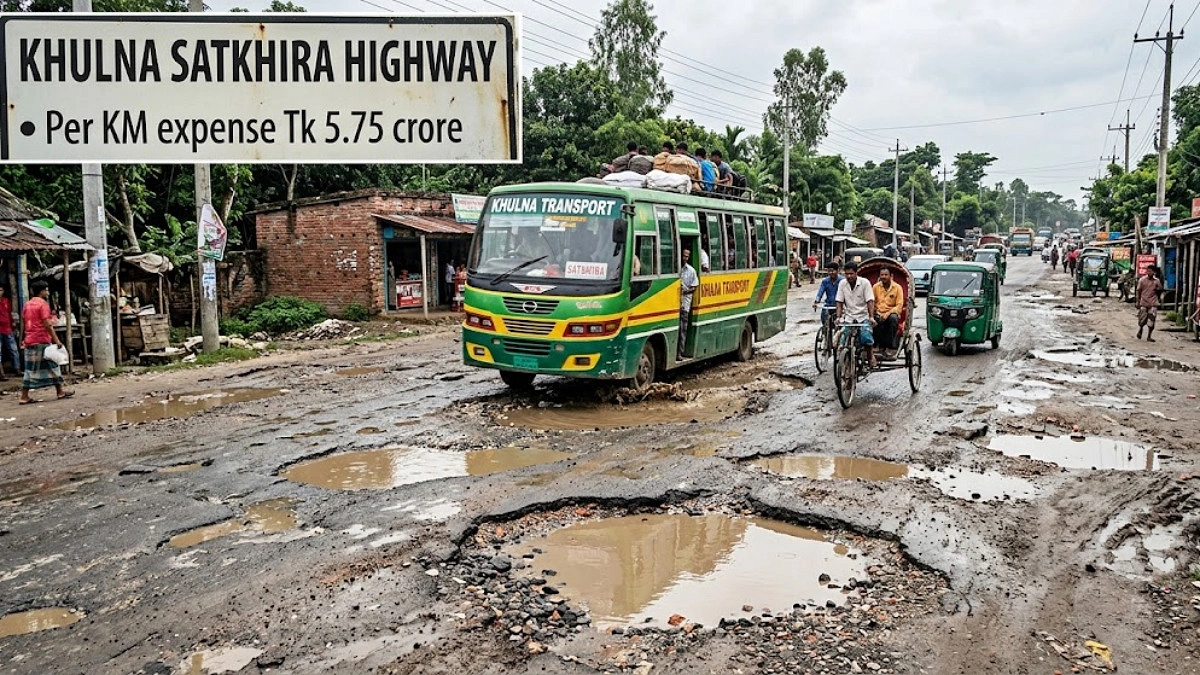
Representational image drawn by AI.
Last year, after the monsoon season, carpeting was done on a 1.5-kilometer stretch of the Khulna-Satkhira highway at a cost of Tk 1.5 crore. However, within a year, potholes and uneven surfaces have appeared in various places on this section, rendering it once again unfit for traffic. This 1.5-kilometer section is not an isolated case; 16 kilometers out of the 33-kilometer highway from Zero Point in Khulna to Atthar Mile are now impassable. This is despite the Roads and Highways Department spending Tk 190 crore on the development and repair of the road just six years ago. Several more crores have been spent on additional repairs in the meantime.
According to RHD sources, between 2018 and 2020, the 33-kilometer Khulna-Satkhira highway up to Atthar Mile was developed and widened to 18-36 feet at a cost of Tk 160 crore. However, within a year of the construction's completion, potholes and unevenness appeared in various sections. Subsequently, the contracting firm, Messrs Mojahar Enterprise, carried out repairs for three years, but the road's condition did not improve. Consequently, the RHD itself carried out eight rounds of repairs at its own cost of Tk 4.21 crore. Additionally, Tk 1.5 crore was spent on carpeting 1.5 kilometers, and Tk 24.25 crore was spent on providing RCC paving for 2.35 kilometers.
According to RHD data, the total expenditure on development and subsequent repairs of the 33-kilometer highway over six years amounts to Tk 189 crore 67 lakh 16 thousand. This translates to an expenditure of approximately Tk 5.75 crore per kilometer.
A field visit revealed that brick soling was laid on the 16-kilometer road section, but it has broken down, creating small and large potholes. In some places, the bitumen has shifted, creating uneven surfaces; large portions have developed wave-like bumps; and in other areas, rainwater has enlarged previous small potholes into craters. Vehicles are forced to move in a bumpy, swaying manner.
According to Fire Service data, 265 road accidents have occurred on this section of the highway in the last four and a half years. These accidents have resulted in 383 injuries and 27 fatalities. Among these, in 2022, 64 accidents caused 107 injuries and 6 deaths. In 2023, 66 accidents led to 108 injuries and 4 deaths. In 2024, 48 accidents resulted in 54 injuries and 8 deaths. In 2025, 53 accidents caused 62 injuries and 7 deaths. Up to July of the current year, 34 accidents have led to 52 injuries and 2 deaths.
Local residents living near the highway allege that substandard materials were used during the reconstruction in 2018-20. Consequently, potholes and swelling appeared in areas like Gutudia and Angardoha right after construction. Because of this, repeated repairs do not last long, resulting in a sheer waste of money.
Firoz, a truck driver on the road, said that the potholes cause the wheels to drop, making the vehicle sway and jolt. The jolts have broken several springs on his truck. Besides, vehicle parts are wearing out quickly, increasing transport costs. Bus driver Osman Sardar mentioned that apart from the suffering of passengers, the broken sections force vehicles to slow down, wasting time. Abdul Kader, an easy-bike driver, stated that due to the broken brick soling, wave-like bumps, and bitumen, it becomes impossible to control the vehicle, and there is immense pressure on it. Drivers try to avoid potholes, often swerving into the wrong lane, leading to head-on collisions and other types of accidents.
Ahmed Musa Ranju, a pedestrian and victim, said he lives in Khulna city with his family but hails from Koyra upazila. While recently going home by motorcycle, he met with accidents four times due to wheels dropping into potholes. He noted that nighttime travel is even more risky.
Regarding the matter, Md. Tanimul Haque, Executive Engineer of the Khulna Roads and Highways Department, said that the target sustainability period after road construction is at least five years. However, the soil or foundation underneath this road is not good. Additionally, the road's load capacity is 27 tons, but trucks carrying 52-ton stones ply on it. These two factors, weak foundation and overloading, have caused the road to deteriorate rapidly. He added that tenders worth Tk 100 crore in four packages have been completed to convert 9 kilometers of the brick soling into RCC paving. Work is expected to begin after the monsoon season.

