
Riverbank erosion devours homes in Khulna

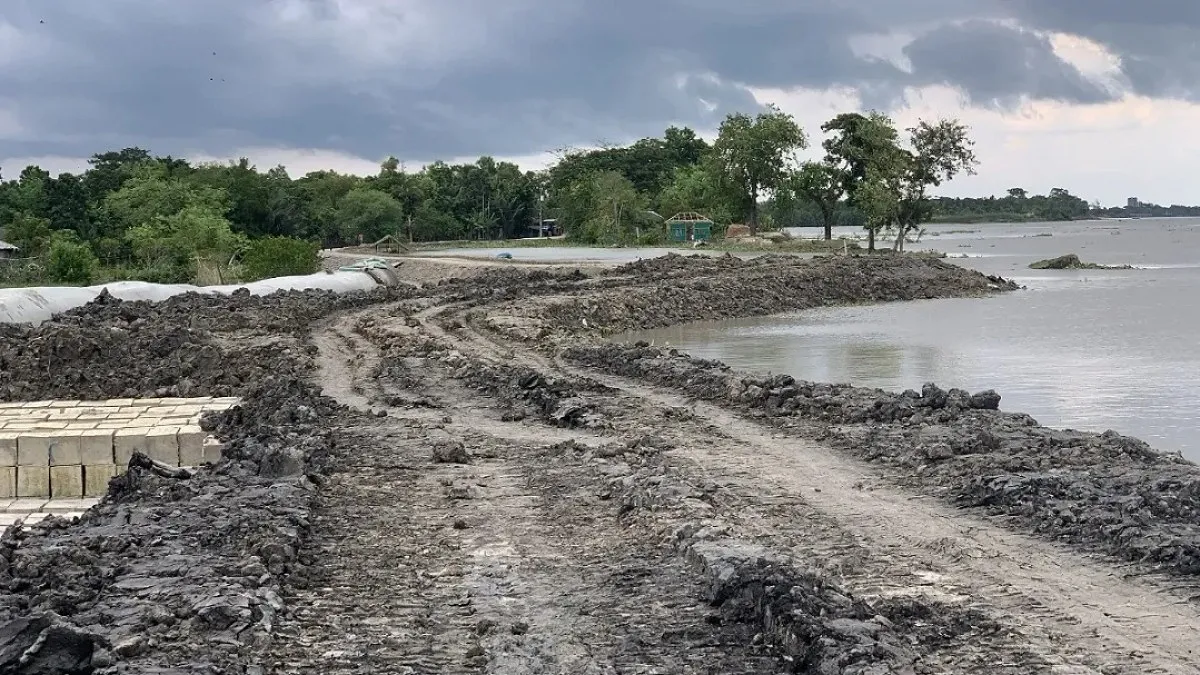
Photo: Agamir Somoy
Riverbank erosion in Dakop, Khulna, is taking a horrific turn day by day. Composed of three separate islands, the erosion caused by rivers such as the Shibsa, Dhaki, Chunkuri, Pashur, Jhapjhapia, and Mangar has become unstoppable.
On one hand due to climate impacts, and on the other hand by falling victim to continuous erosion, locals are losing their assets and properties, becoming destitute, with many families even forced to leave the area after losing everything.
The nine unions and one municipality of the upazila under the Bangladesh Water Development Board (BWDB) are divided into three polders: Polder 31, Polder 32, and Polder 33.
Among these, Polder 31 and its island encompass Chalna Municipality, Pankhali Union, and Tildanga Union. Polder 32 includes Kamarkhola Union and Sutarkhali Union, while Polder 33 includes Bajua Union, Dakop Union, Koilashgon Union, Laudob Union, and Banishanta Union.
Although a new embankment was constructed in Polder 32 and Polder 33 with a loan of Tk 150 crore from the World Bank, erosion has appeared in new areas of these two polders. However, the most vulnerable condition prevails in Chalna Municipality, Pankhali Union, and Tildanga Union under Polder 31, constructed in the 1960s.
In many parts of these areas, embankments have broken and roads have collapsed into the riverbed. Although water has been temporarily contained by placing sand-filled geo-tubes, the vulnerable points still remain unprotected.
On 11 September, the embankment broke in the Batbunia area of Tildanga Union and collapsed into the Dhaki River, instantly rendering seven families homeless. However, thousands of families and crops on nearly 4,000 bighas of agricultural land were saved that time as a ring dam was rapidly constructed using geo-tubes.
Prior to this as well, the embankment broke several times in the Batbunia area, washing away the houses and crop lands of many people into the river.
The same situation prevails at various points in the Khona Molla Bari and Khalisha areas of Pankhali Union. Recently, when the main portion of the embankment in these areas collapsed into the river, a ring dam was built with sand-filled geo-tubes in the Khona area, and an embankment was reconstructed with soil in the Khalisha area.
However, due to erosion, homesteads of ordinary people are sinking into the riverbed. When embankments break, affected individuals are often forced to allow new embankments to be constructed over privately-owned land without receiving any compensation.
Rina Sardar, a resident of the Batbunia area in Tildanga who lost everything to riverbank erosion, said, “I have nothing left; the river swallowed everything. Through several rounds of erosion, all my land went into the river. Now I am staying on someone else's land with my sick husband.”
Liton Molla, a resident of the Khona area in Pankhali, added, “Where our house used to be before is now the middle of the river. There were many families like us, but everything has been lost in the middle of the river. Some moved further inland and built houses, while others left for different areas.”
Dakop Upazila Nirbahi Officer (UNO) Md Borhan Uddin Mitu said dry food and financial assistance of Tk 6,000 were immediately provided to the seven families affected by riverbank erosion in the Batbunia area on behalf of the upazila administration.
However, taking any major measure immediately is not possible as there is no adequate allocation for the permanent rehabilitation of those affected by riverbank erosion.
He added that the overall situation in the erosion-affected areas is being regularly monitored, and regular communication is being maintained with the Water Development Board to take rapid preventive measures at vulnerable points.
Khulna Water Development Board Division-2 Executive Engineer Rashidur Rahman noted that vulnerable sections are being identified, and emergency work involving geo-tubes and embankment repairs is underway.
A permanent project has been proposed to prevent riverbank erosion, and construction work on permanent embankments will begin rapidly once allocations are received.
