Tk 3,000 crore spent annually to stop mosquitoes from biting people

Graphics: Agamir Somoy
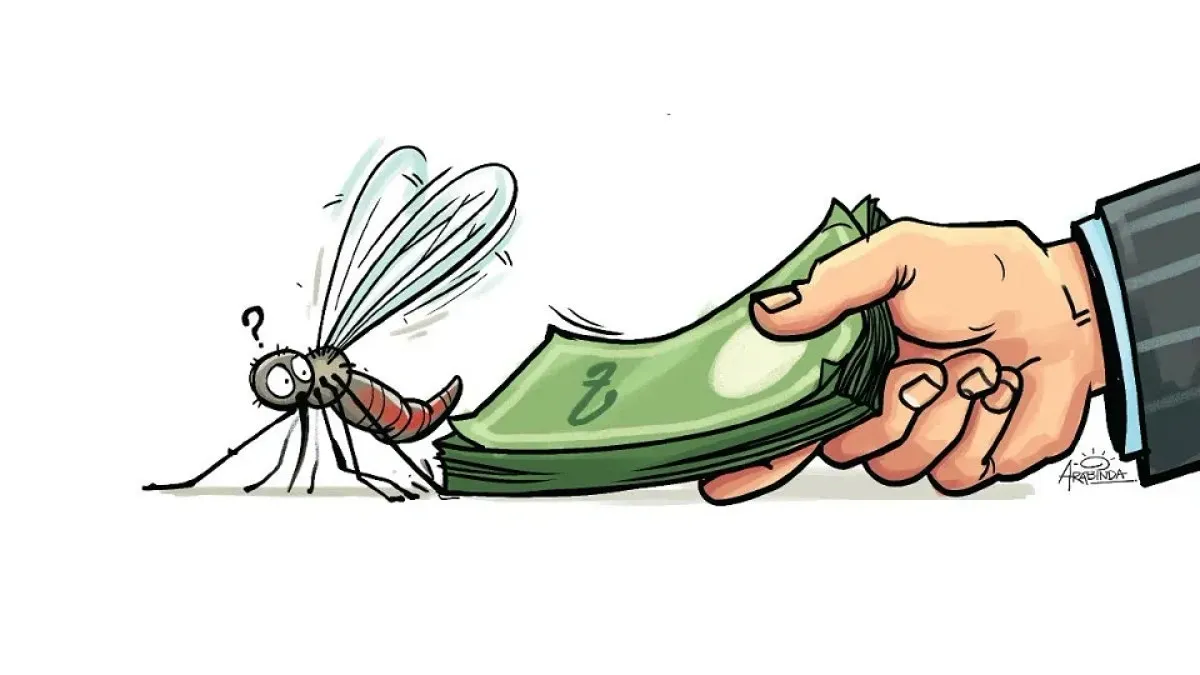
A tiny insect—its name is the mosquito. Just think, to protect people from its bites, the government and citizens of this country spend Tk 3,000 crore every year! To protect themselves from mosquito bites, this money is spent on buying coils, mosquito nets, aerosols, electric bats, vaporizers, and creams, and on treatment. Even so, people are not getting relief from mosquito bites. Up to November 24 of the current year, 176,000 people have been admitted to government and private hospitals across the country after being infected with dengue from mosquito bites. A total of 524 people have died.
Experts say that due to the failure of government institutions to kill mosquitoes, huge amounts of money are being spent from ordinary people's pockets. On the other hand, excessive reliance on chemical-based products is creating health risks. They advise following the efforts of countries that have been successful in controlling mosquitoes and mosquito-borne diseases.
About Tk 5,000 crore worth of chemicals are imported into the country annually, which are used as raw materials for products made for pesticides in agriculture and mosquito control. Among these, the annual market for locally made coils is about Tk 1,600 crore, the market for aerosols, vaporizers, and creams to protect against mosquito bites is Tk 400 crore, the market for mosquito nets is Tk 200 crore, and the market for mosquito bats is Tk 61 crore. Beyond this, people spend about Tk 700 crore on medical expenses. That is, every year people spend Tk 2,961 crore from their pockets. In contrast, the country's 12 city corporations spent Tk 138.50 crore on mosquito control in the last fiscal year (2025-26). Of this, about Tk 120 crore was spent by the two cities of Dhaka. The remaining 10 city corporations spent about Tk 19 crore. This year, the city corporations have allocated Tk 237 crore for this sector.
This calculation of the huge amount of money spent on the tiny but deadly harmful insect—the mosquito—was obtained by analyzing the budgets of city corporations, audited financial reports of domestic and multinational companies, the pesticide registration list of the Department of Agricultural Extension, accounts of traders' associations, Chittagong Customs House and United Nations trade statistics (UN Comtrade), and research papers published in international journals.
Tk 1,500 crore goes to the coil market alone
Munni Akter, a housewife from Banshkhali in Chittagong, said she uses one coil every day to protect herself and her children from mosquito bites. If a mosquito net is used in summer, the fan's air does not reach the body. So during this time, they have to rely entirely on coils. In winter, her family uses mosquito nets.
Research by the Faculty of Pharmacy of Dhaka University shows that 51 percent of people in rural areas regularly use coils. Due to laziness, they do not put up mosquito nets. Because they are easily available and cheap, coils are popular among them. Kamrul Hasan, president of the Bangladesh Mosquito Coil Manufacturers Association, said, "The annual market for coils is Tk 1,500 to 1,600 crore."
After coils, there is a large market for liquid vaporizers, aerosols, and creams. According to the audited consolidated financial report of India's Godrej Consumer Products Limited for the 2025-26 fiscal year, its associate company in Bangladesh, "Godrej Household Products (Bangladesh) Private Limited," did business worth 191.40 crore Indian rupees, or about Tk 248.57 crore, annually. The company's main source of revenue was household insect control products, including "Goodnight" liquid vaporizers.
On the other hand, according to the accounts of ACI Formulations PLC, listed on the stock market, for the 2025-26 fiscal year, they sold about Tk 80 crore worth of aerosols annually. In addition, according to the financial report of multinational company Reckitt Benckiser Bangladesh and an analysis by BRAC EPL, the company earned Tk 524 crore from the "Household and Toiletries" sector. Among these are the coil, aerosol, and vaporizer of the mosquito repellent brand "Mortein." Beyond this, Square Toiletries' "Xpel" aerosol also has a large market. Traders in this sector said the annual market for aerosols and liquid vaporizers in the country is Tk 400 crore.
An analysis of import data from across the country obtained from Chittagong Customs House shows that in the 2025-26 fiscal year, 870,349 electric mosquito bats were imported into the country. And up to November 24 of the current 2026-27 fiscal year, another 334,689 bats were imported. Hridoy Karmakar, a salesperson at RFL Best Buy in Ashkardighirpar in Chittagong city, said the price of their own brand's bat is Tk 630 and the price of bats brought from China is Tk 1,020. At an average retail market price of Tk 700, the annual market value of only imported bats is about Tk 61 crore. Beyond this, there is also a separate market for bats assembled in the country by importing parts.
Beyond this, about Tk 200 crore worth of mosquito nets are sold in the country annually. Most of the country's mosquito net factories are in Rupganj, Narayanganj. Golam Rahman, managing director of Anik Composite Mills Limited there, said about Tk 800 crore worth of mosquito nets are produced in the country annually. Three-fourths of that is exported. The remaining one-fourth is sold in the domestic market.
80 percent of the coil market is held by unbranded and illegal factories
According to the registration list of the Department of Agricultural Extension, among the 6,875 registered pesticides in the country, there are 817 registered products in the public health sector (PHP). Among these are mosquito coils, aerosols, liquid vaporizers, larvicides, and adulticides. However, although the number of members of the coil manufacturers' association is 1,700, the total number of registered products in the public health sector is less than half of that. Again, there are only 224 institutions with BSTI licenses. A large portion of the members are producing coils without licenses.
Due to the mosquito menace, affected people are becoming increasingly dependent on these chemical-based products day by day. Various health risks are being created by using these products. Among these, the use of substandard coils is increasing health risks the most. ACI mentioned in its annual report, "Currently, 80 percent of the market has gone into the hands of unbranded local coils. As a result, top brands are being forced to withdraw their operations from the market." Research by the Faculty of Pharmacy of Dhaka University shows that people immediately suffer from several problems due to the use of coils. Among these are breathing difficulties, eye irritation, allergies, asthma, sneezing, and headaches. Researchers have said that long-term use of coils creates the risk of various respiratory diseases, cardiovascular diseases, and serious risks such as lung cancer.
When asked, Md. Ala Uddin Hossain, Director (CM) of BSTI, said, "There is no scope for producing coils without a license. Those who are producing are illegal. Factories are being shut down through raids."
About Tk 700 crore spent on dengue treatment in 11 months
A joint study by the Bangladesh Institute of Development Studies (BIDS) and the Health Economics Unit of the Ministry of Health shows that the direct out-of-pocket expense for a family for the treatment of a dengue patient admitted to a hospital averages US$ 316.51. At the current exchange rate, that is Tk 39,485. Of this, an average of Tk 24,255 is spent at government hospitals and Tk 57,345 at private hospitals. According to the Health Directorate, up to November 24 of the current year, 176,000 patients have been admitted to hospitals. In just 11 months, the families of dengue patients admitted to hospitals have had to pay about Tk 695 crore directly.
The study, titled "Economic Burden of Dengue in Urban Bangladesh: A Societal Perspective," was published in the international journal PLOS Neglected Tropical Diseases. It said that if someone is infected with dengue, the treatment cost for a family amounts to 56 percent of their monthly income. However, for the poorest families, this cost exceeds 139 percent of their monthly income. To meet this extra cost of treatment, 48 percent of families have to borrow money, and about 42 percent of families have to use their savings.
What successful countries are doing to control mosquito-borne diseases
Among the countries successful in mosquito control are Singapore, Brazil, China, Sri Lanka, and Malaysia. They did not just spray insecticides; instead, they chose biotechnology, surveillance, and inter-ministerial coordination. Singapore's National Environment Agency (NEA) has reduced the risk of dengue infection by 72 percent through the release of sterile male Aedes mosquitoes carrying Wolbachia bacteria and weekly cleanliness campaigns. Brazil has also achieved success by applying the same biological method. In the city of Belo Horizonte, application of this method reduced dengue infection by 68.5 percent and chikungunya infection by 73.3 percent. China launched a time-bound "1-3-7 formula" coordinated across 13 ministries, and Sri Lanka eliminated malaria by appointing entomologists in every district and screening passengers at ports, earning certification from the World Health Organization (WHO). And in Malaysia, implementation of the "Combi" model with the involvement of local residents brought the Aedes larval index down from 5 to 0.96. The World Health Organization's "Global Vector Control Response" report also speaks of reducing reliance on insecticides and of coordination among multiple departments, surveillance, and citizen participation.
Public health entomologist and Professor Dr. Kabirul Bashar of the Department of Zoology at Jahangirnagar University said, "Success is not coming from applying only chemical methods. This has been proven by various data and information. To control mosquitoes and mosquito-borne diseases, scientifically based integrated initiatives must be taken separately for Aedes and Culex mosquitoes. Otherwise, success will not come in any way."
However, Md. Sarful Islam Mahi, Malaria and Mosquito Control Officer of Chittagong City Corporation, said, "Instead of applying chemicals on a random basis, hotspots are being identified and medicine is being applied there. Beyond this, BTI biotechnology is being used for mosquito control."