
‘Golden egg laying goose’ served to foreigners
- Local businesspeople regret Chattogram Port concession agreements
- Strategy to protect foreign investment
- Will connect Bangladesh with the global economy
- Net profit exceeded Tk 3,500 crore last year

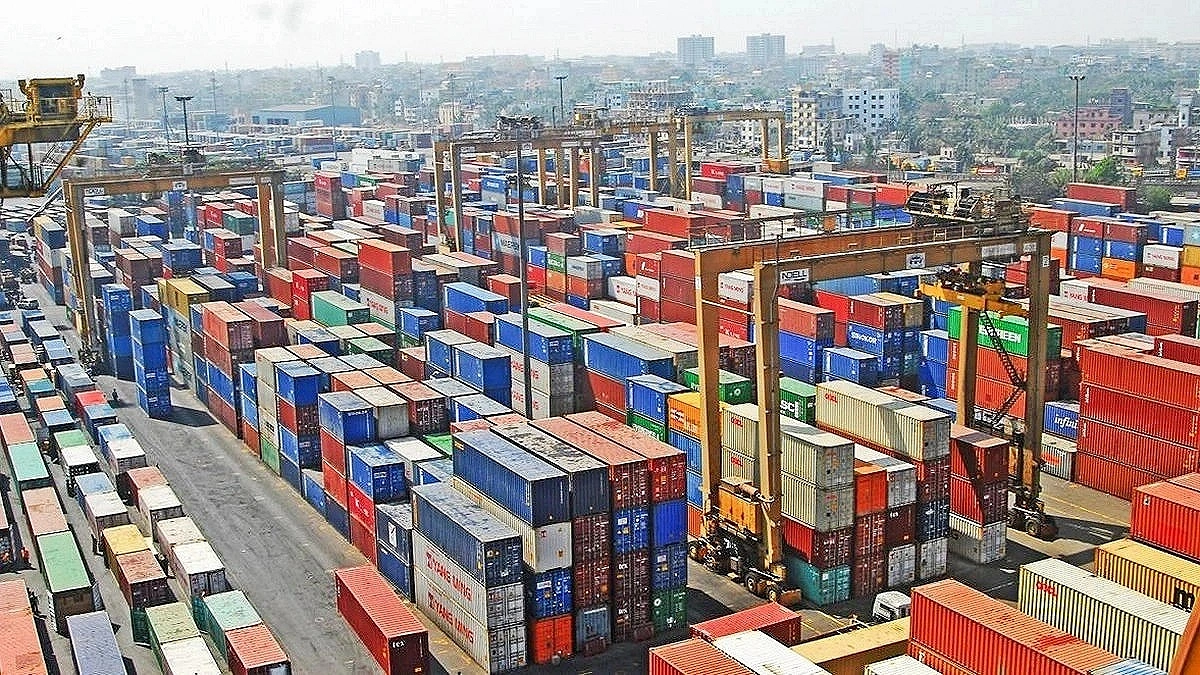
Photo: Agamir Somoy
The issue of concession agreements has become a major topic of discussion among leading importers and exporters, shipping businesses and various port users in the country. Such agreements have never been discussed in this way before. In import dependent Bangladesh, concession agreements have emerged around the movement of ocean-going vessels and the use of port terminals. Foreign operators will handle at least 70 percent of the 140 million tonnes of goods moved annually. The agreements being signed with them are known as concession agreements. In other words, granting a foreign company the right to operate, develop and conduct business using government property and infrastructure under specific conditions is called a concession agreement. Such agreements are a strategy to protect foreign investors. The main issue in the terms of the agreements is maintaining confidentiality.
The question is, 93 percent of Bangladesh’s import and export trade was conducted through this 138-year-old port for the country’s population of 180 million. It is a matter of pride and hope that this work was successfully carried out for so long by locally developed operators and skilled officials and employees. Why was there suddenly a need 55 years after independence to hand over the ‘golden egg laying goose’ to foreigners? The reason for describing it as a golden egg laying goose is that Chattogram Port earned more than Tk 3,500 crore in net profit last year. One businessman who has been involved in port-based business for generations expressed regret and said there is no project as profitable as the port in the hands of the Bangladesh government. Yet it is now being handed over to foreigners. This is a total loss.
During the Awami League government, the Patenga Container Terminal (PCT) was leased to Saudi Arabia based Red Sea Gateway Terminal for 22 years under a concession agreement. The current BNP government has leased the New Mooring Container Terminal (NCT) to UAE based DP World for 15 years under the same formula. The Chittagong Container Terminal (CCT) is located beside it. It is also heading toward the same fate. This means that all 3.4 million containers handled through Chattogram Port each year will now be handled by foreign companies. The General Cargo Berth, known as GCB, is the only one remaining. It is also reported that the process of leasing it to foreigners is underway.
The PCT was handed over through the first agreement during the Awami League era. The NCT agreement was also nearly finalized by that government. During the interim government led by Dr. Yunus, the process was accelerated and given its final form. Ashik Bin Imran, who was involved in the process during the Yunus government, is still working from an influential position under the elected political government. Such preference for foreigners has been observed under three governments over the past two and a half years. None of them took the concerns of domestic operators and investors into consideration. It also appears mysterious why they did not. During the Awami League era, then Prime Minister’s Private Industry and Investment Adviser Salman F Rahman and Sheikh Hasina’s relative Sheikh Hafizur Rahman were actively involved in playing major roles in such concession agreements.
Many port users know quite well what is behind such secret agreements. Who is involved where and, in whose interests, and who has benefited and how are now open secrets. It is also being strongly discussed how the BNP government, which stands at the opposite end from the Awami League in terms of policy, strategy and ideology, also became involved in this process. But no one wants to make a clear statement. Chittagong Chamber President Amirul Haque said in a careful manner, “Only Allah knows what is happening. Since 2013, it does not seem that the governments have had any mercy or compassion.”
Ahsan Iqbal Chowdhury Abir, managing director of leading shipping company Continental Group, said, “Is the dream of turning Chattogram into Singapore that is being talked about actually possible? Even neighboring Malaysia could not become Singapore despite making so many efforts. There is only one Singapore in the world. A medium sized mother vessel has a container capacity of 15,000 to 20,000. A mother vessel with that capacity will never come to Chattogram. Because only 60,000 containers leave Chattogram for foreign countries in an entire month.”
A senior level port user who did not want to be named said it needs to be investigated whether a third party is taking advantage by showing the government dreams and misleading it. This is because control of the entire port is going to foreigners. No one remembered the capabilities and contributions of those who have operated the port in the country for so long. If there had been open competition, there would have been an opportunity to assess the capabilities of domestic companies against foreign ones. And to attract foreign investment, greenfield projects such as the Bay Terminal would have been the best opportunity. Instead, a “ready made meal” equipped with modern equipment worth thousands of crores and built with port funds has been served to foreigners.
Some have also presented arguments in favor of leasing the port to foreigners. How port efficiency will increase and how technological development will take place are very important to them. They believe these foreign operators will connect Bangladesh with the global economy. Amid the current economic crisis, the port is facing the prospect of attracting massive foreign investment. Who should get it and who will benefit is not something businesspeople should decide. Selim Rahman, first vice president of BGMEA and managing director of KDS Group, said, “Increase the service. Reduce the vessel turnaround time. Ensure port efficiency. Whether the additional fees you charge are consistent with those of international standard ports. Whether the operator managing the port is domestic or foreign will not be a consideration for us at that point. At Colombo Port in Sri Lanka, goods are unloaded and the vessel leaves within 48 hours. It takes four days at our port.”
Thirteen private companies have been working at the port since the beginning. Many of them offered the government proposals to operate NCT and CCT at competitive rates against foreign companies. They also expressed interest in participating in open tenders with foreign companies and demonstrating their capabilities. However, instead of responding to the proposals from domestic companies, the government leased the port to foreigners through concession agreements.
The current growth rate of container handling at Chattogram Port is 4.5 percent. The largest development work, such as the NCT, was completed in 2007. The highest growth in cargo handling was around 2012 to 2013 when it was approximately 12 percent.
