
Materbari business hub in discussion during the Prime Minister's Japan visit

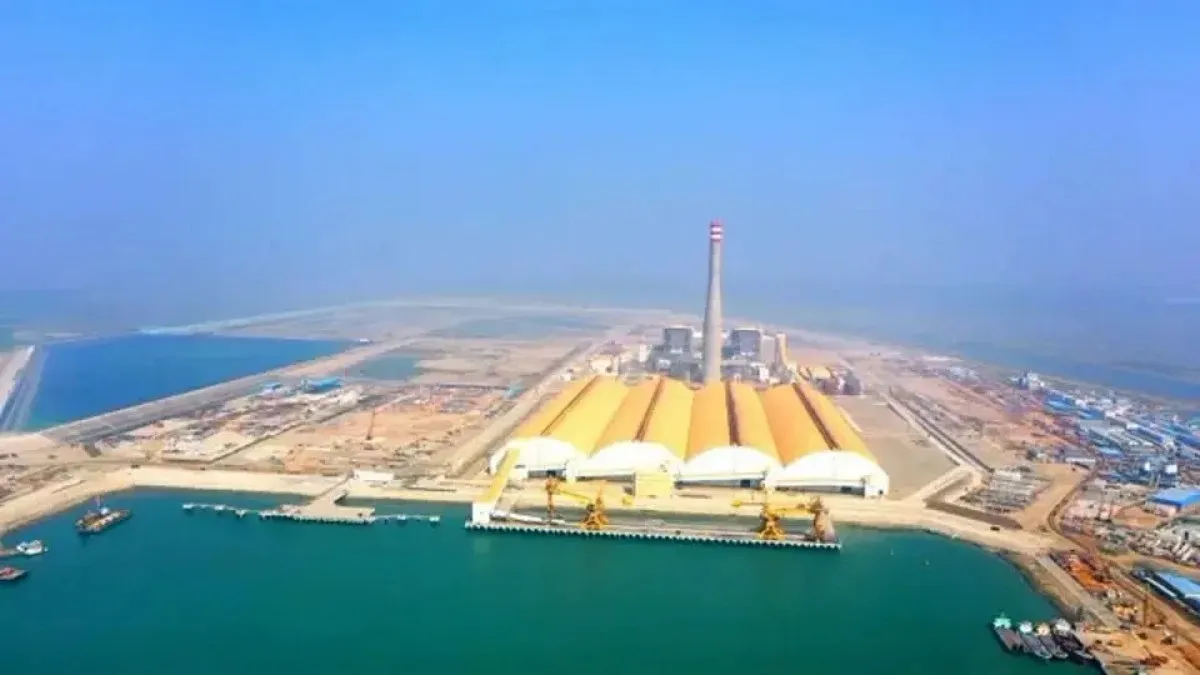
Photo: Agamir Somoy
Prime Minister Tarique Rahman is flying to Japan with a whole lot of investment proposals that could uplift the economy of this country.
This is not merely an ordinary state visit. It is a historic journey to turn the country's economy around. At the center of the visit is the maritime belt of Chattogram and Cox's Bazar. More specifically, Matarbari and Maheshkhali. If Japan's massive investment is secured, one of the largest industrial and logistics hubs in South Asia will be built here. The picture of the entire region from Chattogram to Cox's Bazar will change centering on the country's first Matarbari deep-sea port. Such is the expectation.
During the Prime Minister's visit, Bangladesh is going to propose to Japan a strategic investment and cooperation package of a total of 14 billion US dollars, or about 2.2 trillion yen. Calculated at 125 taka per dollar, the amount stands at about 1 lakh 75 thousand crore taka in Bangladeshi currency.
According to an internal report of the Economic Relations Division (ERD), this money will be sought for 12 priority sectors for the 2026 to 2031 period. Among these, the largest allocation is being sought for the communication and urban infrastructure sector, amounting to 3.45 billion dollars or about 43,125 crore taka. The second highest, 3.14 billion dollars or 39,250 crore taka, has been proposed for the direct Maheshkhali-Matarbari Integrated Infrastructure Development Initiative (MIDI) and the port hub.
Besides, there will be investment proposals of 2.2 billion dollars for the energy and climate sector, 1.57 billion dollars for manufacturing, semiconductors, and the automobile sector, and 1.22 billion dollars for agriculture, the blue economy, and the tourism sector.
The main focus of PM's Tokyo visit is not limited to seeking conventional loans only. This time, alongside official development assistance (ODA), the government is giving the most importance to direct Japanese private investment and public-private partnerships (PPP). One of the main agendas of the visit is to further energize the Bay of Bengal Industrial Growth Belt, or "Big-B" 2.0 framework. Under it, Dhaka, Chattogram, and Cox's Bazar will be tied into a single industrial and logistics corridor.
First, transforming the Matarbari deep-sea port into a full-fledged logistics hub. Second, building an uninterrupted energy hub in Maheshkhali. Third, creating a special economic zone for Japanese investors. Heavy industries such as automobiles, semiconductors, and shipbuilding will be built there. Besides, upgrading the Chattogram-Cox's Bazar highway to six lanes is also a major goal.
Chattogram Chamber President Mohammad Amirul Haque says, "Becoming a regional logistics hub will be a major progress for Chattogram through ensuring Japanese investment. This is a farsighted decision by the government. Its success can be ensured by providing services to all our neighbors."
Why is the government focusing on Matarbari-Maheshkhali?
Because of its geographical location and depth. This point of the Bay of Bengal is very close to international trade routes. The draft or depth here is more than 18 meters, which is ideal for berthing large ships or mother vessels. Ships deeper than 10 meters cannot berth at Chattogram port.
On the other hand, why is Japan so interested? The answer lies in Japan's "Free and Open Indo-Pacific" policy. Japan wants to increase its geopolitical and commercial control in the Bay of Bengal. Matarbari is the main foundation of their "Big-B" master plan. To counter China's influence and secure their own supply chain in Asia, Japan has no better alternative than Matarbari.
Japan has already poured huge amounts of money into this region.
Construction work on a deep-sea port at Matarbari is underway with funding from JICA. Japan also has investments of thousands of crores of taka in building a 1,200-megawatt power plant there. They are also working on port channel dredging and connecting road construction. Altogether, Japan's current investment in projects centered on Matarbari and Maheshkhali alone is more than about 5 to 6 billion dollars. If the new 14 billion dollar investment is secured, it will surpass all past records.
Industrialists and businesspeople believe that if this massive investment is secured, a magic will happen in Bangladesh's economy. First, the cost and time of imports and exports will be nearly halved. Our long-standing dependence on Singapore or Colombo ports will decrease. Mother vessels or huge ships will be able to berth directly at the Matarbari deep-sea port. This will save thousands of crores of taka in financial losses annually. There will be new employment for lakhs of people. This hub alone will contribute at least 3 percent additional to the country's GDP growth.
Matarbari will be a game-changer not just for Bangladesh but for the entire region. India's landlocked northeastern region, or the "Seven Sisters," will easily gain access to the sea using this port. This will greatly reduce their cargo transport costs. A direct ship feeder network will develop between Matarbari and Myanmar's Yangon port. Even China's Kunming province will be able to reap the benefits of this logistics hub through Myanmar. Matarbari will become the main transshipment hub of all of South and Southeast Asia. Bangladesh will become the center of regional trade.
To transform the Chattogram and Cox's Bazar region into a full-fledged global hub, the government has drawn up a multi-pronged connectivity plan. As part of this, it will seek 3.831 billion yen, or about 320 crore taka, from Japan to design the upgrading of the Chattogram-Cox's Bazar highway to six lanes.
Besides, there is also a proposal to build a modern bridge over the Cox's Bazar-Maheshkhali channel to connect Maheshkhali island directly with the mainland. In essence, the government wants to ensure that a vast area from Cox's Bazar Sadar through Maheshkhali, Chakaria, Pekua, Anwara, and Banshkhali to Chattogram benefits from this hub.
In other words, the entire coastal region from Chattogram to Cox's Bazar will turn into a vast industrial corridor. A marine drive and dedicated freight corridor will be built from the Mirsarai Economic Zone to Matarbari. This entire transformation will not take very long. Once the port is fully operational, this region will become a business logistics hub.
An economist at Chattogram University said the government must not be one-sided or lean to one side regarding the Bay of Bengal. There is a big danger in that. Whether the hub succeeds will depend on the government's prudent geopolitical strategic decisions.
