
Karnaphuli Tunnel Project: Tk 50 cr embezzled without planting trees

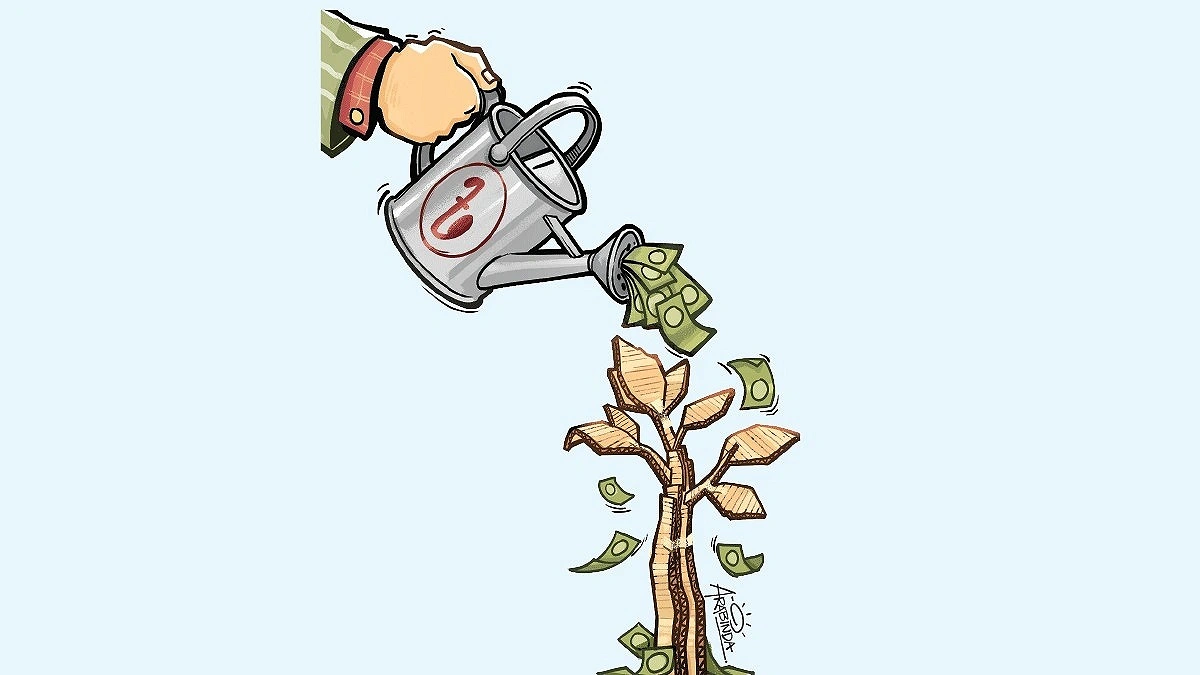
Graphics: Agamir Somoy
Karnaphuli Tunnel Project planned trees across 78 spots, but the contractor billed Tk 49.36 crore against a Tk 19.65 lakh budget - 251 times the estimate - without planting any trees until an audit caught him.
An Agamir Somoy reporter inspected two of the 78 spots, finding 226 trees - mostly bottle palm and Ixora (Rangan) - at two spots on the Patenga end. According to the Bangladesh Bridge Authority, spending on planting trees in these two spots alone reached Tk 1,26,56,000 making the average cost per sapling Tk 56,000.
Bangladesh Bridge Authority Executive Director and Bridges Division Secretary Mohammad Abudur Rouf told Agamir Somoy, “How much money was spent on planting trees and whether the money taken by the contractor was justified cannot be said without looking at the documents. The matter is under investigation. A case has also been filed in the ACC. Work is also ongoing regarding the IMED report.”
For the trees that were planted, the retail market price ranges between Tk 100 and Tk 300, while bottle palm is somewhat more expensive, reaching a maximum online price of Tk 1,500.
Mohammad Tauhid of Sabuj Mela Nursery in Muradpur and Mohammad Jamal Uddin of Bonofool Nursery in Dewanhat said Orange Jasmine sells for Tk 100-150, Thuja for Tk 200-250, Bougainvillea for Tk 100-150, Mango for Tk 200-250, and Litchi and Jam for Tk 250-300.
Inquiries across six nurseries in the city failed to turn up the bottle palms planted at the tunnel, although an online page named “Bonayon” sells them for Tk 1,500.
Office of the Controller General of Accounts (CGA) raised an audit objection regarding showing expenditures without planting trees. The Implementation Monitoring and Evaluation Division (IMED) of the Ministry of Planning categorized this as an “alarming and serious financial irregularity”.
Although IMED recommended conducting an on-site verification and survey at the project’s conclusion to evaluate tree count, species, and survival rate, the Bridge Authority failed to do so and is only planting 19,180 new saplings following the audit objection.
The tree plantation consultant Kamal Hossain of the Institute of Forestry and Environmental Sciences at University of Chittagong told Agamir Somoy, “Before the tree planting, project officials took my advice. I also provided design layouts showing where and what trees to plant. But they did not plant trees according to the design. Although I gave a design for planting 23 species of trees, they rushed to plant some trees right before the inauguration just to discharge their duty.”
Asian Development Bank (ADB) Senior Procurement Specialist and Bangladesh Public Procurement Authority former director general Amulya Kumar Debnath said, “Where is the space there to plant so many trees? Under an EPC Turnkey contract, money cannot be withdrawn without doing the work.
“It is the responsibility of those associated with the project to ensure whether work has been done according to the allocated money. If they disburse money without doing so, they cannot escape this responsibility. They are supposed to sign the bill only after accepting the work. Otherwise, irregularity has definitely occurred here.”
Karnaphuli Tunnel Site Office Superintending Engineer and Deputy Project Director Abul Kalam Azad said, “There is an audit objection regarding this. It has not been resolved yet. Therefore, I do not want to make any comment.”
However, a project-related official added that because this was an EPC Turnkey project under the G2G method, there was a one-time fixed allocation for trees, and money was disbursed to the Chinese contractor accordingly. Statements were sought via email from Pang Ming, chief representative of China Communications Construction Company (CCCC) in Bangladesh, but no response was received by 8 pm on Sunday.
Approved by ECNEC in 2015, the tunnel project under the Karnaphuli River opened to traffic following its inauguration on 28 October 2023. The tunnel was constructed by the CCCC at Tk 10,690 crore under the G2G method.
In 2013, CCCC and Arup JV submitted a feasibility study report containing an outline for tree cutting and planting within its environmental impact and rehabilitation action plan, specifying that 780 trees would be cut for the tunnel and connecting roads, including 66 in Patenga and 714 in Anwara.
The feasibility study report budgeted Tk 19.65 lakh for tree compensation and new planting - comprising Tk 12,07,950 for tree compensation, Tk 6,30,600 for the timber value of fruit trees, and Tk 1,26,500 for sapling planting - and mentioned afforestation with local trees and shrubs along the alignment to mitigate noise pollution.
However, the CGA alleged an expenditure of Tk 49,36,46,465 without planting trees, labeling it a Serious Financial Irregularity (SFI) that caused immense financial loss to the project.
On 30 June, the IMED published an impact evaluation report on the Karnaphuli Tunnel Project, calling the situation alarming and pointing out that an expenditure of Tk 49.36 crore was shown in the 2022-23 fiscal year without planting trees.
This expenditure was not mentioned in either the Revised Project Proposal (RDPP) or the Project Completion Report (PCR), leading IMED to classify spending in an unlisted sector as a serious irregularity.
While inspecting procurement activities, trees including Orange Jasmine, Thuja, Bougainvillea, Mango, Litchi, and Jackfruit were found across 78 locations at the Patenga end, including the weigh scale, administrative building, toll plaza complex, and connecting roads. However, because the implementation agreement lacked a Bill of Quantities (BOQ) for tree planting, IMED could not verify the target versus actual tree count.
The report attributed the expenditure to structural weaknesses in the contract, which was executed on a G2G basis under the EPC Turnkey method without a separate BOQ for tree planting and landscaping.
As a result, neither the quantity, species, nor unit price of trees was defined, creating an opportunity to withdraw funds for the entire sector after planting only a handful of trees.
