
Myanmar must take back Rohingya: Khalilur

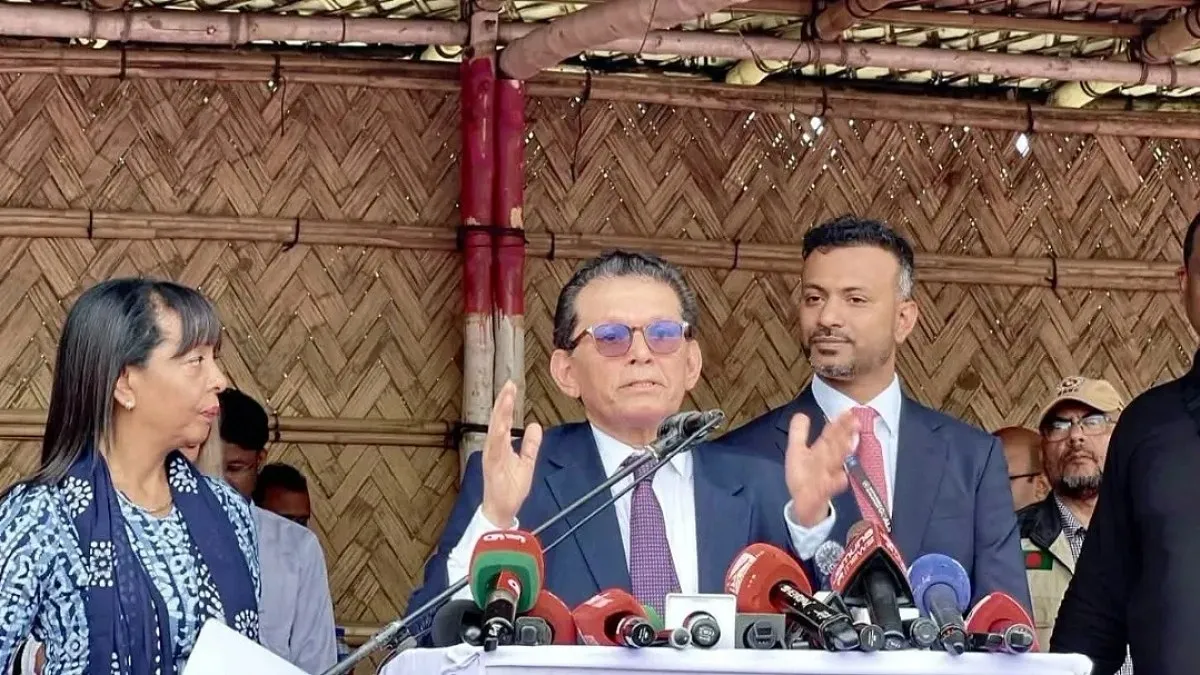
Photo: Agamir Somoy
Foreign Minister Khalilur Rahman has called for the implementation of the historic verdict of the International Court of Justice (ICJ) regarding the genocide committed against the Rohingya in Myanmar.
He said the Rohingya must be taken back to their own country. However, before repatriation, their security and citizenship must be ensured, protection from discrimination must be provided, and freedom of movement must also be guaranteed.
On Friday morning, Khalilur visited Rohingya Shelter Camp 4 in Ukhiya, Cox’s Bazar. Later, around 9:30 am, he delivered a speech to the Rohingya gathered at the camp’s football ground. More than 20,000 Rohingya were present on that ground, with many holding placards bearing demands for justice, citizenship, and repatriation.
Visiting the shelter camp the day after the ICJ verdict in the genocide case against Myanmar, he added that the court’s verdict must not remain merely on paper, but its implementation must be ensured. On Thursday, the ICJ delivered a historic verdict in The Hague, Netherlands, in the Gambia vs Myanmar case, marking an important event in the history of the court.
Highlighting the court’s observations, Khalilur noted that the judges identified the events committed against the Rohingya in 2017 as genocide. They found evidence of planned killings, widespread sexual violence, attacks on women and children, and the destruction of Rohingya villages by Myanmar’s security forces, noting evidence of the killing of at least 10,000 people.
Highlighting the importance of the identity of the Rohingya, he said the court recognized them as a distinct ethnic group whose connection with Myanmar spans many generations, making the verdict vital for recognizing the identity and history of the Rohingya.
He remarked, “No verdict can bring back those who were killed or heal all wounds. However, the recognition of the truth is the beginning of justice. The longstanding experience and testimony of the Rohingya have been reflected in the international judicial process through this verdict.”
Khalilur emphasized four key issues to ensure the implementation of the ICJ verdict and justice for the Rohingya. First, Myanmar must take effective measures to ensure the investigation, trial, and punishment of individuals against whom there is reasonable suspicion of involvement in prohibited crimes under the Genocide Convention, while addressing deficiencies in national laws and carrying out necessary legal and institutional reforms to prevent recurrence.
Second, the safe, voluntary, and dignified repatriation of displaced Rohingya must be ensured, without returning anyone into danger. Prior to repatriation, citizenship, security, protection from discrimination, and freedom of movement must be guaranteed, along with reuniting separated families, restoring lost homes, land, and property, or making alternative arrangements.
Medical treatment for the injured, searching for missing persons, and reburying the deceased with dignity according to Rohingya culture and traditions must be arranged, while giving the highest priority to the opinions and aspirations of the Rohingya and ensuring UN access to Myanmar for accountability and justice.
Third, compensation must be provided individually and collectively for the material damage suffered by the Rohingya due to genocide and persecution, with a report required within two years regarding restorative measures and the proposed amount and method of compensation. Khalilur said while money cannot bring back lives or fill the void of losing loved ones, proper compensation can help restore a sense of security and hope for survivors.
Fourth, Myanmar must take necessary steps to prevent the recurrence of such crimes, focusing on legal and institutional reforms, training for security forces, and establishing effective civilian control.
Khalilur also highlighted the responsibility of the international community, saying UN member states must work unitedly to exert pressure on Myanmar and offer cooperation, under Article 94 of the UN Charter, member states are bound to comply with ICJ decisions, with recourse to the Security Council if a state fails to comply. He will hold discussions with member states on subsequent actions.
Addressing the Rohingya, he added that the court’s verdict proved the world has not forgotten them, promising to convey the statements and aspirations of the Rohingya to the 193 member states of the UN in New York, particularly raising the voices of women, children, and youth.
In his words, justice was delivered in The Hague, and the responsibility now is to implement that justice in the shelter camps and in Rakhine. He declared that 19 November 2026 must be remembered in history as the day starting the journey of the Rohingya’s return to their homeland.
He called for continuing humanitarian assistance in the shelter camps until repatriation occurs, stressing that children need food and education, and families need healthcare, shelter, and protection. As the Government and people of Bangladesh cannot bear this burden alone, the international community and development partners must increase humanitarian funding.
He expressed gratitude to the Gambia for filing the case, the OIC for supporting it, the 11 intervening states, the ICJ judges, and the UN investigators, while acknowledging the contributions of Bangladesh and the local community of Ukhiya-Teknaf.
Meanwhile, Rohingya leaders welcomed the speech of the UN General Assembly President, expressing expectation that effective international pressure will force Myanmar to implement the ICJ verdict and end the repatriation crisis.
United Council of Rohingya (UCR) President Kin Maung said, “The Government of Bangladesh and the people of this country saved our lives by giving us shelter. For this, we are grateful. But we do not want to stay in camps forever.”
He affirmed that the ultimate goal of the Rohingya is returning to their homes in Myanmar, which requires citizenship, security, freedom of movement, and fundamental rights. Noting Khalilur’s prior work as Bangladesh’s representative on the issue, he expressed confidence that as UN General Assembly President, he will champion the Rohingya’s suffering and repatriation goals globally.
Rohingya youth rights activist Mujibur Rahman noted, “We have been waiting for justice for many years. The ICJ verdict has created a space of hope for us. But having just a verdict will not be enough; those who persecuted us must be brought under accountability.”
Former UCR President Syed Ullah echoed gratitude for shelter in Bangladesh, adding that no one wishes to remain outside their homeland, necessitating security, citizenship, and free movement before returning.
Leaders urged giving utmost weight to Rohingya opinions, emphasizing that repatriation without citizenship and basic rights guarantees will yield no lasting solution.
