
Karnaphuli Tunnel: A 'Rosy' hope now turns into 'White Elephant'
- Loss of Tk 409 crore over three years
- 27,000 vehicles per day on Shah Amanat Bridge, 3,800 in the tunnel
- 91% of vehicles use Shah Amanat and Kalurghat bridges, while only 9% use the tunnel

Agamir Somoy graphics regenerated by AI.
It was said that constructing a tunnel beneath the Karnaphuli River would open the doors to tourism and economic potential in South Chattogram and Cox's Bazar. The feasibility study also indicated as much. Where 28,305 vehicles were supposed to ply daily in 2025, only 3,872 actually did—just 14 percent of expectations. In the same year, revenue was supposed to be Tk 400 crore. Instead, only Tk 39.38 crore was earned. Keeping the tunnel operational has incurred losses of Tk 409 crore over the past three years. In other words, the project that was presented with the bright prospect of a 'pink elephant' in the feasibility study has now, after inauguration, turned into a massively loss-making 'white elephant.' Vehicle movement through the tunnel, built at a cost of Tk 10,690 crore, began on October 29, 2023.
An analysis of the latest impact assessment study report by the Implementation Monitoring and Evaluation Division (IMED) of the Ministry of Planning, the 2013 feasibility study report, and updated data from the Bangladesh Bridge Authority (BBA) reveals this major gap between the tunnel's projections and reality. The feasibility study of the Karnaphuli Tunnel was jointly conducted by China Communications Construction Company (CCCC) and Hong Kong-based firm Ove Arup.
Parliament's standing committee on the Ministry of Planning has decided to investigate the flaws in the feasibility study and the causes of project implementation and financial losses. When asked, Zahir Uddin Swapan, president of the parliamentary standing committee on the Ministry of Planning and political adviser to the prime minister, said, "Whatever problems exist within the feasibility study are very clear. Why such large projects were undertaken in the past, how much the public benefited from them, and where the mistake was—whether it was simply a mistake or a crime—will be investigated."
In this connection, Mohammad Abdur Rouf, Secretary to the Bridges Division and Executive Director of the Bangladesh Bridge Authority, said, "The study did not overstate traffic. At the time, it was assumed that ancillary works would proceed alongside tunnel construction. But due to the COVID pandemic, financial issues, and government decisions, the ancillary works did not progress at the pace at which the tunnel work advanced."
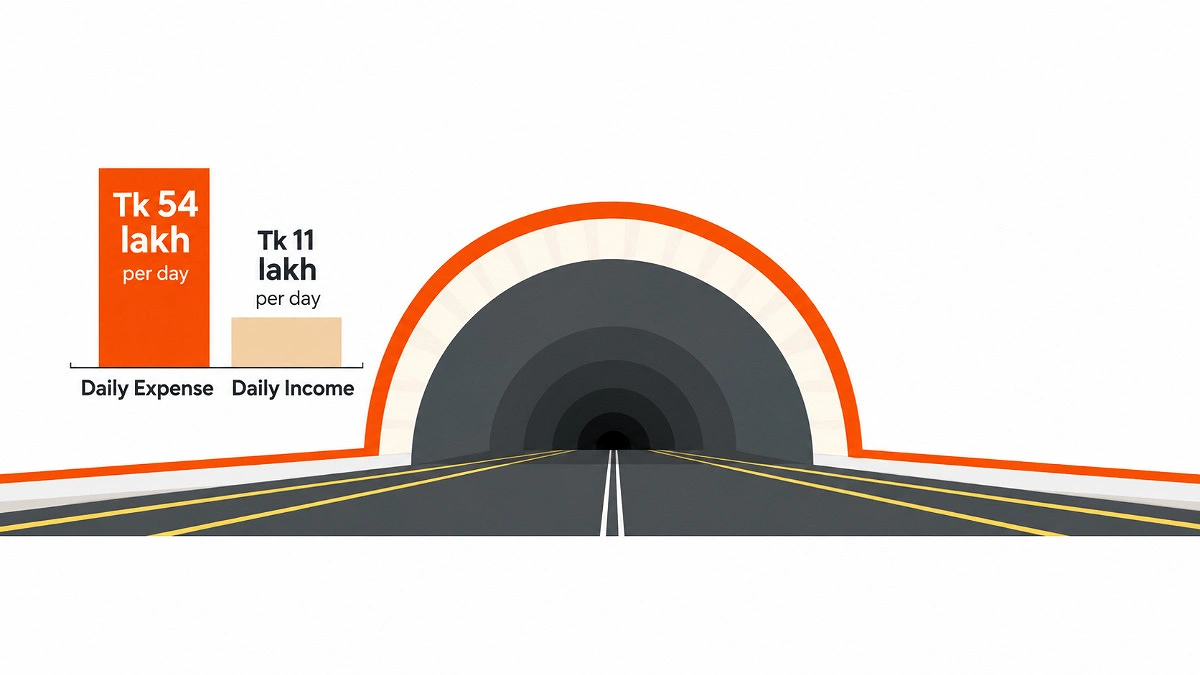
The feasibility study cited that annual operation and maintenance costs would be Tk 32 to 45 crore. According to the Bridge Authority, a five-year operation and maintenance contract worth Tk 984 crore has been signed with the Chinese contractor China Communications Construction Company Limited (CCCC). According to the contract value, keeping the tunnel operational costs Tk 196.76 crore per year—Tk 54 lakh per day. In contrast, from September 1, 2025, to October 17 of the current year, total toll collection from the tunnel amounted to only Tk 47 crore. By this calculation, average daily income was Tk 11 lakh, with a daily loss of Tk 42.55 lakh. Over the past three fiscal years, Tk 513 crore was spent to keep the tunnel operational, while toll collection amounted to only Tk 104 crore.
The study stated that due to the Sonadia deep seaport and industrial zone, about 50 percent of total tunnel users would be trucks. But according to updated Bridge Authority data, since the tunnel opened, 70.60 percent of vehicles using it have been light vehicles such as private cars, jeeps, and microbuses. Buses accounted for 10.40 percent, trucks 17.95 percent, and trailers only 1.06 percent.
Md. Jahangir Alam, former vice-chancellor of Chittagong University of Engineering and Technology (CUET) and professor of the Department of Civil Engineering, said, "To secure project approval and ensure rapid implementation, feasibility studies are often conducted while ignoring many real-world factors. Whether intentional or unintentional, the study was flawed. However, since a huge amount has already been invested, keeping the tunnel operational and effective will require quickly completing the bypass road from the Anwara end toward Cox's Bazar and the flyover connection."
One of the main objectives of constructing the Karnaphuli Tunnel was to reduce vehicular pressure on the Shah Amanat Third Karnaphuli Bridge and the Kalurghat Bridge over the Karnaphuli River. However, an analysis of data from the Roads and Highways Department (RHD), the Bridge Authority, and the Railway shows that currently an average of 27,416 vehicles ply daily through the Shah Amanat Bridge and an average of 11,000 vehicles daily through the century-old Kalurghat Bridge. That is, across the two bridges and one tunnel combined, an average of 42,244 vehicles cross the Karnaphuli River daily. Of these, 65 percent cross through the Shah Amanat Bridge and 26 percent through the Kalurghat Bridge—meaning 91 percent of vehicles cross via the two bridges combined. Only 9 percent of vehicles cross through the tunnel.
The average toll per vehicle on the Shah Amanat Bridge is only Tk 82, whereas the average toll per vehicle in the tunnel is Tk 306.63. The toll for a private car is Tk 75 on the bridge but Tk 200 in the tunnel. Again, the toll for a bus with fewer than 31 seats is Tk 50 on the bridge but six times higher—Tk 300—in the tunnel. Besides, while CNG-powered auto-rickshaws and motorcycles are allowed on the bridge, they are banned in the tunnel.
Bridge Authority's initiatives to reduce losses
To reduce losses, the Bridge Authority has informed the parliamentary standing committee of 10 measures. Among these, initiatives have been taken to save Tk 123 crore by reducing manpower and costs from the Tk 983.83 crore operation and maintenance contract signed with CCCC. In addition, widening the Anwara-Barkal-Gachbaria road and the Anwara-Banshkhali-Chakaria road, and construction of the Karnaphuli Dry Dock and seven new jetties by the Chattogram Port Authority at the Anwara end. Once these are operational, an additional Tk 200 to 240 crore in tolls is expected to be collected from the tunnel annually. Alongside this, initiatives have been taken through the district administration to accelerate operations of the Chinese Economic Zone and the Korean EPZ and to encourage long-distance buses and trucks to use the tunnel.
