
Khatunganj of Chattogram
Small traders pushed out of import trade!
- Volatility in the dollar market
- 16 percent bank interest rates
- Advance income tax, 100 percent margin requirements are huge pressure
- Opening of letters of credit has dropped by 79 percent over two years

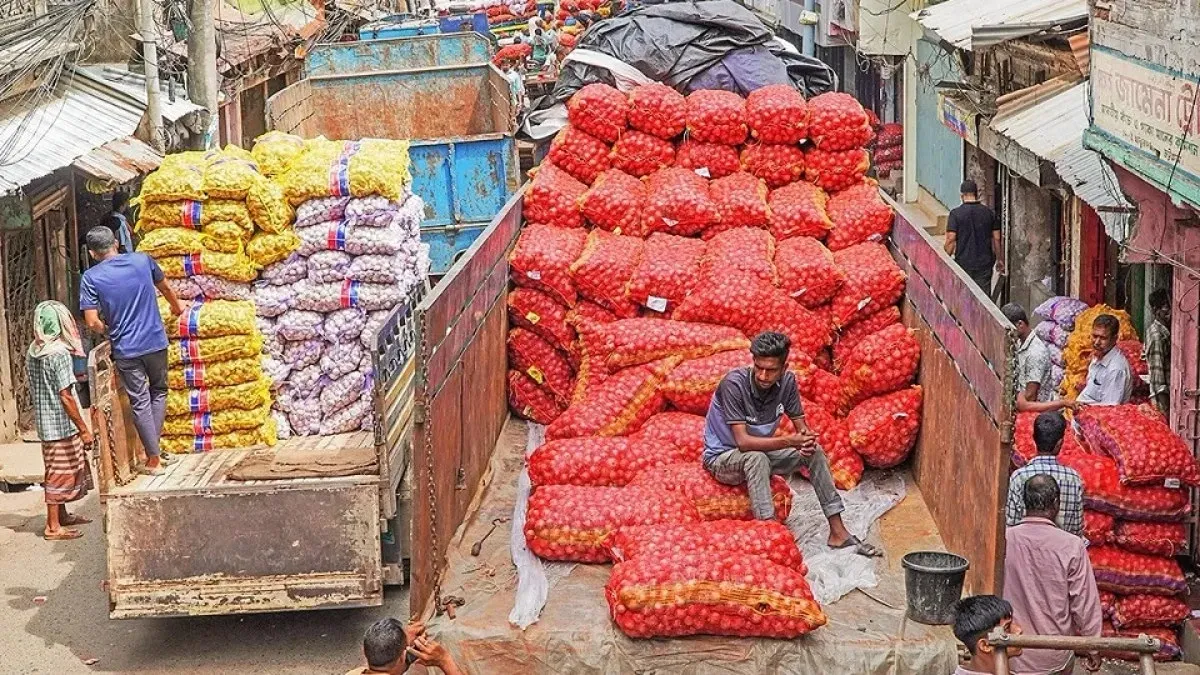
Khatunganj bazar of Chattogram. Agamir Somoy.
The country's small and medium importers are silently disappearing from the import trade. They are now bewildered under the pressure of dollar market instability, 16 percent bank interest, advance income tax, and 100 percent LC margin.
Facing this four-pronged pressure, many are losing their capital and folding up instead of continuing their businesses. As small traders withdraw, the market for essential commodities is now coming under the control of the big players. This has threatened to shut down alternative sources of imports. A serious risk of monopoly dominance in the market has emerged.
Clear evidence of this crisis has been found in the banking data of Agrabad and Khatunganj in Chattogram. According to the accounts of a private bank, LC settlements in the SME sector amounted to $5.86 million in 2024. In 2025, it dropped to $2.52 million. In the current year 2026, it has fallen further to just $1.23 million. In other words, in two years, the opening of letters of credit by small traders has decreased by about 79 percent.
Professor Dr. Md. Selim Uddin of the Accounting Department at Chittagong University told Agamir Somoy, "SME entrepreneurs play a role in 70 to 80 percent of the country's total business. They bring perishable and essential goods to the market quickly and keep supply flowing. Currently, this sector is facing a major blow due to the credit crisis and high interest rates. If the small players disappear, the entire market will fall into the hands of a few institutions. In the long run, consumers will be the losers in the commodity market."
Abul Bashar Chowdhury, Chairman of BSM Group, told Agamir Somoy, "Both small and big traders are needed to keep the market stable and balanced. If the small players disappear, it will be difficult to control the market. Government revenue and employment will decrease."
Manzur Morshed, owner of Zarif Trade International, a trader in Khatunganj, told Agamir Somoy, "Small importers are the ones who keep the supply of essential commodities normal. But everyone is losing enthusiasm due to the runaway price of the dollar. On top of that, the burden of high bank interest and advance income tax (AIT) has held them hostage. It is impossible for us to survive if the government does not provide policy support and banking complications are not reduced."
Due to the dollar crisis, banks are now suffering from uncertainty over the spot rate. Big groups have their own export earnings. They can also bring goods from abroad on credit. But small traders are getting into trouble having to buy dollars at the cash spot rate. Besides, bank loan interest is now 16 percent. Moreover, since the gap between lending and deposit rates (spread) is limited to 4 percent, banks are not interested in lending to small borrowers.
A top official of a private bank in Agrabad said that monitoring costs and risks are higher in the SME sector. Therefore, banks consider investing in big groups and government treasury bonds safer than lending to small borrowers. As a result, the small players are falling behind.The biggest blow has come in the LC margin for opening letters of credit for commodity imports. Although margins are supposed to be low for essential commodities, 100 percent cash margin is being taken from small traders. As a result, their entire capital is stuck in the bank before the goods even arrive.A lentil importer at Amir Market in Khatunganj is a big example. Having to pay 100 percent margin and advance tax on two shipments, all his capital got stuck. Unable to get new loans, he has shut down his business and now works as a commission agent for others.In the "Import Policy Order 2026-29," the limit on trade without an LC has been lifted. But foreign suppliers do not extend credit without a bank with a good credit rating. As a result, while the big players can bring goods on credit under this facility, the small ones cannot get goods without a bank guarantee. This is gradually limiting the competitive market.On the other hand, advance income tax (AIT) is being deducted at the port and customs at a rate of 2 to 5 percent. Big institutions adjust this tax against the profits of their other businesses. But for small traders bringing in single agricultural products, the money is never refunded or adjusted. As a result, their cash capital is getting stuck permanently.
