
Five-year project launched to help entrepreneurs tap Canadian market

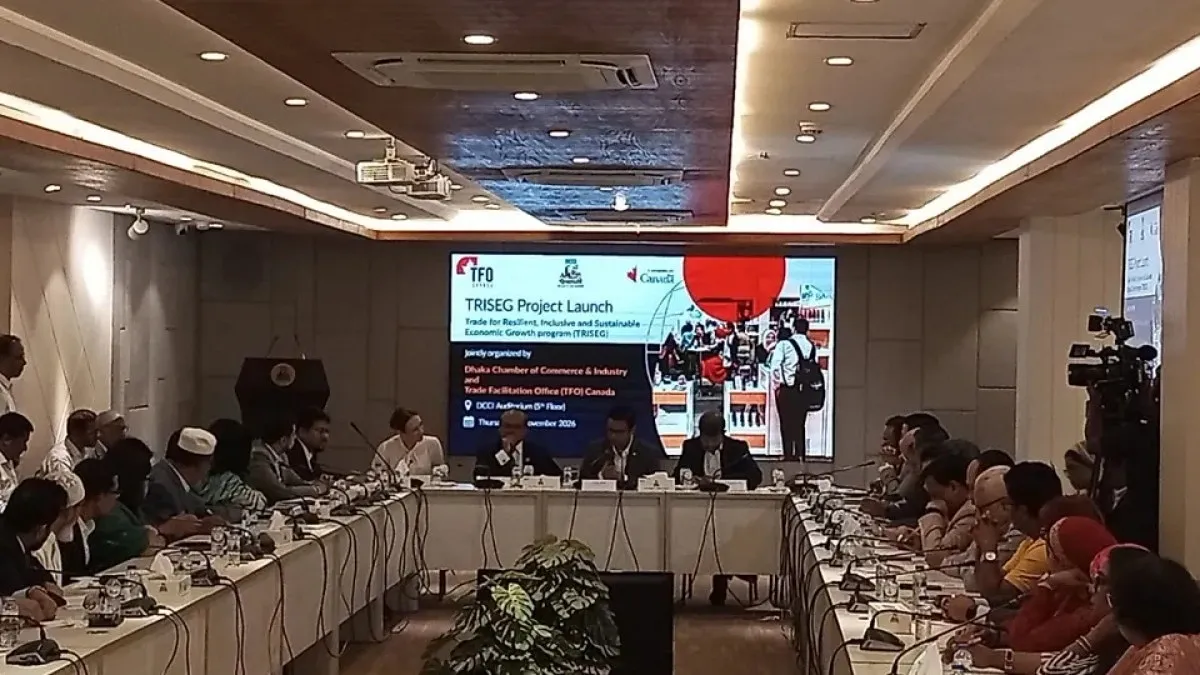
Collected Photo
A five-year project named TRISEG has been launched to enhance the export capacity of Bangladesh’s small and medium enterprises (SMEs) and create opportunities for them to enter international markets, including Canada.
Under the initiative, businesses producing diversified jute products, handicrafts and fashion items in Bangladesh will receive training, market linkages, financing and technical assistance. Special attention will be given to women entrepreneurs and those from disadvantaged communities.
The project was formally launched on Thursday (November 12) at the Dhaka Chamber of Commerce and Industry (DCCI) auditorium in Motijheel, Dhaka. The DCCI and Canada’s Trade Facilitation Office (TFO) jointly organized the event.
DCCI President Taskin Ahmed delivered the welcome address. TFO Canada Project Manager Md Ashraf Hossain presented an overview of the project. LightCastle Partners presented the keynote paper on market conditions and potential.
Dina Muzik, First Secretary of the Development Section at the Canadian High Commission in Bangladesh, also spoke at the event. Khandaker Md Nazmul Huda Shamim, Additional Secretary of the Ministry of Textiles and Jute, attended as a special guest.
Mohammad Hasan Arif, Vice Chairman and Chief Executive Officer of the Export Promotion Bureau (EPB), was the chief guest.
The discussion also featured Md Saiful Islam, Director of the Bangladesh Jute Spinners Association and Managing Director of Majeda Jute Industries; Protima Chakraborty, Managing Director of Jute Land Bangladesh; Md Jabdul Islam, Director of the SME and Special Programs Department of Bangladesh Bank; and Md Zahid Hossain, Managing Director of the Jute Diversification Promotion Centre.
The Trade for Resilient, Inclusive and Sustainable Economic Growth (TRISEG) project is a Canadian-funded initiative. Its objective is to integrate climate-resilient and inclusive small businesses into international trade.
According to TFO Canada, the project aims to support 3,200 small and medium enterprises across 16 countries in Asia, Africa and Latin America. At least two-thirds of these businesses are expected to be owned or led by women and members of disadvantaged communities. The initiative also plans to provide 5,500 entrepreneurs with online trade-related information services.
The project focuses on five key areas: strengthening export capacity, promoting women’s participation and social inclusion, digitalization, environmental sustainability and climate resilience, and expanding access to finance.
A preliminary market assessment in Bangladesh found that the country accounted for 18.5 percent of Canada’s jute product import market in 2025. India’s share stood at 58 percent while China’s was 11 percent. However, Bangladesh’s opportunities remain limited in the market for processed and diversified jute products. China supplies nearly two-thirds of Canada’s market for finished jute products.
Among the 55 SMEs covered by the assessment, 40 were involved in producing diversified jute products, 13 in handicrafts and two in fashion items. Around 74 percent of these businesses were owned or led by women.
However, the assessment identified difficulties in finding buyers, obtaining international standards and certifications, maintaining production quality, securing financing and managing transportation costs as major barriers to export expansion.
Of the 36 promising businesses surveyed, 22 identified a lack of buyer identification and market linkages as their primary obstacle. Meanwhile, 93 percent of experienced exporters identified high transportation and freight costs as a major challenge.
The project assessment also proposed developing an export model in which capable entrepreneurs would consolidate products from several smaller businesses for export. This could create opportunities to maintain international standards, reduce packaging and transportation costs, and establish business relationships with major buyers.
