
42 banks struggle with directors' Tk 2 Lakh crore loans

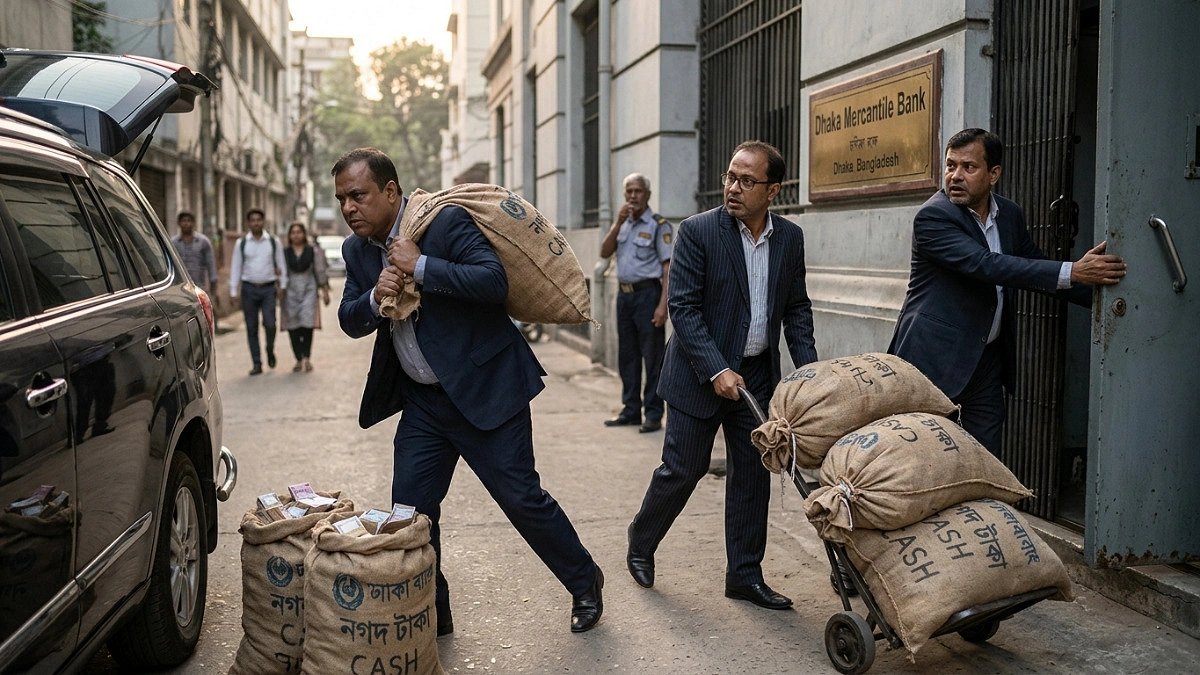
Representational image drawn by AI.
They are all directors of private banks. Quite influential. Numbering around 500. They do not care about rules and regulations. Using their influence, they have taken loans amounting to Tk 2 lakh 8 thousand crore. Some pay installments occasionally, while many do not pay at all. Using various legal loopholes, they deposit a small amount to keep themselves from being classified as defaulters, then take out new loans again. The amount keeps growing. Their dominance persists under all governments. It decreased somewhat during the interim government's tenure. Then it became unbridled again. Bank MDs (Managing Directors) are helpless. Even the central bank and the finance ministry are aware of everything. But there is no effective action. Moreover, official published reports no longer contain information on these loans. This sensational information was obtained by speaking with relevant officials of Bangladesh Bank and analyzing documents related to directors' loans.
According to central bank data, as per regulations, a director can purchase 2 to 10 percent of a bank's shares. The current paid-up capital of banks is generally Tk 500 crore. According to that calculation, they can take shares worth a maximum of Tk 50 crore. Furthermore, the limit for a director's loan from any bank is a maximum of 50 percent of their own shares. That means they cannot take loans exceeding Tk 25 crore. If 500 directors of 42 private banks have taken loans, the total amount would stand at a maximum of Tk 12,500 crore. However, the current amount of directors' loans stands at Tk 2 lakh 8 thousand crore, which is completely illegal — such is the comment from experts.
In their opinion, a large portion of directors have strategically taken large loans from banks other than their own. The highest record of this was created during the Awami League era. At that time (until June 2024), bank directors' loans were Tk 2 lakh 35 thousand crore. During the interim government's tenure (until December 2025), directors' loans decreased to Tk 2 lakh 7 thousand crore; but from June 2025, the loan trend again moved upward, and after the formation of the current government, loans from just 42 banks stood at Tk 2 lakh 8 thousand crore last June.
At least 12 MDs of commercial banks, sharing almost identical information with the newspaper Agamir Samay, said that banks are unable to ensure accountability in the disbursement and use of loans to bank directors. These directors are businessmen, and they are also the entrepreneurs of the banks. They take loans without hindrance, become defaulters, and then strategically take loans again. This has seemingly become a kind of 'permanent culture,' which continues year after year despite being illegal. This is severely harmful to banks and the economy. The central bank is not paying attention to directors' loans and defaults. Despite the existence of laws, directors are not repaying loans. Yet executives are forced to approve loans to directors helplessly. This clearly indicates that bank directors are more powerful than the country's laws. Due to their excess loans, others are not receiving credit. The only solution to this can be political goodwill.
When asked about the matter, Dr. Salehuddin Ahmed, former Finance Adviser to the interim government and former Governor of Bangladesh Bank, told Agamir Samay, "Bank directors are naturally influential. A huge amount of loans is stuck with them. The primary responsibility for recovering this massive amount lies with the banks. Just because someone is a director does not mean everything must be forgiven. Furthermore, the bank's chief executive should not show helplessness but speak with the bank's chairman. If a solution is not found there, they must seek ways from Bangladesh Bank to recover the loans. Bangladesh Bank can find a way if it wants to. Then results will follow. All power cannot be displayed or exercised there."
An investigation into directors' loans reveals that the crisis in the banking sector began in 2013. At that time, at least 9 banks received approval due to political considerations. After the Awami League government was formed in 2014, most directors of these banks began exerting illegal influence in the banks. Although S. Alam, Salman F. Rahman, Nazrul Islam Majumdar, and the Zainul Haque Sikder group had been known as mafia in the banking sector from earlier, the takeover of Islami Bank by S. Alam in 2017 raised concerns of bank plunder. Since then, bank directors also became reckless. Statistics show that in 2016, directors' loans were only Tk 90,000 crore, which reached Tk 2 lakh 8 thousand crore last June, ten years later.
According to information, notable banks that have given loans to their own directors include: Pubali, United Commercial, Bank Asia, Shahjalal Islami, Dutch-Bangla, Prime, Dhaka Bank, Bank Asia, Southeast, BRAC, City Bank, Eastern Bank, AB Bank, Standard Bank, Premier, and South Bengal Agriculture and Commerce (SBAC).
Additionally, banks that have given loans to directors of other banks include: Pubali, United Commercial, Shahjalal Islami, Dutch-Bangla, Prime, Dhaka Bank, Bank Asia, Southeast, BRAC, City Bank, Eastern Bank, and South Bengal Agriculture and Commerce.
Recently, Bangladesh Bank Governor Md. Mostakur Rahman met with leaders of the Bangladesh Association of Banks (BAB), an organization of bank owners. During the meeting, the Governor urged for swift action in recovering defaulted loans. He also brought the issue of directors' loans to their attention. In this regard, he instructed that the rules and regulations in bank management must be properly followed.
In this context, BAB chief and Chairman of Dhaka Bank, Abdul Hai Sarkar, told Agamir Samay, "Changes have come in bank management now. Directors are trying their best for the development of the banking sector. Loan management is proceeding according to rules. Loans are disbursed after proper verification and scrutiny following due regulations. In that case, there should be no problem for directors to get loans. Taking a loan is not a crime. That is specifically stated in the Bank Company Act."
Dr. Mostafa K. Mujeri, former Chief Economist of Bangladesh Bank, said, "Bank directors can take loans if needed. They will take loans just like regular customers, keeping conditions and collateral assets. Banks should follow loan criteria. No extra facilities should be given. If loans are not disbursed according to conditions through special collusion or conspiracy, the crisis will recur as before, which still persists. People's trust in banks has decreased. Now is the time to come out of such a corrupt culture. Because certain identified groups have siphoned off money from banks. They are also the owners of the banks. And it is the responsibility of the regulatory body to take action based on what comes up in bank inspections."
Arif Hossain Khan, spokesperson and Executive Director of Bangladesh Bank, said, "Bank directors can take loans if needed. But there is no scope to exceed the limit. How did such a huge amount of loans go to the owners? According to rules, it should be investigated whether they have the scope to have so much money. Moreover, defaulters cannot remain directors. Why aren't the banks taking action? How long will this continue? This needs a resolution."
Nazma Mobarak, Secretary of the Financial Institutions Division (FID) of the Ministry of Finance, said, "Bangladesh Bank is essentially the regulatory body for all banks. That is, bank management, supervision, director loans — everything will be overseen by Bangladesh Bank. We do not oversee the loans of private bank directors. Their loan information does not come to us. However, if Bangladesh Bank wishes, we will instruct them to take action according to the law."
