
Rising commodity prices shrink shoppers’ bags

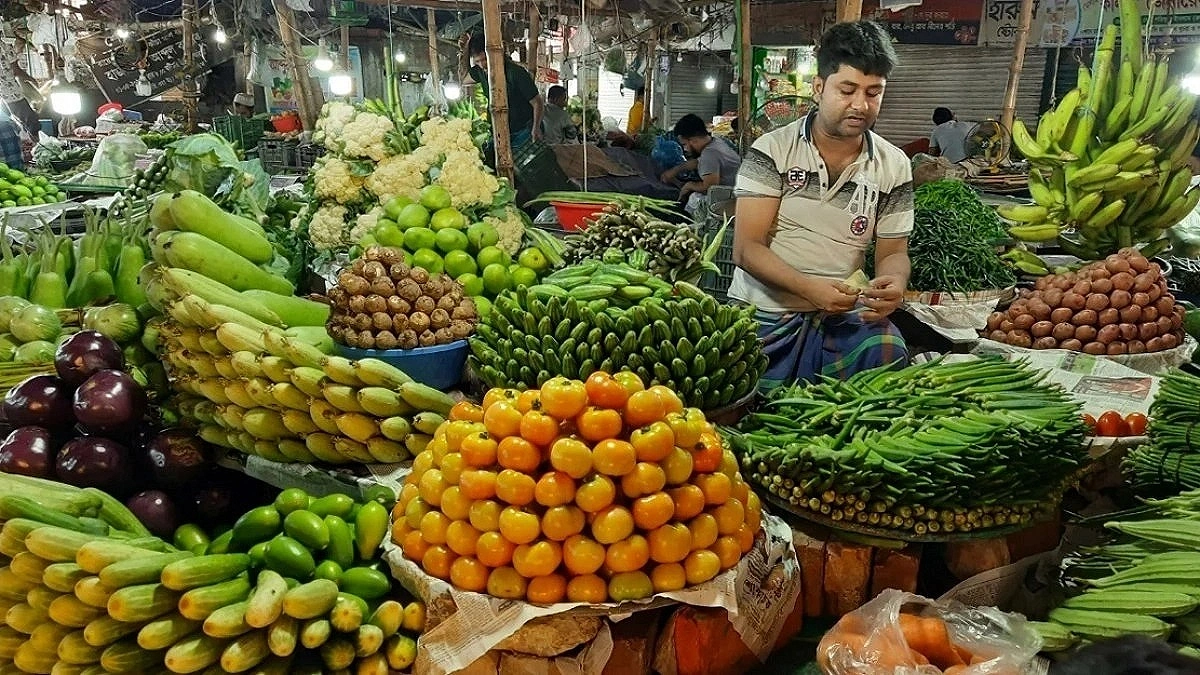
Photo: Agamir Somoy
Due to rising commodity prices, consumer purchasing habits are changing. Many people who previously purchased a certain quantity of vegetables, fish, meat, or grocery items are now buying smaller quantities within the same budget.
Limited and middle-income people are trying to manage market pressures by shortening their essential commodity lists, dropping certain items, or reducing quantities. As a result, although shoppers are present in the market, many are returning home with smaller bags than before.
This scenario was observed on Friday at Karwan Bazar and Mohammadpur Krishi Market in Dhaka, as well as Reazuddin Market and Kazir Deuri Market in Chattogram.
Vegetable prices in the markets remain high. Early winter hyacinth bean is selling at Tk 200 per kg. In contrast, papaya is available at a relatively lower price of Tk 30 per kg. However, excluding papaya, the price of most vegetables exceeds Tk 70.
Most vegetables, including eggplant, bitter gourd, yardlong bean, okra, pointed gourd, and teasel gourd, are selling between Tk 70-120 per kg. Long eggplant is priced at Tk 100, round eggplant at Tk 120, tomatoes at Tk 120-140, yardlong bean, ridge gourd, and bitter gourd at Tk 80, taro root at Tk 80, and bottle gourd at Tk 50- 70 per piece depending on size.
While cucumber is available at a relatively lower price of Tk 50-60 per kg, the local variety of cucumber costs Tk 80-100. However, some relief has arrived in the vegetable market regarding green chilies. Green chilies, which soared up to Tk 200 per kg a few weeks ago, are selling at Tk 120-140 depending on quality due to increased supply. This marks a price reduction of Tk 60-80 per kg compared to the peak price from a few weeks prior.
Meanwhile, there is not much change in the fish market either. Tilapia is selling at Tk 250-260, pangas at Tk 220-230, rui-katla at Tk 380-420, shrimp at Tk 1,000-1,300, pabda at Tk 350-400, large-sized rui at Tk 450-500, tengra at Tk 700, bhetki at Tk 400-550, and mrigal at Tk 250-300 per kg. Local koi is available at Tk 700-800 and baim at Tk 600-800 per kg.
In the Chattogram market, the price of hyacinth bean has increased the most over a one-week period. According to traders, hyacinth bean, which sold at Tk 170-220 per kg last week, is selling at Tk 220-250 per kg. That means the price per kg has increased by up to Tk 30-50 in a week.
The price of tomatoes has also risen by nearly Tk 20, reaching Tk 120-150 per kg. Last week, this vegetable was sold at Tk 100-130 per kg. Carrots are selling at Tk 100-140, yardlong bean at Tk 60-70, eggplant at Tk 80-100, cauliflower at Tk 60, cabbage at Tk 80, ridge gourd at Tk 80-90, and bitter gourd at Tk 80-100 per kg.
Fish prices have not changed significantly either. There, rui-katla is selling at Tk 300-430 depending on size, pangas at Tk 180-250, tilapia at Tk 200-250, mrigal at Tk 250-300, loitta at Tk 200-250, and koral at Tk 650-1,000, baim at Tk 600-800, local koi at Tk 700-800, and hilsa at Tk 800-1,800 per kg.
Traders claim that the rise in commodity prices, transportation, and fuel costs in the wholesale market is impacting the retail market.
Chicken seller Abul Kalam said, “We do not intentionally increase prices. We have to sell by adding transportation and shop expenses to the price we buy from poultry farmers. Selling at the previous price would result in a loss.”
SM Mohiuddin, general secretary of the Khatunganj Wholesalers’ Association, added, “Product prices at the import stage, shipping, transportation, and other expenses have increased. Due to the rise in fuel oil prices, the cost of transporting goods within the country has also increased. These added expenses are creating pressure in the wholesale market. However, wholesale prices for some products have started to drop.”
SM Nazer Hossain, vice president of the Consumers Association of Bangladesh (CAB), noted, “It is necessary to verify actual purchase prices, transportation costs, and selling prices from wholesale to retail levels. If abnormal price hikes occur at the retail level despite normal supply, the reasons must be identified and action taken.”
Mohammad Fayez Ullah, deputy director of the Directorate of National Consumer’ Rights Protection, Chattogram Divisional Office, said, “Regular monitoring activities are ongoing in markets. Action will be taken according to law if irregularities are found.”
