

Project Boom Despite Strict Scrutiny

Graphics: Agamir Somoy generated by AI
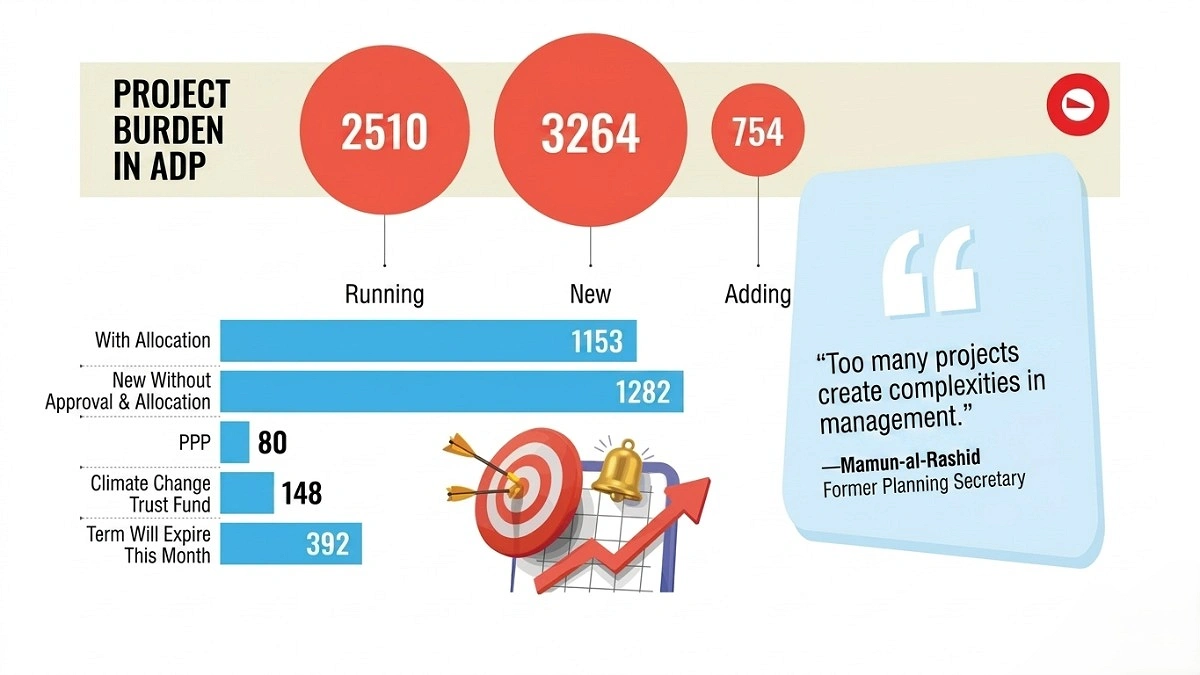
Despite the current government’s strict measures for project evaluation and selection, the outcome has largely been ineffective. The number of projects in the upcoming Annual Development Programme (ADP) has risen to 3,164, up from 2,510 in the current fiscal year—an increase of 654 projects. This shows that instead of decreasing, the number of projects has significantly increased.
Officials say the rise is mainly due to political commitments and the demand to fulfill public expectations under elected governments. As a result, the ADP has become increasingly burdened. The National Economic Council (NEC) has approved a budget allocation of around Tk 3 trillion for the programme.
Former Planning Secretary Mamun Al Rashid told Agamir Somoy that a higher number of projects creates management difficulties, requiring more project directors, manpower, and supervision, along with larger allocations. He added that while the government initially promised strict scrutiny, political realities and election commitments often influence project selection. He emphasized that the key question is whether projects are chosen based on public welfare or political considerations.
According to Planning Commission sources, the upcoming ADP includes 1,153 projects with allocated funding. These include 976 investment projects, 23 feasibility studies, 109 technical assistance projects, and 45 projects funded through internal resources.
In addition, there are 1,282 unallocated “Sobuj Pata” projects in the ADP. Among them, 1,064 are to be implemented through government funding, 179 through foreign loans, and 40 by autonomous bodies or corporations.
There are also 80 public-private partnership (PPP) projects, 148 climate change trust fund projects, and 392 ongoing projects that are expected to expire this month but have still been included in the upcoming ADP.
Among these, 344 are investment projects, nine feasibility studies, 18 technical assistance projects, and 21 projects under autonomous organizations. Additionally, 32 projects that were expected to be completed within the current month but failed to do so have been carried forward into the next ADP. Another 77 development projects have been listed without formal approval under foreign funding arrangements.
Key projects included in the upcoming ADP include power distribution system upgrades in the Chattogram zone, the Rooppur Nuclear Power Project, the Matarbari 1,200 MW coal-based power plant, and the Agricultural and Rural Transformation for Nutrition Project. The sustainable management of the Jamuna River Project-1 is also included.
Foreign-aided projects include the Matarbari 2,400 MW ultra-supercritical coal power project, construction of the second Jamuna Bridge, electrification of the Narayanganj–Dhaka–Joydebpur railway section, construction of the Dhaka–Cumilla rail cord line, Dhaka Mass Rapid Transit Development Project Metro Rail Line-5 Southern Route, and Metro Rail Line-2.
Several major PPP projects are also included, such as the Matarbari land-based LNG terminal, Dhaka Outer Ring Road, Kamalapur Multimodal Hub, Bay Terminal construction, and the Dhaka East-West Elevated Expressway project. Another notable inclusion is the Second Padma Multipurpose Bridge which is Paturia–Goalanda project.

