
IMF advises to go for less borrowing while tackling crisis

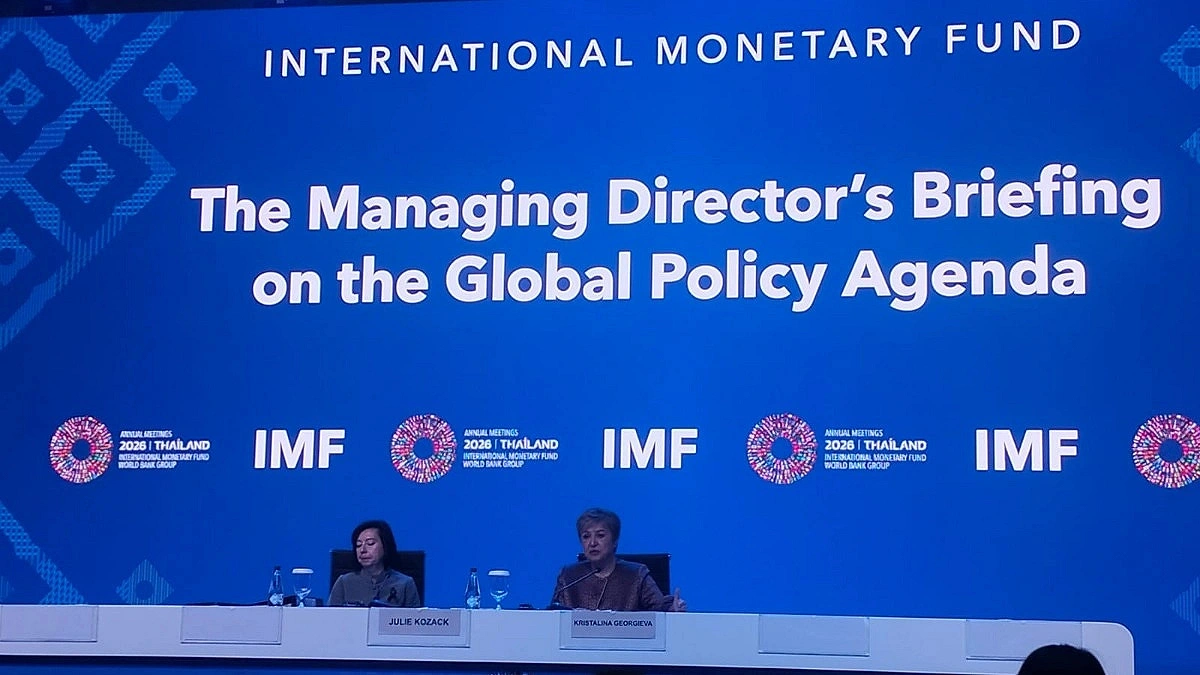
Photo: Agamir Somoy
The International Monetary Fund (IMF) has advised taking on less debt to tackle the rise in fuel oil prices in the global market and to reform the revenue sector by moving away from conventional practices. At the same time, the organization has said to ensure the quality of spending and to protect ordinary people.
IMF Managing Director Kristalina Georgieva said this at a press conference on Wednesday at the Queen Sirikit National Convention Center in Bangkok. A separate briefing on fiscal policy was held there.
The briefing said that due to the rise in global fuel oil prices, subsidy expenditure in many countries will equal about 1.5 percent of GDP. This is putting the security of ordinary people's livelihoods at risk. In addition, due to high interest on loans and subsidy expenditure, low-income countries including Bangladesh are facing a difficult situation. As interest rates rise in the global market, pressure on foreign and domestic debt management is becoming increasingly intense. Fuel oil prices and high subsidy expenditure have become a big burden for the economy.
Highlighting this global situation, advice was given there for every country to formulate new revenue income policies and tax structures. In particular, it was mentioned that modernizing the tax structure and strengthening the design of the collection system are now the biggest demands of the time in terms of increasing revenue income. It was also said there that in the current global situation, expenditure on human resource development such as health, education, and social protection must be increased rather than on certain sectors such as pensions.
Kristalina Georgieva said the world economy is currently going through a complex and multidimensional crisis. Overexpectations about artificial intelligence (AI), high interest rates, high food and fuel prices, and debt burdens are slowing global growth. Against the backdrop of this instability and the IMF's warning, there is a push for major reforms in domestic policies for developing and emerging economies like Bangladesh.
According to the IMF's World Economic Outlook and Global Financial Stability Report, the global growth rate is still "cloudy and stagnant" by historical standards. The IMF kept this year's global growth forecast unchanged at 3.1 percent, but slightly raised it to 3.4 percent for next year.
However, Eric LeCompte, executive director of the religious development organization Jubilee USA Network and a longtime IMF observer, warned that the data inside the report is quite alarming. In particular, concern has been expressed that overly optimistic expectations that artificial intelligence will change the economy overnight or eliminate the crisis could cause a crash in financial markets.
In addition, pressure from high interest rates created in advanced economies is quickly pressing down on emerging markets and low-income countries. As a result, the cost of repaying loan interest is increasing abnormally. According to the IMF, due to high prices of fuel oil and food and a reduction in global development assistance, GDP growth in many countries is at risk of being damaged by up to 1.5 percent. In such a situation, the use of modern technology must be ensured to prevent tax evasion and increase the taxpayer base. And if revenue income does not increase significantly as a ratio of GDP, the government's development and social protection expenditure will be threatened.
The briefing also said that a transparent and periodic pricing or adjustment policy must be adopted in line with the international price of fuel oil, so that ordinary people do not suffer from unreasonable inflation. At the same time, subsidy sectors must be made more targeted.
In the case of foreign and domestic loans, quality and transparency must be ensured. Moving away from unnecessary and low-priority projects, loans must be limited to productive sectors.
In response to a question, Kristalina said that in order to protect marginalized and low-income people from the shock of global recession and inflation, budget allocations for the social safety net and the health sector must be increased.
