


Most of country's wealth in the hands of 10 percent

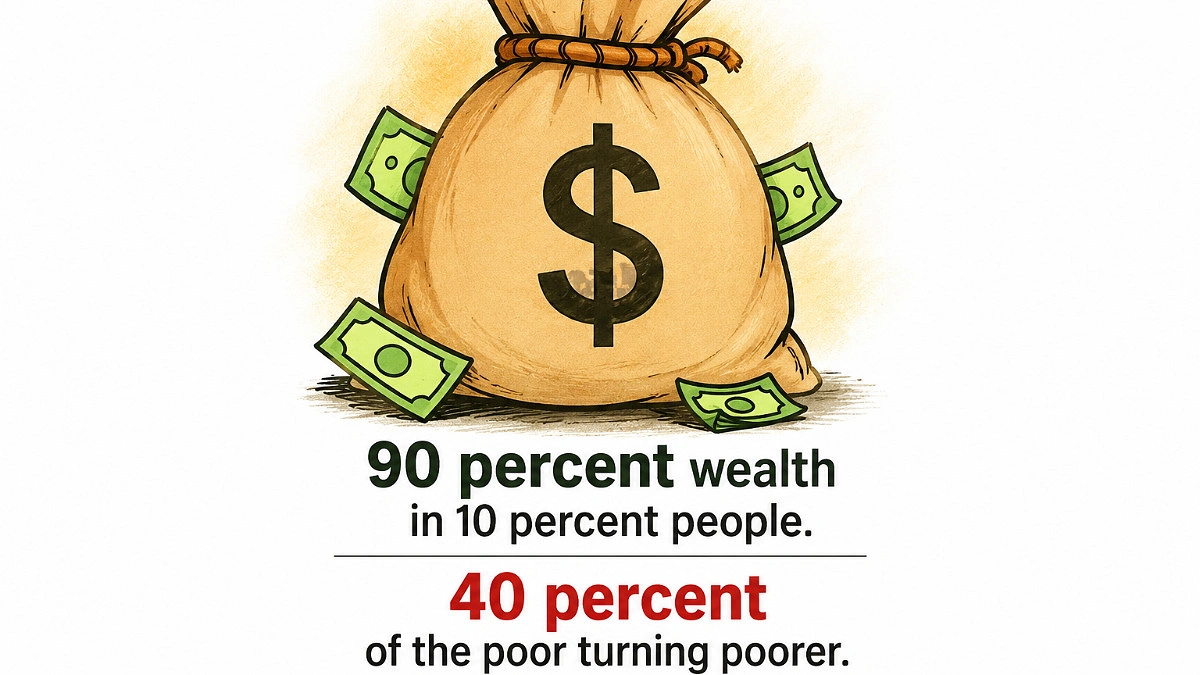
Photo by AI.
As the country's economic growth has brought many gains, successes are not even few, but beneath that shining veil, a deep wound is slowly growing. Its name is inequality. The wheels of the economy turn on the labor and sweat of millions of people. Yet the lion's share of those achievements is accumulating in the hands of a few.
Overall, Bangladesh faces the risk of extreme income inequality. The top 10 percent of the wealthy hold the majority of the country's wealth. Consequently, their income also rises by leaps and bounds.
Even official government accounts show that the income of the top 10 percent is 3.18 times higher than the combined income of the bottom 40 percent of the population. Over the past four decades, the income inequality situation in the country has continuously worsened. Because while the income of those at the top has increased at a certain rate, the income of those at the bottom has decreased at a much higher rate.
On the other hand, the poverty rate in the country is increasing. As a result, the once-success story is now fading. Middle-class people remain at extreme risk of poverty. Against this backdrop, the government has plans to take several initiatives in the coming days. These details have been highlighted in the Five-Year Strategic Framework. It has been prepared by the General Economics Division (GED) of the Planning Commission. The goal is to implement it from the current fiscal year to the fiscal year 2030-31.
Dr. Monjur Hossain, Member (Secretary) of the GED responsible for creating the framework, said about the future: "Inequality has emerged as a major concern in Bangladesh's development journey. According to the 2022 survey, the national Gini coefficient (inequality measure) is 0.499. This indicates high inequality. In poverty and inequality data, the disparity between urban and rural progress is evident. Where the rural Gini coefficient is 0.446, the urban Gini coefficient is 0.539, which is higher in urban areas. That is, higher, indicating that income inequality is more pronounced in urban areas. Unequal access to education, healthcare, finance, technology, and government institutions continues to strengthen structural inequality.
In the framework, the GED states that a large portion of the population is becoming vulnerable due to rapid and unplanned urbanization. This is resulting in overcrowded settlements, inadequate housing, insufficient public services, and growing urban inequality. Many urban workers are engaged in informal and low-wage occupations without social protection or employment security, which makes them particularly vulnerable to inflationary pressures and economic downturns.
It also said that in 1983-84, the income of the richest 10 percent was about one and a half times the combined income of the poorest 40 percent. By 2022, this ratio had more than doubled to 3.18, reaching its highest level. During this period, the income share of the bottom 40 percent declined sharply. On the other hand, the share of the top 10 percent increased significantly to over 40 percent of total income. Although export-led growth, particularly through the ready-made garment sector, increased employment, the benefits were unevenly distributed, so the desired outcomes were not achieved. Most of the benefits were enjoyed by high-income groups. Inequality has increasingly affected the middle class, whose income share fell to its lowest level in 2022.
Poverty is also increasing in tandem with inequality: The GED has stated that the relationship between inequality and poverty is deep. Over the past five decades, Bangladesh has achieved significant economic progress. However, poverty and inequality remain major development challenges. Bangladesh has received international recognition for reducing poverty, improving social indicators, expanding access to education and healthcare, and sustaining relatively high economic growth over a long period. Millions of people have been freed from extreme poverty. The rate fell from 41.1 percent in 1991-92 to 9.35 percent in 2025. During the same period, average life expectancy increased from about 50 years to 73 years. Child mortality has also decreased. But over time, the nature of poverty in the country has also changed.
Poverty increasingly reflects multidimensional challenges related to education, healthcare, housing, employment security, digital inclusion, and environmental resilience. Many families that have nominally crossed the poverty line remain highly vulnerable to economic shocks, illness, climate‑related disasters, or sudden loss of income. Recent research shows that moderate poverty rose from 18.7 percent in 2022 to 27.93 percent in 2025, and during the same period extreme poverty increased from 5.6 percent to 9.35 percent.
Questions about the sustainability of growth: In the framework, the GED states that the persistence of poverty, inequality, and vulnerability raises important questions about the inclusivity and sustainability of Bangladesh's growth model. Although economic expansion has generated significant national income, there are concerns regarding job creation, wage growth, labour productivity, the quality of public expenditure, and equitable access to opportunities.
Steps to overcome the situation: The framework outlines various initiatives over the next five years to reduce inequality and eliminate poverty. Notable among them are—improving economic growth and its distributive impact, strengthening the link between growth, job creation, and real income increases, and undertaking labour market reforms.
In addition, sector‑specific skill development will be pursued to boost productivity, the prices of essential commodities will be stabilised to manage the cost of living in line with inflation, targeted social protection will be expanded, support will be provided to vulnerable workers, poverty status will be assessed in short intervals, and the quality of work, wages, and working conditions for informal‑sector workers will be improved.
Further measures include increasing formal‑sector employment, assisting sectoral transformation, raising women's participation in the labour force, extending social protection programmes to informal workers, ensuring transparency and accountability of social safety net programmes, and reprioritising budget allocations.

