
Construction of Chinese Economic Zone to begin after 10 years

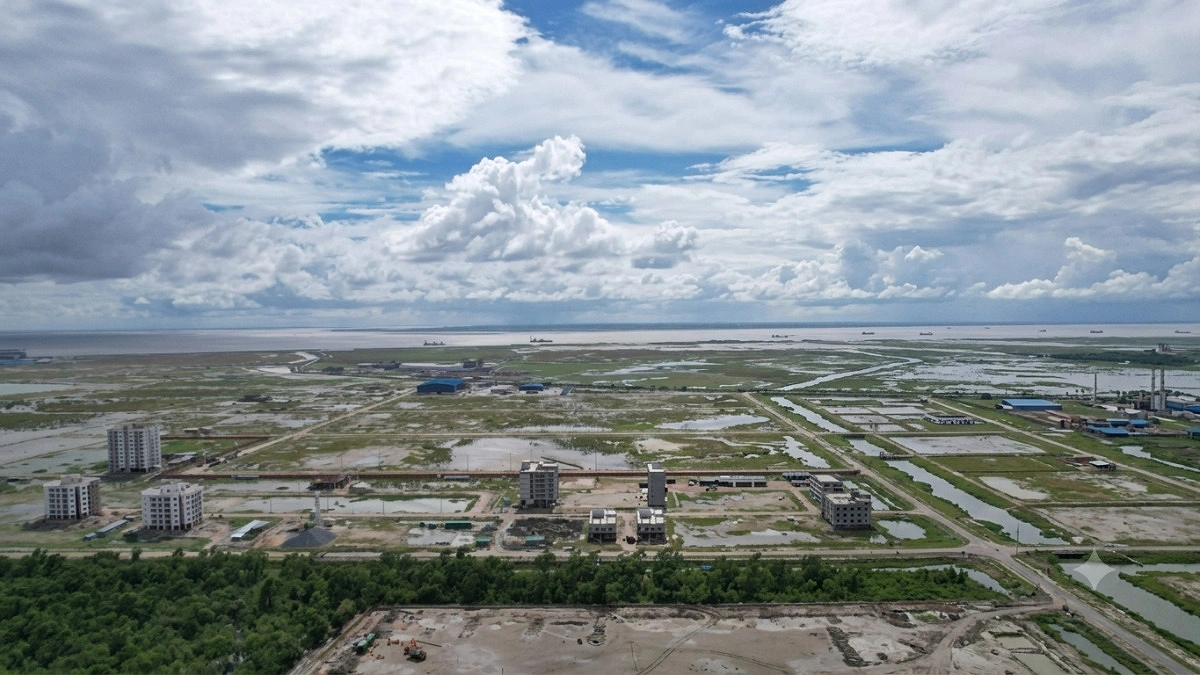
Agamir Somoy image regenerated by AI.
After being stalled for over a decade due to various reasons, the much-anticipated "Chinese Economic and Industrial Zone" (CEIZ) in Anwara, Chittagong, is finally set to begin its main infrastructure construction. As part of the formal launch of the project, a foundation stone will be laid tomorrow (Monday) at 10:00 AM at the project site.
Situated in a strategic location close to Chittagong Port, the Karnaphuli Tunnel, and Shah Amanat International Airport, this economic zone is expected to attract approximately Tk 6,100 crore in foreign direct investment (FDI). Additionally, it is anticipated to create employment opportunities for over 100,000 people, according to those involved.
The economic zone is being developed on around 800 acres of land under a government-to-government (G2G) initiative. Once implemented, it is expected to add a new dimension to Bangladesh-China economic cooperation and positively impact the country's export-oriented manufacturing sector.
Major General (retd.) Md. Nazrul Islam, Executive Member (Planning and Development) of the Bangladesh Economic Zones Authority (BEZA), said the project has a target completion date of 31 December 2031. While the total implementation period is set at five years, there are plans to make at least 60 percent of the industrial plots ready for factory construction within the first three years.
The foundation-laying ceremony at the project site in Anwara is expected to be attended by Finance Minister Amir Khosru Mahmud Chowdhury, Home Minister Salahuddin Ahmed, Chinese Ambassador to Bangladesh Yao Wen, and BEZA Executive Chairman Ashik Chowdhury.
The initiative to establish the Chinese Economic Zone began in 2014 with the signing of a memorandum of understanding between Bangladesh and China. Although land acquisition was completed in 2016, various administrative complexities kept the project stalled for a long time.
The project later gained fresh momentum following Prime Minister Tarique Rahman's visit to China. In continuation of that visit, a final agreement was exchanged between BEZA and the Chinese developer CRBC. According to Chinese government sources, all necessary documentation was completed within the first four months of the new government's term, paving the way for project implementation. Already, more than 30 Chinese companies have committed to investing $500 million in the economic zone.
To transform the project into a full-fledged industrial city, alongside the main economic zone, a supporting infrastructure project worth Tk 4,189 crore has also been undertaken. A large portion of this project will be financed by the Chinese government through concessional loans, with the remaining amount to be provided by the Government of Bangladesh.
This funding will be used to construct a four-lane connecting road, bridges, an environmentally friendly Central Effluent Treatment Plant (CETP), a multipurpose jetty with a 20,000 DWT capacity, uninterrupted gas and power transmission lines, and a boundary wall.
Business leaders have expressed satisfaction at the project finally getting underway after a long wait. Amirul Haq, President of the Chittagong Chamber of Commerce and Industry (CCCI), said this economic zone, designated for Chinese companies, will further strengthen trade and economic partnership between the two countries. At the same time, it will play a vital role in job creation, expanding international trade, and attracting new foreign investment.
S M Abu Tayeb, a director of the Bangladesh Garment Manufacturers and Exporters Association (BGMEA), said the country's readymade garment industry is currently heavily dependent on importing fabrics, accessories, and other raw materials from China. If these materials can be produced and supplied within this economic zone in Chittagong, both production costs and lead times will decrease. This will further enhance the competitiveness of Bangladesh's garment industry in the international market.
Those involved with the project expect that, in addition to the garment industry, this economic zone will play a significant role in boosting domestic and foreign investment in various export-oriented industries, including pharmaceuticals, advanced textiles, light engineering, and information technology. This is expected to have a positive impact on the country's industrialization and economic growth.
