
How China became the world’s factory

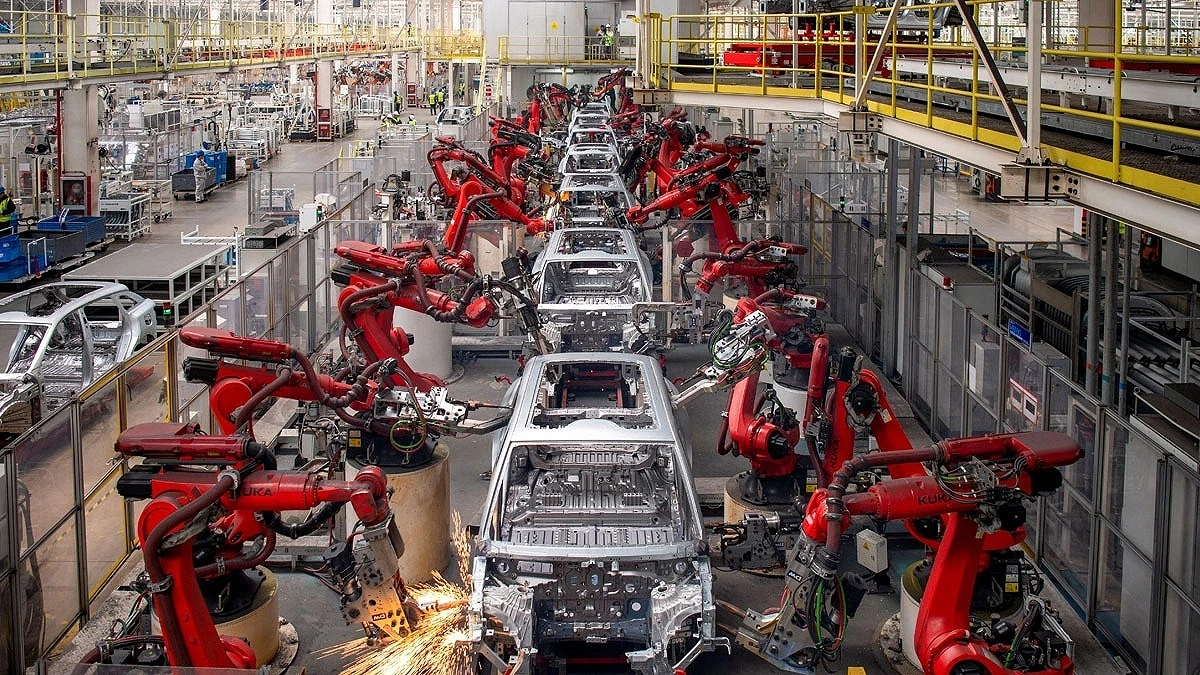
China is the world’s largest producer and consumer of automobiles. Photo: Collected
With a population of 1.42 billion, China is the world’s second most populous country. It is the world’s largest producer and consumer of automobiles. Last year, automobile production and consumption stood at 35 million. The country covers an area of 9.6 million square kilometers, making it the world’s third largest country by area. In 2026, it ranks second among the world’s 10 largest economies, with an economy valued at $21 trillion. China ranks sixth among countries with the largest gold reserves, one of the most valuable and easily marketable commodities. Its gold reserves stand at 2,192 tons. Of the 33 megacities worldwide identified by the United Nations, four are in China.
China holds all these impressive and enviable records. Today, it is known as the “factory of the world.” In 2024, Chinese goods worth $500 billion were exported to Donald Trump’s America. While Bangladesh is dependent on imports, China has taken a leading position in global trade by exporting goods worldwide.
After nearly 11 years, I have returned to China, and the country’s enormous potential is unfolding before my eyes. Here are some of the experiences that may also captivate and inspire your curious mind.
Once aboard the plane, I noticed that all the passengers were Bangladeshis. They were traveling to China in groups. They were not going on a tour or a vacation. Nor were they seeking medical treatment. So why were they going? Everyone gave the same simple answer in one word: “Business.”
Imon Hossain has been traveling to China regularly for 15 years. He supplies modern design elevators for large buildings. He said, “Our business depends on China. In terms of price, quality and commitment, they are in a good position in every respect.”
I asked him what made the experience so good. He gave an excellent example. “When we visit a factory, we are impressed by their warm welcome and sincerity. The comfortable hotel accommodations, halal food and rides in the latest model cars are all arranged so perfectly that you feel as if you are in your own city.”
How did a country in Asia gradually become the factory of the world? There was no simple theory behind this transformation. It was the result of the government’s liberal policies, political stability and the sincere participation of low cost workers. China has not experienced events such as the forcible capture of Venezuela’s president by the United States or the outbreak of a war with Iran.
Amirul Haque, an industrialist and president of the Chittagong Chamber of Commerce and Industry, said, “China has become the controller of the global economy without firing a single bullet at anyone.”
Consider the dedication of the couple Leo and Susan. While studying at university, Susan took a job as a salesgirl at a factory. During that time, she established connections with many foreign buyers. Her ability to speak English well also gave her an advantage in business.
Leo was involved in the apartment business. He left that business and joined his wife and two other partners to establish a small factory. For customers looking to buy products at slightly lower prices, Leo and Susan’s “Global Fuji” is the destination. Here, good quality products are available at prices 20 to 30 percent lower.
Susan said, “Bangladesh is a major market for us.”
An hour’s drive away, in Hangzhou, is another major elevator manufacturing plant called “Xizi.” In 2012, Xizi began a joint venture with the famous American company “OTS.” This highly modern factory produces 150,000 elevators annually, including cargo elevators and escalators. It also manufactures elevators for the German brand “TKE.”
Its strategy is to keep prices affordable. Manager Jeremy said, “We focus more on quality. Products for brands in Russia, Mexico and Germany come from our factory. China’s President Xi Jinping has visited our factory.”
Jahangir Alam has come from Bangladesh. He supplies generators, elevators and lighting equipment to government institutions. He has visited factories in Europe many times, but his experience in China has been entirely different. His admiration seems endless.
“The factory grounds have trees full of fruit. The environment is clean. Everything is high tech. Along with that comes warm hospitality. We have never received this kind of hospitality in Europe. In the future, I will keep China in mind when doing business.”
The People’s Republic of China was officially established on October 1, 1949. Under Mao Zedong’s leadership, the Chinese Communist Party declared the establishment of the modern Chinese state. At that time, the country’s population was 540 million. Per capita income was $23. Today, it stands at $15,000.
Behind China’s rise, however, lies a dark chapter. More than 10 million people died in China during the devastating famine of 1959 to 1961, one of the worst famines in human history. Today, Chinese products dominate an export market worth nearly $5 trillion.
Thousands of factories have sprung up in the cities of Hangzhou and Suzhou. Products manufactured there are transported in large prime movers toward seaports. To keep the supply chain running smoothly, China has built extensive road networks. The roads have neither traffic congestion nor potholes.
Along the way, I witnessed a minor car accident. Within 10 minutes, the road was cleared. Traffic police removed the damaged vehicle from the middle of the road.
Shanghai is China’s main commercial capital. This megacity has a population of 25 million and is home to one of the country’s major seaports. In many ways, it resembles our Chittagong. When traffic signals turn red, people cross the streets in streams.
The city features stunning skyscrapers, a modern lifestyle, busy shopping malls and bustling roads. Although lively and crowded, it is also charming with its flowers, trees and greenery. Shopping is in full swing. There, too, the alluring smiles of attractive salesgirls catch the attention of foreign buyers.
A tourist visiting China for the first time might be astonished and wonder whether this exceptional culture of salesmanship has also helped the country secure its position as the world’s factory.
China has thousands of factories producing everything from needles, thread, pins, safety pins, plates, glasses, cups, clothing, curtains, ceramics and tiles to electrical goods, raw materials for the garment industry, light and medium machinery, automobiles, refrigerators, air conditioners, computers and heavy industrial equipment.
Millions of businesspeople from around the world are now heading to China. The Chinese have elevated business into an art form, like a painting created with the precise strokes of a professional artist’s brush.
Whatever your purchasing budget may be, they can supply products to match it. Suppose you want to buy a nail clipper and your budget is 10 taka. They will make one for you. If your budget is 20 taka, they will provide that option too.
China has also developed an impeccable system to ensure the safety and orderly movement of the countless people arriving by air from all over the world. At the airport, smart and attractive male and female employees will greet you warmly. Each airport has been designed as a showcase of modern architecture.
Finally, it is worth mentioning that language barriers remain a problem. Using toilets can also be complicated. Nevertheless, the world continues to turn toward China.
Ah! What a magical and dreamlike country China.
