Garment unrest tests Bangladesh’s fragile economic recovery

Graphics: Agamir Somoy
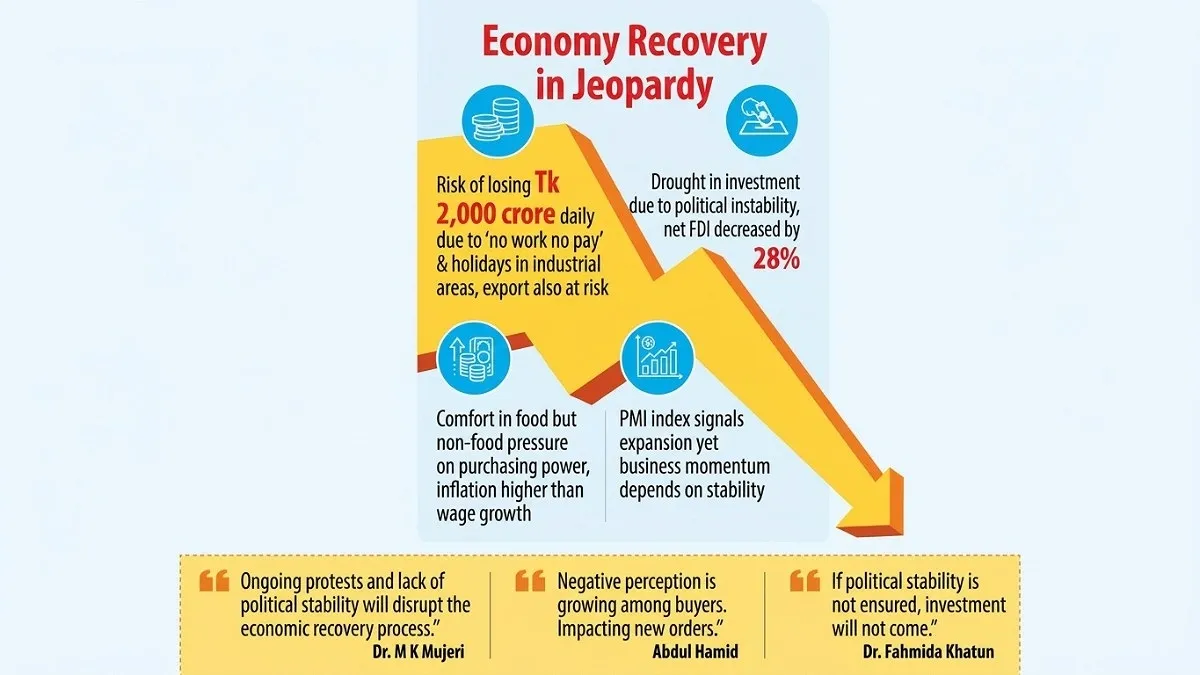
After remaining on an upward trend for several consecutive years, food inflation dropped to a 54-month low of 6.40 percent. However, non-food inflation still stands at 9.89 percent.
The wage growth rate is 7.63 percent. This maintains continued pressure on the real purchasing power of ordinary people. Added to this are geopolitical tensions, the Middle East conflict, and instability in the energy market.
Under such circumstances, domestic political instability and garment worker protests are plunging the economic recovery process into fresh uncertainty. Work abstentions in industrial zones, closures in certain factories, and the adoption of the “no work no pay” system are disrupting production and supply chains.
Foreign buyers’ trust has been somewhat fractured. Along with fears of declining new purchase orders, export earnings for the upcoming months could face heightened risks. On the other hand, the momentum of investment remains stalled due to political uncertainty.
The ongoing worker movement surrounding the announcement and implementation of a new wage structure in the ready-made garment (RMG) sector, the primary engine of the country’s export earnings, has sparked fresh anxiety across the economy.
According to calculations by the Bangladesh Garment Manufacturers and Exporters Association (BGMEA), until Thursday, the “no work no pay” rule was being implemented across 198 factories in various industrial hubs, including Savar, Ashulia, and Gazipur.
Besides, the number of factories declaring holidays and then reopening stands at 224. Factory owners claim they were forced to take decisions regarding factory closures and reopening due to worker protests.
Disruptions to production in this stalemate and complications in failing to meet scheduled shipments have created fears of stagnation in export operations. Preliminary estimates by the Bangladesh Garment Buying House Association (BGBA) indicate that the ongoing movement is causing daily financial losses of Tk 2,000-2,200 crore in the garment industry, with additional losses of Tk 3,000-4,000 crore incurred beyond this.
Speaking to Agamir Somoy, BGBA President Abdul Hamid said, “Due to the instability, a negative impression is being created among foreign buyers regarding the capacity to deliver goods on schedule. This is directly impacting the securing of new purchase orders. Buyers are facing uncertainty about sourcing goods from Bangladesh. The adverse impact of this crisis may reflect on the country’s overall export earnings over the next three months.”
The total export target for FY 2026-27 is set at $58 billion, of which the target for the ready-made garment sector is $46.6 billion or 80.34 percent. This export earning is the main pillar for maintaining foreign currency supply and reserves.
Under these circumstances, Economist MK Muzeri considers it urgent to restore stability in the industry through swift discussions among the government, factory owners, and worker representatives. According to him, a major portion of export earnings comes from this sector. The ongoing situation within the country sends a different message to buyers.
Moreover, it will hinder the economic recovery process. Muzeri believes that new investment is not taking place, which is why growth momentum and employment generation are not increasing. Amid this, the ongoing protests and political instability have plunged the overall situation into anxiety. This will weaken and disrupt economic momentum.
Meanwhile, one of the key conditions for investment is a stable political environment. However, the political environment inside the country is becoming unstable. The country is becoming unstable due to the violent activities of the activity-banned Awami league and its organizations.
The government began its journey with a fragile investment situation. In the first half of 2026 (January-June), net foreign direct investment (FDI) dropped by 28 percent compared to the same period of the previous year, falling to $794.25 million. Although net FDI in the April-June quarter stood at $346.9 million, nearly 75 percent of it came from the reinvestment of profits by companies already operating in the country.
Economists caution that if the ongoing political instability and garment workers’ movement are prolonged, it will create risks of further delaying new foreign investment and domestic private investment.
Speaking to Agamir Somoy, Fahmida Khatun, distinguished fellow of the private research institution Center for Policy Dialogue (CPD), said, “Eighty percent of our economy belongs to the private sector. Employment opportunities in the public sector are only 5-6 percent. Investors will come to the country only when there is political stability, the cost of doing business decreases, and energy availability is secured. There is no alternative to creating a suitable environment by reducing bureaucratic red tape and corruption.”
Meanwhile, another crucial driver of the external sector is remittances from expatriates. According to data from Bangladesh Bank, total remittances received over the four months (July-October) stood at $11.46 billion, which is 13 percent higher than the same period of the previous fiscal year ($10.15 billion).
However, despite positive remittance growth, its expected pace has somewhat slowed down due to the Middle East conflict and regional instability, rising cost of living for expatriates, and global economic stress. Boosting remittance inflows further is essential, especially when new foreign investment is slow and energy import costs are rising.
This is because, alongside export earnings, remittances are the primary reliance for preserving the country’s foreign exchange reserves and current account balance.
Meanwhile, slightly positive indications have emerged in short-term business activity. Following two months of contraction, Bangladesh’s Composite Purchasing Managers’ Index (PMI) rose by 3.2 points to return to 51.8 in October.
PMI is an index that measures the country’s overall business momentum. An HSBC survey also revealed that despite pressures from energy and operational costs, 91 percent of enterprises remain optimistic about expanding international trade over the next two years.
However, the organization considers political stability, policy continuity, uninterrupted energy supply, and guarantees of law and order alongside labor standards essential for sustainable and long-term investment.
One of the weakest areas of the macroeconomy is revenue collection and budget implementation. During the first four months of the current fiscal year (July-October), revenue collection by the National Board of Revenue (NBR) remained below Tk 1.28 lakh crore. Here, against a target of nearly Tk 1.78 lakh crore, the deficit has surpassed Tk 50,000 crore.
Sector-wise figures show that while income tax and import duties saw nearly 14 percent growth, VAT collection fell by about 6 percent. Overall revenue growth remained below 6 percent. This contraction in VAT collection indicates a slump in domestic market transactions and consumer demand.
At the same time, major sluggishness has been observed in the implementation of the Tk 9.38 lakh crore budget and the Tk 3 lakh crore Annual Development Program (ADP) for the FY 2026-27. During July-October, the ADP implementation rate stood at only 6.53 percent, which is lower than the same period of the previous fiscal year (8.33 percent) and marks the slowest pace for the period in at least 17 years.