
Two decisions could double vegetable exports

Graphics: Agamir Somoy
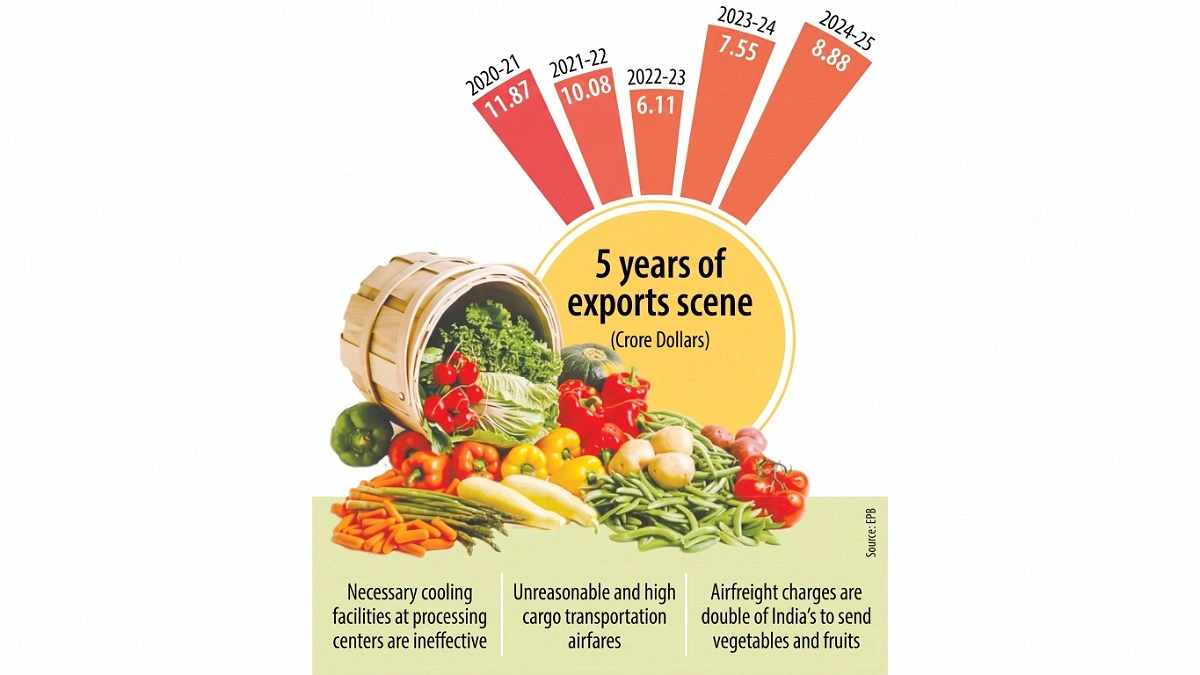
Although the market for fresh vegetables and fruits produced in Bangladesh is expanding in the European Union and various Asian countries, the full development of this promising sector is being held back mainly by two major administrative and logistical barriers. One is unusually high air freight costs and the other is the ineffective cooling system at processing centers. According to sector insiders and leading exporters, Bangladesh could at least double its vegetable and fruit exports if two decisions are implemented quickly: reducing air freight costs and ensuring the cooling system at the Shyampur Central Packing House remains operational around the clock.
Cargo transportation costs have become the biggest obstacle to getting Bangladeshi agricultural products into mainstream European markets. Currently, exporters have to pay between Tk 490 and Tk 600 to send each kilogram of vegetables and fruits from Bangladesh to European countries by air. In contrast, the cost in competitor India is only Tk 260 per kilogram, nearly half the rate in Bangladesh. The lack of specialized cargo aircraft and competition for limited space on passenger aircraft with products from the ready-made garment industry are causing transportation costs to rise uncontrollably.
Abul Hossain, owner of Messrs Lee Enterprise and a member of the executive committee of the Bangladesh Fruits, Vegetables and Allied Products Exporters Association, said that even a decade ago when air freight costs were affordable, Bangladesh exported more than India. However, Bangladesh is now losing international markets because of excessive freight costs. He said that simply bringing air freight costs down to a reasonable level could double export earnings from this sector overnight.
Similarly, Russell Ahmed, owner of JN International, said exporters currently have to pay between Tk 490 and Tk 510 in air freight to send one kilogram of vegetables to Germany, Italy, Sweden or London. This is nearly double the rate in India. He said the cost difference has made it impossible to remain competitive in the global market.
Alongside air freight costs, the fragile cold chain system at the Shyampur Central Packing House is also creating a major obstacle to exports. Vegetables and fruits are processed at the packing house under the Department of Agricultural Extension. However, its four cooling chambers do not operate simultaneously. Exporters have alleged that the cooling equipment remains shut down for more than half of each month.
Aminur Rashid, deputy director of the packing house, also acknowledged the problem. As a result, vegetables and fruits brought from farmers for processing have to be taken to Shyambazar in Old Dhaka for cooling again after being washed and treated. This increases unnecessary transportation costs. Repeated handling also breaks the cold chain and severely damages the quality of perishable products.
Due to transportation costs and logistical problems, the fruit and vegetable export sector has not seen significant growth in earnings in recent years. Although vegetable production in the country has increased several times over the past decade, Bangladesh’s gains in international markets have declined due to rising air freight costs and weak logistics.
Agriculture Minister Mohammad Aminur Rashid said discussions have already been held with the Ministry of Civil Aviation and Tourism to resolve the crisis. Effective measures are also being taken to increase the storage capacity of warehouses at the airport and expand the capacity of the Shyampur Central Packing House. The government is committed to resolving these problems as soon as possible and significantly increasing vegetable and fruit exports.
