
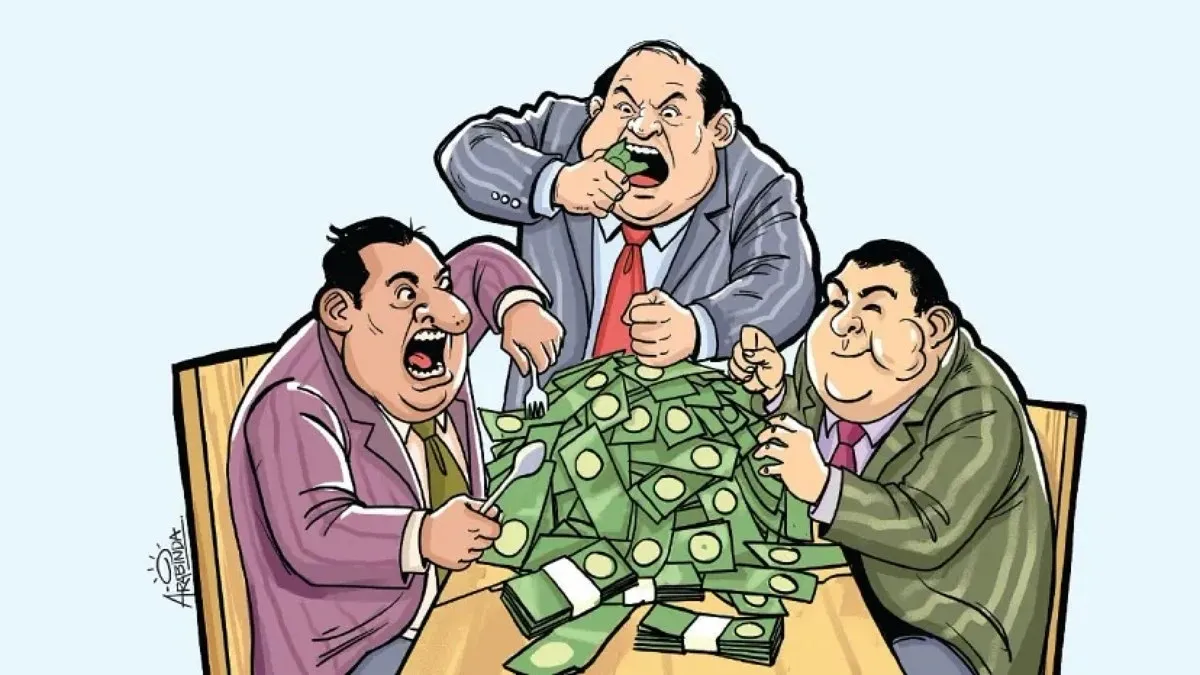
DSE has no workers but maintains a fund its officials share among themselves

Graphics: Agamir Somoy
The Dhaka Stock Exchange (DSE) has no workers, yet it maintains a fund intended for them. The fund is called the Workers’ Profit Participation Fund (WPPF).
Every year, 5 percent of the interest earned on shareholders’ money is allocated to the fund. Highly paid officers and employees of the institution are sharing this money among themselves. Over the past six years, they have withdrawn more than Tk 320 million without facing any obstacles. Those responsible for overseeing the matter have remained mysteriously silent. They have declined to comment. However, relevant stakeholders consider such activities entirely irregular and unethical. They say the irregularities must be addressed promptly and those responsible must face necessary action. Banks, insurance companies, leasing companies and other financial institutions do not establish such funds because they have no workers.
Sources say the DSE has 342 officers and employees receiving high salaries and benefits but cannot generate enough income to cover its operating expenses. Yet 13 years ago, the DSE transformed itself from a nonprofit into a for-profit institution with high hopes. Currently, interest earned from fixed deposit receipts (FDRs) and bond investments using shareholders’ money has become a major source of the institution’s profits. In other words, despite losses in its core business, the DSE is making profits by relying on this interest income. A portion of that income is going to the institution’s officers and employees, while shareholders receive only nominal dividends.
Former DSE president Shakil Rizvi told Agamir Somoy, “Banks have not established WPPFs because they have no workers. Yet the DSE provides this fund to its highly paid officers. This is happening even though the officers have failed to generate profits from the core business. This is not reasonable. Meanwhile, DSE shareholders are in a difficult situation.”
A DSE director said, “DSE officials receive high salaries. They are also provided with interest free car and housing loans. In addition, they receive benefits for drivers, fuel and maintenance. Even after receiving these benefits, they are taking 5 percent under the WPPF. That money comes from interest income earned using shareholders’ funds. Yet the shareholders who own the DSE are facing severe financial hardship. Some brokerage houses have even shut down because of financial difficulties, in addition to laying off employees.”
On Wednesday morning, the DSE chairman, Mominul Islam, was contacted by phone for comment. Although the phone rang, he did not answer. A text message seeking comment was later sent to the same number through WhatsApp. However, he had not responded by 10 p.m. when this report was being written. A DSE director informed the reporter that the chairman would not comment on the matter.
That same night, DSE Managing Director Nuzhat Anwar told Agamir Somoy over the phone, “I will not make any comment.”
According to the DSE’s annual reports, the exchange allocated Tk 323.3 million to the WPPF over the past six fiscal years. Of this amount, Tk 26.5 million was allocated in fiscal year 2019 to 2020, Tk 78.3 million in 2020 to 2021, Tk 90.2 million in 2021 to 2022, Tk 53.5 million in 2022 to 2023, Tk 40.6 million in 2023 to 2024 and Tk 34.2 million in 2024 to 2025.
Dr. Mahmud Osman Imam, a professor in the Department of Finance at the University of Dhaka, told Agamir Somoy, “A WPPF must be established when there is operating profit. Establishing this fund using interest income in the absence of operating profit is a violation of the law. The officers have no role in generating the interest income. Therefore, it is not right to establish the fund based on that income and distribute the money among the officers. DSE shareholders should consider this matter.”
It is known that although the DSE allocated Tk 34.2 million to the WPPF in fiscal year 2024 to 2025, the exchange recorded an operating loss of Tk 494.3 million during the same period. Its operating revenue was Tk 1.0103 billion against operating expenses of Tk 1.5046 billion.
However, the DSE earned Tk 941.1 million in interest income from FDRs and Treasury bonds and bills outside its operating activities in fiscal year 2024 to 2025. The exchange allocated Tk 34.2 million to the WPPF for its officers based on this interest income earned using shareholders’ money. To generate that interest income, the DSE had to invest Tk 5.7865 billion in FDRs and Treasury bills. It also invested Tk 2.3325 billion in Treasury bonds.
The DSE recorded a net profit of Tk 311.9 million in fiscal year 2024 to 2025. Its earnings per share (EPS) stood at Tk 0.17. However, without the funds available for investment in FDRs and Treasury bonds and bills, the DSE would have incurred losses.
The Dhaka Stock Exchange was established on April 28, 1954. It introduced an automated trading system in 1998. Following the enactment of the Exchanges Demutualization Act in 2013, the DSE became a demutualized stock exchange on November 21 that year. This created an institutional framework separating ownership, management and trading membership. In 2018, the Shenzhen Stock Exchange and the Shanghai Stock Exchange of China joined as strategic investors.
The DSE has paid up capital of Tk 18.0378 billion. Despite earning interest income, the stock exchange has managed to accumulate only Tk 749.8 million in retained earnings to date. The institution’s precarious financial condition has largely resulted from the failure of its officials. For fiscal year 2024 to 2025, the institution paid shareholders a dividend of 1.70 percent, or Tk 0.17 per share.
