
Fuel companies earn Tk 17.93 billion in profit as higher prices hit consumers

Graphics: Agamir Somoy
Ordinary people are struggling with fuel shortages, supply disruptions and rising prices across the country. The impact is being felt in everything from transportation fares to production costs and daily household expenses. Meanwhile, the government has raised fuel prices several times. However, three government-owned companies involved in the fuel business and listed on the stock market have reported substantial profits. Their combined profit stood at Tk 17.93 billion in the 2025-26 fiscal year.
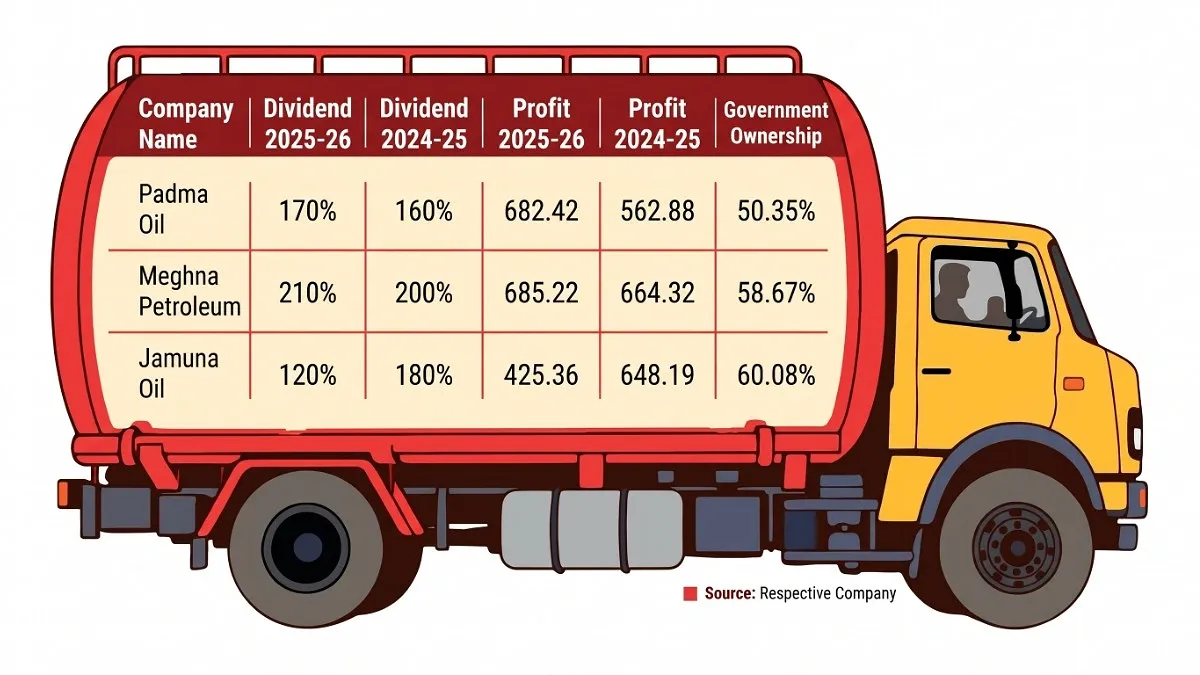
The three companies are Padma Oil, Meghna Petroleum and Jamuna Oil. They are subsidiaries of the Bangladesh Petroleum Corporation (BPC). The government owns 50.35 percent of Padma Oil, 58.67 percent of Meghna Petroleum and 60.08 percent of Jamuna Oil.
Commenting on the issue, AHM Shafikuzzaman, president of the Consumers Association of Bangladesh (CAB), told Agamir Somoy, “There is a severe lack of transparency in the government’s announced subsidy process in the energy sector. On the one hand, subsidies are being justified by citing losses. On the other hand, government-owned companies in the same sector are making substantial profits. This contradiction is unacceptable.”
He further said, “When oil prices rise in the international market, domestic prices are increased accordingly. However, consumers in the country never benefit when prices fall in the global market. The government is setting prices unilaterally without giving due importance to our opinions and recommendations at public hearings. As a result, consumers’ rights are being continuously undermined. In addition, substantial amounts of money are being withdrawn in the name of board meeting fees at these companies, while proper accounting and oversight of public tax money are not being ensured.”
An analysis of the financial performance of the three government-controlled fuel companies shows that Padma Oil earned a profit of Tk 6.8242 billion in the 2025-26 fiscal year. Its profit was Tk 5.6288 billion in the previous fiscal year. The company’s profit increased by approximately 21 percent in one year. Earnings per share (EPS) rose from Tk 57.30 to Tk 69.47.
The company has declared a 170 percent cash dividend for the 2025-26 fiscal year. It had paid a 160 percent dividend in the previous year.
Meghna Petroleum earned a profit of Tk 6.8522 billion. Its profit stood at Tk 6.6432 billion in the previous fiscal year. During this period, the company’s earnings per share increased from Tk 61.39 to Tk 63.32.
The company has declared a 210 percent dividend for the 2025-26 fiscal year, up from 200 percent in the previous fiscal year.
In contrast, Jamuna Oil’s profit declined compared to the previous year. The company earned a profit of Tk 4.2536 billion in the 2025-26 fiscal year, down from Tk 6.4819 billion in the previous fiscal year. Its earnings per share fell from Tk 58.70 to Tk 38.52.
The company has declared a 120 percent dividend, compared to 180 percent in the previous fiscal year.
Of the three companies, two recorded increases in both profit and dividends. Although Jamuna Oil’s profit declined, the combined profit of the three companies remained well above Tk 10 billion. Given the government’s substantial ownership stakes, a portion of these profits could also go to the national exchequer.
Meanwhile, the government has raised fuel prices several times since assuming office.
Under a price hike announced on April 18, diesel prices increased from Tk 100 to Tk 115 per liter, effective April 19. The price of octane rose from Tk 120 to Tk 140 per liter, petrol from Tk 116 to Tk 135 and kerosene from Tk 112 to Tk 130.
Later, effective June 1, the prices of octane, petrol and kerosene were increased by another Tk 5 per liter. Diesel prices remained unchanged at the time, while octane was priced at Tk 145, petrol at Tk 140 and kerosene at Tk 135 per liter.
Most recently, effective September 21, the prices of all four types of fuel were increased by another Tk 20 per liter. Diesel is currently selling at Tk 135 per liter, octane at Tk 165, petrol at Tk 160 and kerosene at Tk 155.
In total, since the government assumed office, diesel prices have increased by Tk 35 per liter, octane by Tk 45, petrol by Tk 44 and kerosene by Tk 43.
These fuel price increases have raised costs in the transportation, agriculture and industrial sectors, adding to the financial burden on ordinary people.
