
Tarique meets Erdoğan in Turkey ahead of COP31 summit

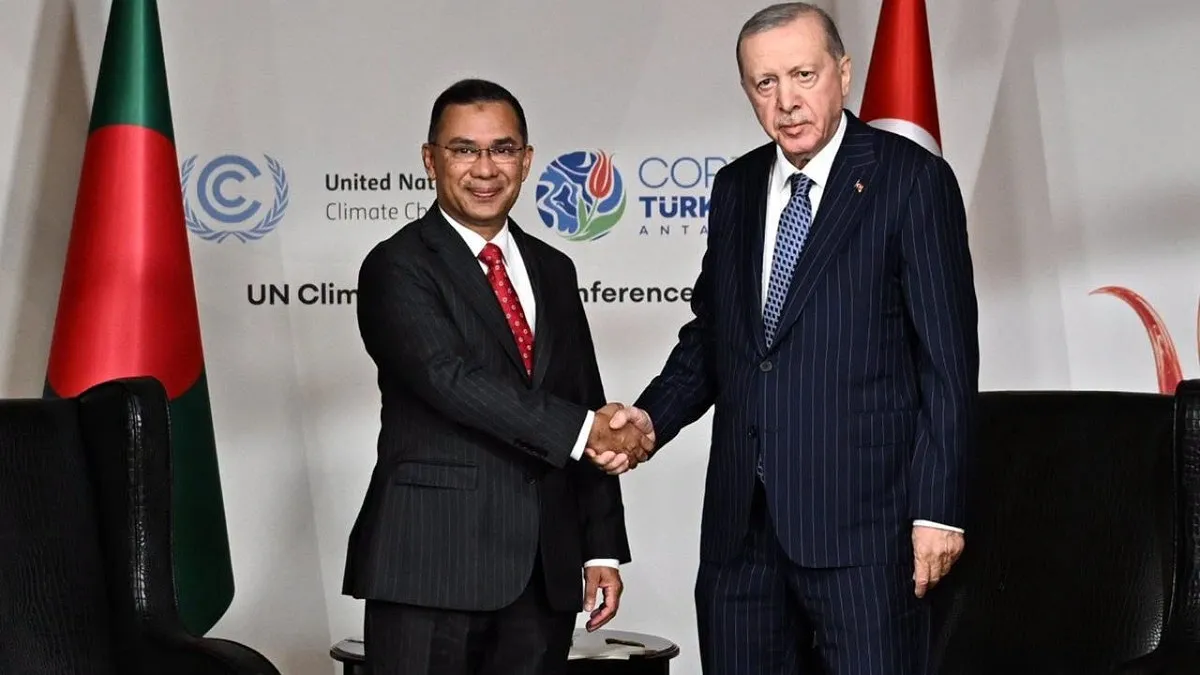
Photo: PMO
Prime Minister Tarique Rahman is visiting Antalya, Turkey, to attend the UN Climate Change Conference (COP31). After arriving at 4:03 pm local time, he held a bilateral meeting with the country’s President Recep Tayyip Erdoğan.
On Tuesday, during the bilateral meeting at the Maxx Royal Hotel in Antalya, discussions were held on various issues of mutual interest, including strengthening bilateral relations between Dhaka and Ankara, expanding defense cooperation, increasing trade and investment, Rohingya repatriation, cooperation in the energy and mineral resources sector, tackling the impact of climate change and building a partnership in the renewable energy sector.
Both leaders held the meeting on the evening prior to the start of the World Leaders Summit at COP31. At the beginning of the meeting, the prime minister mentioned the meeting held with the Turkish president on the sidelines of the 81st Session of the UN General Assembly in New York in September.
He appreciated the progress of cooperation between the two countries in various fields of mutual interest. He also congratulated Turkey on organizing the COP31 conference.
In the meeting, Tarique emphasized deepening and diversifying defense cooperation between Bangladesh and Turkey. He laid emphasis on expanding Bangladesh’s defense sector cooperation with Turkey as well as on joint investments. To increase bilateral trade and investment, he stressed discussions between the two countries.
Discussions were also held on expanding cooperation in energy security and the mineral resources sector. Tarique noted during the meeting that there are investment opportunities for Turkey in the renewable energy sector. He highlighted the importance of international cooperation for vulnerable countries like Bangladesh to address the adverse impacts of climate change.
Moreover, the prime minister praised Turkey’s consistent support in resolving the Rohingya crisis. He expressed gratitude for Turkey’s steadfast solidarity at the International Court of Justice (ICJ) regarding the Rohingya humanitarian crisis. He also thanked the country for providing humanitarian aid to the Rohingyas on the ground.
Tarique said, “Turkey’s continued support and active role in the United Nations and the Organisation of Islamic Cooperation (OIC) are extremely vital to ensure the safe, dignified, and sustainable repatriation of the Rohingyas”. To this end, he called upon Turkey to continue its support for the Rohingyas in the international arena.
Foreign Minister Khalilur Rahman and State Minister Humaiun Kobir were also present at the meeting. The prime minister was accompanied on this trip by his wife Zubaida Rahman.
Global climate challenges and COP31 summit
The world is devastated by the impact of climate change. In this situation, the biggest challenge is the implementation of old commitments. Keeping the reality in mind, the UN Climate Conference - COP31 - began on Monday.
The conference, attended by representatives from over 200 countries, will continue until 20 November. At the center of discussion are climate finance, transition to clean energy, reduction of greenhouse gas emissions, adaptation, and addressing loss and damage from climate change.
Tarique is scheduled to deliver his speech on 12 November.
Analysts said the importance of this year’s conference is not limited merely to new international declarations or agreements. Rather, the big test will be how much promised financial and technical assistance the countries worst affected by the climate crisis are actually receiving.
For vulnerable countries like Bangladesh, COP31 is therefore an important diplomatic platform for establishing climate justice.
According to analysts, while the world faces severe floods, cyclones, wildfires, droughts, and heatwaves on one hand, war, energy security, and geopolitical instability on the other hand are making climate cooperation difficult.
The climate agreement was reached at the COP21 conference held in Paris in 2015. The main goal of the agreement was to keep the rise in global temperature well below 2 degrees Celsius above pre-industrial levels and to pursue efforts to limit it to 1.5 degrees Celsius.
But even after a decade, the world has not achieved sufficient progress toward reaching that goal. Although countries have national climate plans, emission reduction commitments, and adaptation programs, implementation gaps remain.
Reliance on fossil fuels, inadequate investment, and differences of opinion between developed and developing countries have made the situation more complex.
The 2026 Emissions Gap Report published by the United Nations Environment Programme (UNEP) highlighted the need for faster and more effective action to reduce global emissions. If the continuation of current policies is maintained, the rate of global temperature rise risks remaining far above the 1.5 degrees Celsius target.
Under these circumstances, one of the main goals of COP31 is to accelerate the implementation of decisions taken under the Paris Agreement. In particular, the implementation of national climate plans, investment in clean energy, and enhancing adaptation capabilities will receive priority.
Bangladesh demands grants over loans for climate adaptation
The most important topic of discussion at this year’s conference is climate finance. Developed countries, which are more responsible for climate change, promised financial assistance to developing countries, but in reality, the required flow of funds has not been ensured.
Bangladesh is one of the most vulnerable countries to the impact of climate change. Although Bangladesh’s contribution to global carbon emissions is relatively minimal, due to its geographical location, high population density, and economic limitations, the damage from climate change here is extensive.
Cyclones, floods, river erosion, droughts, heatwaves, salinity, and sea-level rise threaten the lives and livelihoods of people in various regions, including coastal areas. In this reality, Bangladesh’s main demand at COP31 is to ensure adequate, accessible, and grant-based climate finance.
Dhaka will seek international cooperation to triple adaptation finance, increase the effectiveness of the Loss and Damage Fund, transfer technology, and build climate-resilient infrastructure.
Environment Minister Abdul Awal Mintoo said, “It is essential to increase grants without burdening us with debt to implement national adaptation plans. In particular, Bangladesh will highlight the need for global support for the security of people in coastal, haor, char, and drought-prone regions, early warning systems, and local-level adaptation activities.”
Dhaka’s discussion topics include adaptation, addressing loss and damage, emission reduction, technology transfer, capacity building, and just energy transition. Along with these, accessible funding to address non-economic losses such as displacement, loss of livelihood, and cultural loss will also be sought.
World Leaders Summit and Bangladesh’s international role
The prime minister is attending the high-level World Leaders Summit on 11 and 12 November. There, he will highlight Bangladesh’s climate vulnerability, adaptation experiences, and the necessity of international cooperation.
According to the schedule published by the UN, Erdoğan will inaugurate the Antalya Leaders Summit on 11 November. UN Secretary-General Antonio Guterres is also scheduled to deliver a speech. During this two-day session, heads of state and government from various countries will present their respective national climate positions.
The prime minister’s Special Assistant Saimum Parvez added that the Bangladesh delegation will work in coordination with LDCs, G77, and like-minded countries. Initiatives have been taken to set up a 100-square-meter main pavilion and a separate jute pavilion on behalf of Bangladesh at the venue. Through this, Bangladesh’s adaptation experience, climate initiatives, and the eco-friendly potential of jute will be presented on the international stage.
