
Bangladesh's trillion-dollar plan for building a climate-resilient economy

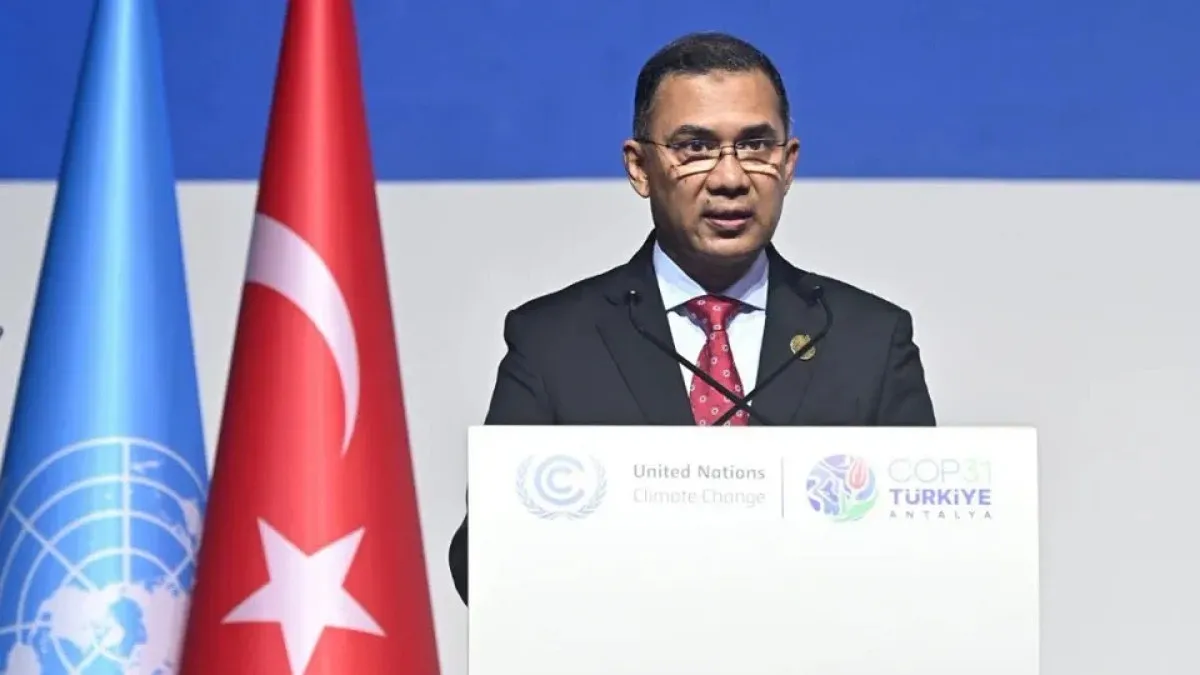
PM Tarique Rahman delivers his speech at the UN Climate Change Conference (COP-31) on Thursday in Turkey. PMO
Prime Minister Tarique Rahman has said that the Bangladesh government is committed to building a one-trillion-dollar climate-resilient and sustainable economy to address the challenges of climate change. Inspired by the vision of "Bangladesh First," the government believes that economic growth and environmental protection must advance as complements to each other. Importance must be given to protecting nature and maintaining environmental balance in the process of industrialization and development.
His observatrions came Thursday at the high-level session of the United Nations Climate Change Conference (COP-31).
Noting that Bangladesh is at the forefront of dealing with the impacts of climate change, Tarique Rahman said Bangladesh's contribution to global greenhouse gas emissions is less than 0.5 percent. He said the government elected by the people's vote has set a target of meeting 20 percent of the country's electricity demand from renewable energy by 2030. This step has been taken with the goal of achieving net zero carbon emissions in line with the Paris Agreement. The government is working with the target of producing 4,000 megawatts of solar power, especially through incentives. Alongside this, initiatives to produce fuel from waste are also being encouraged.
Highlighting the government's various initiatives in green industrialization, the Prime Minister said there are currently about 300 LEAD-certified readymade garment factories in the country. Environment-friendly transport systems, including electric vehicles, are being advanced. Alongside this, work is underway to increase the use of environment-friendly products such as jute bags and to create a national framework for carbon trading.
The Prime Minister further said the government has planned to plant 250 million trees over the next five years. To protect the environment, along with masterplans for the Padma Barrage and Teesta Barrage, 20,000 kilometers of rivers and canals are being excavated. The purpose is to conserve water, reduce flood risk, revive wetlands, and raise the groundwater level. In addition, an initiative has been taken to reestablish mangrove forests on recovered coastal land. Through this, it will be possible to protect local communities and increase climate resilience.
Noting that the world's climate financing system is still inadequate, Tarique Rahman said this system is not properly taking into account the needs and priorities of developing countries. Climate change-induced losses are creating major pressure on the country's economy. At the same time, the growing burden of debt repayment and limited financial resources are making the situation even more difficult.
He said climate-vulnerable countries need grants, not more loans. Because new loans increase their debt burden. These countries need reliable financial support, access to modern technology, and strong support for adaptation activities. In light of the principle of "common but differentiated responsibilities and respective capabilities," the Prime Minister called for five urgent actions on behalf of Bangladesh.
The proposals include allocating at least 50 percent of international climate finance to adaptation activities based on each country's priorities. Alongside this, support must also be provided for emission reduction initiatives.
Second, urgent debt relief facilities must be introduced for climate-vulnerable countries, including a "climate-resilient debt clause" and a "debt-for-climate swap."
Third, fair access to environment-friendly climate technology must be ensured. At the same time, necessary support must be provided for the transfer of these technologies to developing countries.
Fourth, the use of renewable energy must be increased through affordable financing, skills development, and a fair energy transition.
Fifth, the "Belem-Antalya Action Mechanism" must be adopted at the COP-31 conference for a fair energy transition, with fair financing and fair trade as its core foundation.
