
Three ministries under pressure
- Killings, shootings, extortion, and muggings continue unabated
- Economy and daily life crippled by power and gas crises
- Farmers worried about fertilizer supplies

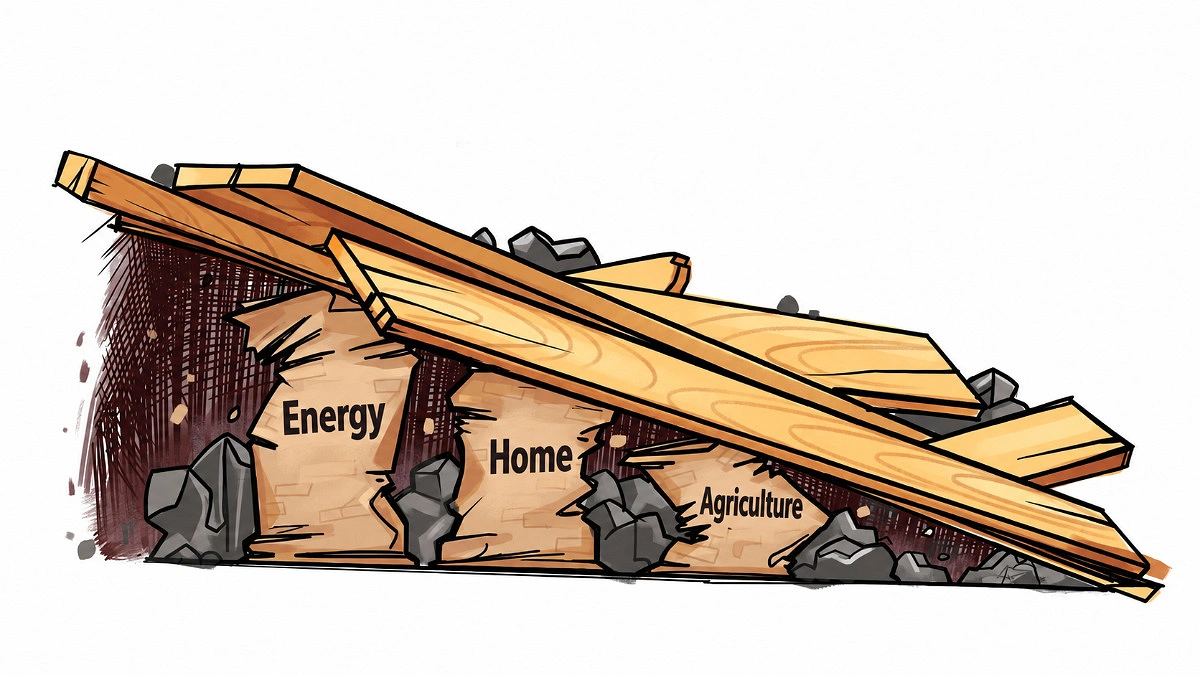
Agamir Somoy graphics regenerated by AI.
Three phenomenon: Law and order, power and energy and fertilizer. These three issues have put three ministries under pressure. Just seven months into their tenure, these three areas of the governance have placed the BNP government before a major political and administrative test.
On one hand, the deterioration in the law and order situation is increasing public anxiety; on the other hand, people are suffering from power and gas shortages. A fertilizer crisis has also emerged in farmers' fields.
These issues are not only being questioned by the opposition; even at a meeting of the BNP's parliamentary party, MPs have demanded answers from the concerned ministers. The government has had to present its position and the reasons behind the crises regarding the law and order, power-gas, and fertilizer situations before them.
Economist and Distinguished Fellow of the Centre for Policy Dialogue (CPD), Dr. Fahmida Khatun, told Agamir Somoy: "This is truly a difficult issue. Not a single day citizens can pass without power and energy. Due to the Iran war, securing these has become very expensive and difficult. Even with money, LNG is not available.
"Nevertheless, at this moment, we must ensure electricity supply and energy security. We must not remain solely dependent on the Middle East but look for alternative sources. As a medium-term measure, power and energy production must be increased. Renewable energy security must be ensured. Otherwise, food security will be threatened. Furthermore, without overall security, domestic and foreign investment will not come. Without investment, employment will not be created. One depends on the other."
According to Dr. Fahmida Khatun, "If any group attempts to create sabotage or anarchy in these areas, they must be identified and brought under the law."
The BNP formed the government on February 17 after winning the 13th national election. Salahuddin Ahmed was given the responsibility of the Ministry of Home Affairs. Iqbal Hassan Mahmood took charge of the Ministry of Power, Energy, and Mineral Resources, and Mohammad Amin Ur Rashid was given the responsibility of the Ministry of Agriculture. Anindya Islam (Amit) was made the Minister of State for Power. While the Home Minister and Agriculture Minister are new to their ministries, the Power Minister previously served as the Minister of State for the same ministry from 2001 to 2006.
Biggest Pressure on Law and Order: In the government's seven months, there have been no instances of oppressive police actions, enforced disappearances, murders, or extrajudicial killings. However, during this period, over 2,000 people have been killed. Among them, 75 died in political conflicts, of which 90% were leaders and activists of the ruling party. From February to July of this year, 21,756 cases were filed in six months. Cases of violence against women and children and attacks on police have increased. Incidents of open firing, extortion, snatching, and the taking away of accused persons from busy roads, markets, and business establishments are also heightening public anxiety.
After forming the government, Prime Minister Tarique Rahman had said that improving the law and order situation would be a priority. Last May, at the Police Week event, he directed the police to play a more effective role in preventing mob violence, teen gangs, and the spread of drugs; but so far, the desired improvement is not visible. Rather, an educator was not safe from snatchers right in front of the Parliament building. She died after falling from a rickshaw when someone tried to snatch her bag. Such incidents have raised new questions about the safety of ordinary people.
The government's spokesperson and the Prime Minister's Advisor for Information and Broadcasting, Dr. Zahed Ur Rahman, has also acknowledged the government's challenges regarding the law and order situation. At a press conference on Tuesday at the Secretariat on the progress of various government activities, he said that compared to the interim government period, the number of homicides or homicide cases in the country has slightly increased. However, cases of other crimes such as theft, robbery, and snatching have decreased.
According to Dr. Zahed, after the mass uprising, the morale of a large portion of the police force was broken. The government is working with this "devastated police force." It will take time for their confidence to return.
A Two‑Pronged Crisis in Power and Energy: The government is also facing major pressure in the power and energy sector. The government alleges that the entire responsibility for the plunder in the power and energy sector during the 15‑year rule of the Awami League has fallen on the current government. Experts had long warned that a crisis in this sector would arise.
Added to this are the Middle East war and the recent technical glitch at the LNG terminal, which have further complicated the overall situation. Industrial production is being disrupted. Small traders are suffering losses. Load‑shedding, which had crossed rural areas, has now also taken hold in cities. Overall, the power‑gas crisis is directly affecting the economy and public life.
A number of ministers have also stated that a solution to this problem will not come soon. According to data, there are 64 government‑owned power plants in the country, with a total generation capacity of 12,302 megawatts. There are 69 privately‑owned power plants, with a capacity of 10,853 megawatts. In addition, there are three plants under joint public‑private ownership, with a capacity of 3,068 megawatts. That is, while the country has a power generation capacity of nearly 29,000 megawatts, actual average generation is about 15,000 megawatts. Due to a deficit compared to demand, load‑shedding of up to 1,000–1,500 megawatts is being imposed in various areas.
The government, however, expects an improvement in the situation by next February. At that time, about 3,000 megawatts of solar power will be connected to the national grid, according to officials. They have also expressed optimism that there will be no more load‑shedding then.
Fertiliser: Syndicate and Supply‑Chain Crisis: Fertiliser production is also linked to the energy problem. Although it is claimed that there is sufficient fertiliser stock in the country, an artificial shortage has been created in various places. There have even been incidents of looting of fertiliser warehouses. Yet the Ministry of Agriculture claims there is no fertiliser shortage.
From October this year to February next year, the total fertiliser demand across the country is 40.29 lakh tonnes (4.029 million tonnes). The government has a stock of 54.48 lakh tonnes (5.448 million tonnes)—that is, 14.19 lakh tonnes (1.419 million tonnes) more than required. By this calculation, there should be no fertiliser shortage.
So why is there a crisis at the field level? Officials of the Ministry of Agriculture say that an artificial shortage is being created through manipulation in the supply and distribution system. Allegations have been raised that a syndicate is behind this fertiliser crisis. There are also allegations that this syndicate involves a group of beneficiaries from the Awami League era.
Given the situation, on 25 August the government formed a three‑member Cabinet Committee to provide necessary advice and assistance to the Ministry of Agriculture regarding fertiliser extraction, distribution, and dealer appointment activities. Professor Dr. A.Z.M. Zahid Hossain, Minister for Women and Children Affairs and Social Welfare, has been made the convener of this committee. The other two members are Disaster Management and Relief Minister Asadul Habib Dulu and Minister of State for Local Government, Rural Development and Cooperatives Mir Shahe Alam.
This Cabinet Committee is overseeing that crop damage or production disruption does not occur due to shortages of fertiliser and uninterrupted power supply. Meanwhile, Faisal Imam, the Additional Secretary to the Ministry of Agriculture, has been transferred. He had previously been the Personal Secretary (PS) to Awami League government minister Syed Qamrul Islam.
Anger at the Parliamentary Party Meeting: Questions have also been raised at the ruling party's policymaking level regarding the law and order situation, the power‑gas problem, and the fertiliser crisis. On 27 August, a meeting of the BNP's parliamentary party was held in the government party's meeting room at the National Parliament Building. Chaired by Prime Minister and BNP Chairman Tarique Rahman, the meeting was attended by the party's Members of Parliament.
Several MPs, speaking on condition of anonymity, told Agamir Somoy that at the meeting many MPs raised complaints about police officers involved in persecuting opposition activists during the previous Awami League government. At that time, Home Minister Salahuddin Ahmed briefed the MPs on the law and order situation, Social Welfare Minister A.Z.M. Zahid Hossain briefed them on the fertiliser situation, and State Minister for Power Anindya Islam (Amit) briefed them on the power situation.
The Home Minister said that a "mob culture" is being seen in some places, in which BNP members are also involved. This, he noted, would give the opposition an opportunity to create an anti‑government atmosphere. MPs complained that many police officers involved in persecuting opposition voices during the previous government are still holding positions as OCs (Officers‑in‑Charge) and in other key posts.
The State Minister for Power informed that due to the infrastructure left behind by the previous government, a complete solution to the power situation is not possible immediately. However, a balance between urban and rural areas in load‑shedding will be ensured. Regarding the fertiliser situation, the Social Welfare Minister said that there is adequate stock in the country. The government remains vigilant to prevent any kind of "sabotage" in the supply chain.
At that time, Prime Minister had said: "The public must also be informed about the power‑energy, fertiliser, and gas crises—so that they do not misunderstand the government."
At the seven‑month mark, these three crises have become a major test for the government. In the past as well, the BNP government had faced crises over power and fertiliser. During the tenure of the BNP‑led coalition government, major protests and fatalities occurred in Kansat, Shonir Akhra, and Gaibandha over demands for electricity and fertiliser. Taking those incidents as a rallying point, the Awami League had also intensified its political movement. This time too, concerned quarters fear that the power and fertiliser crises could give rise to public discontent.
