
Contractor Occupies Waste Inspector’s Office

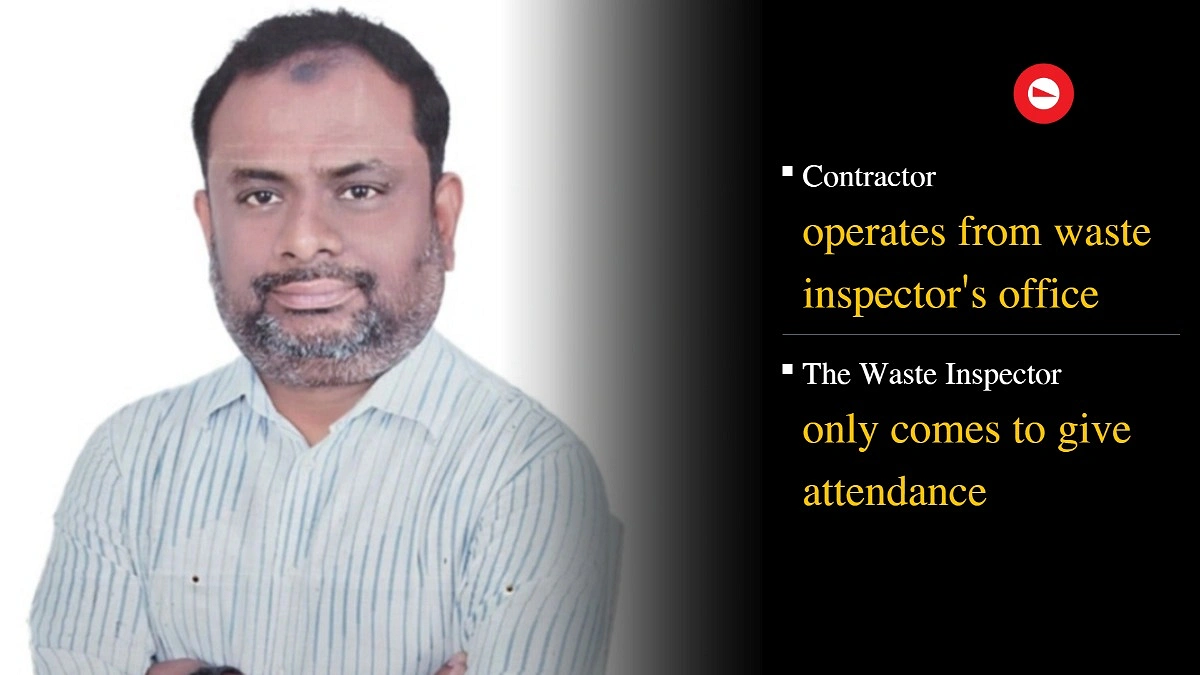
Graphics: Agamir Somoy
A former BNP leader has occupied the waste inspector’s office building in Ward 26 of the Dhaka South City Corporation (DSCC) and is using it for political and business activities. The occupier previously served as joint convener of the Dhaka South unit of Jubo Dal and as president of the former Greater Lalbagh Thana unit of Chhatra Dal. He has kept the waste inspector’s office under his control for a long time. Waste Inspector, or Conservancy Inspector (CI), Firoz Alam is also involved, as he handed over the office keys to Zakir Ahmed Babu.
A visit to the site at around 4:30 pm on Monday confirmed the situation. CI Firoz Alam’s office is located behind the Secondary Transfer Station (STS) in Ward 26. The building, with its polished white-tiled floor and red-brick walls, appeared neat and well maintained. Upon entering, the reporter found Babu seated inside with four loyal associates. He sat in a large cushioned black chair, while several smaller chairs in front of him accommodated the others. A glance inside revealed two additional rooms. Several eyewitnesses said that when CI Firoz Alam visits, he sits in one of the smaller chairs, while Babu occupies the large executive-style chair. Multiple CCTV monitors were installed throughout the office.
When asked whether CI Firoz Alam was in the office, Zakir Ahmed Babu replied, “No, he came earlier and left around 4 pm.” However, when contacted by phone, Firoz Alam said he had left the office around 1 pm, exposing an inconsistency in Babu’s account from the outset. Asked what they were doing in the office after the CI had left, Babu said he was a contractor and was monitoring waste management operations through the CCTV system. When asked whether he could conduct personal business from a city corporation office, he replied, “This is waste management work. I am the contractor.”
The reporter then contacted CI Firoz Alam. Asked why someone else possessed the keys to his office, he promptly replied, “Waste workers use the washroom, so the keys are with them.” When asked why a contractor was sitting in his chair and conducting political activities from the office despite the availability of public toilets nearby, Firoz attempted to defend Babu. “Actually, he does not have an office of his own, so he sits here occasionally,” he said. When pressed further and asked whether anyone else could similarly use the office as their workplace, Firoz replied, “No. How is that possible?” His response appeared to underscore his own role in the matter.
Zakir Ahmed Babu is the contractor for the Primary Collection Service Provider (PCSP) responsible for waste collection in Ward 26. Under this system, workers collect household waste and transport it to the STS using vans or small vehicles. Babu’s firm, Messrs Joy Construction and Suppliers, secured the waste collection contract on January 1 this year. In addition to being a contractor, he is also a BNP leader. Using that political influence, he allegedly took control of the city corporation office, where he conducts both contracting and political activities throughout the day. CI Firoz visits only occasionally. At present, Babu effectively acts as the office’s self-appointed authority.
When informed that contracting and political activities were being conducted from a CI office, DSCC Administrator Md. Abdus Salam told Agamir Somoy, “They obtained the waste management contract, so they are sitting there.” Asked why the matter had gone unnoticed by the city corporation for so long, he replied, “You (the reporter) did not notice it before, so we did not notice it either. Besides, the CI did not inform us of anything significant.” The administrator eventually said authorities would take action if they received a formal complaint.
Asked whether such a dismissive response from the administrator sends the message that politically connected individuals can occupy government offices, urban planner Adil Muhammad Khan told Agamir Somoy, “The matter has become a farce. It is the administrator’s responsibility to look into these issues. He should know what is happening and where. Yet he does not. The only reason is that he was appointed without an election. As a result, he continues to provide unlawful advantages to party loyalists.”
The urban expert further said, “A culture has emerged in which political figures are not held accountable. When accountability disappears, encroachment inevitably increases. As a result, the functions of public institutions are breaking down.” Professor Adil Muhammad Khan said local government elections are necessary to curb such practices.
