Birth control campaign goes with a 22-year-old slogan

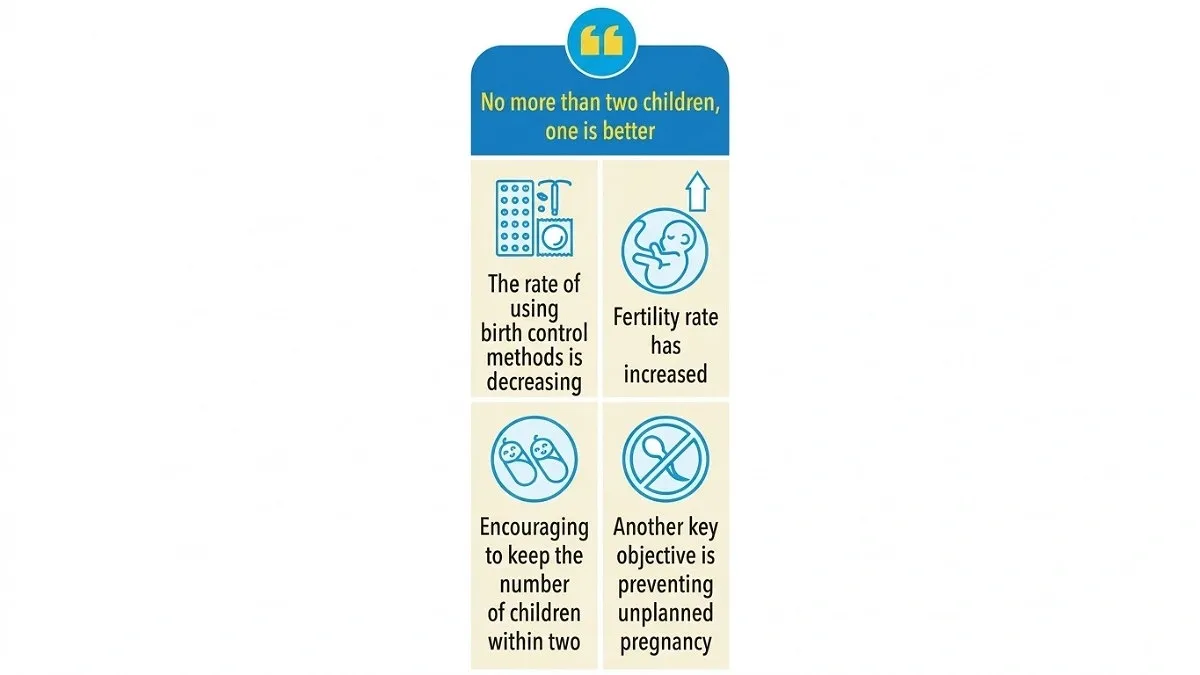
Graphics: Agamir Somoy
A university professor couple has three children. In deciding to have their youngest child, the death of the only son of the woman professor's brother played a role. When the woman professor's nephew died of dengue, they planned to have a third child. Their third child was born in 2024.
The fourth child of Moyna Akter, a housemaid in a residential building in the capital, was also born in the same year. Moyna from Gaibandha did not plan to have a child. She became pregnant unintentionally because she could not get birth control pills. She did not have an abortion out of concern for the unborn child.
Though the contexts differ, in the country, on one hand, the rate of contraceptive use is declining, and on the other hand, the fertility rate is rising. In 1971, the population was a little over 70 million. Around 1990, that number crossed 110 million. Currently it is 180 million, which will be 250 million by 1945. According to data from the Bangladesh Bureau of Statistics (BBS) and UNICEF's Multiple Indicator Cluster Survey (MICS) 2025, the country's fertility rate has risen to 2.4. In 2022, this rate was 2.15. On the other hand, the rate of contraceptive use has dropped from 62.7 to 58.2 percent.
Yet in the past, Bangladesh had achieved significant progress in lessening the fertility rate through its family planning programmes. In 1975, the country's fertility rate was 6.3. Over the span of a few decades, it came down to 2.15 in 2022.
Taking these factors into account, the government is strengthening its family planning program. As part of this, a national campaign will begin on December 1. This year-long program will run under the slogan "Not more than two children, one is better." The Directorate General of Family Planning has set a target to involve more than 2.7 million people in awareness activities during this time, including counseling for newlywed couples and various other initiatives. Dr. Jinnat Rehana, Director General of the directorate, says that since the coronavirus pandemic, family planning services have somewhat slowed down. There was also a shortage of contraceptives. That is why many indicators have declined. Considering these matters, this campaign will be carried out.
After independence, Bangladesh began promoting its family planning program with the slogan "Small family, happy family." In the 1980s, that slogan was changed to "Whether a boy or a girl, two children are enough." Later, in 2004, on World Population Day, the slogan "Not more than two children, one is better" was brought forward. Considering China's declining population, in 2018 the government moved away from its previous position and returned to the slogan "Whether a boy or a girl, two children are enough." Thus, over nearly four decades, the family planning slogan has changed multiple times.
Field workers of the Directorate General of Family Planning supply about 28 types of contraceptives free of charge, including condoms, oral pills, injections, implants, and IUDs. For more than two years, there have been disruptions in the purchase and supply of contraceptives. In some places, condom stocks have run out. In others, there were no stocks of birth control pills or IUDs, the contraceptive method placed inside the uterus.
In the words of Md. Taslim Uddin Khan, Director (IEM) of the directorate, government free supplies are important for women from low-income families. Many cannot afford to buy from the market if they cannot get them at government centers. In 1953, family planning activities began in the country through private initiative. The following year, the government joined the program, and in 1965 it became a national priority program. During the 1971 Liberation War, the program nearly came to a standstill. After independence, it began again in 1972. In 1975, the Directorate General of Family Planning was established. The following year, population growth was identified as one of the country's main problems. The government adopted a national population policy.
Director (IEM) Md. Taslim Uddin Khan said that over time, the goals of the family planning program have not remained limited to birth control alone. Safe motherhood, reproductive health, and prevention of unintended pregnancy have been added to it. In this campaign, along with encouraging people to keep the number of children to two, another key objective is preventing unintended pregnancy. This director said that unintended pregnancy has an impact on increasing the fertility rate.
This time, the Directorate General of Family Planning is undertaking a 22-point strategic action plan. Forming wellbeing clubs, family dialogues at the union level, free medical camps at markets, and involving religious and social leaders are among them. There will be counseling for newlywed couples and men will be included in family planning activities. There are also special programs for slums, floating populations, adolescents, and young people. For the first time, content creators will be included. Director General Dr. Jinnat Rehana says that "Family Welfare Service and Promotion Week" is observed in the first week of December. This time, alongside it, a year-long campaign will also begin at the same time. She further says that under a new project, the process of purchasing 71 percent of contraceptives has been completed. As a result, the campaign and the availability of contraceptives will have a positive impact on birth control.