
Flawed BRT project: government considers punishing those behind it

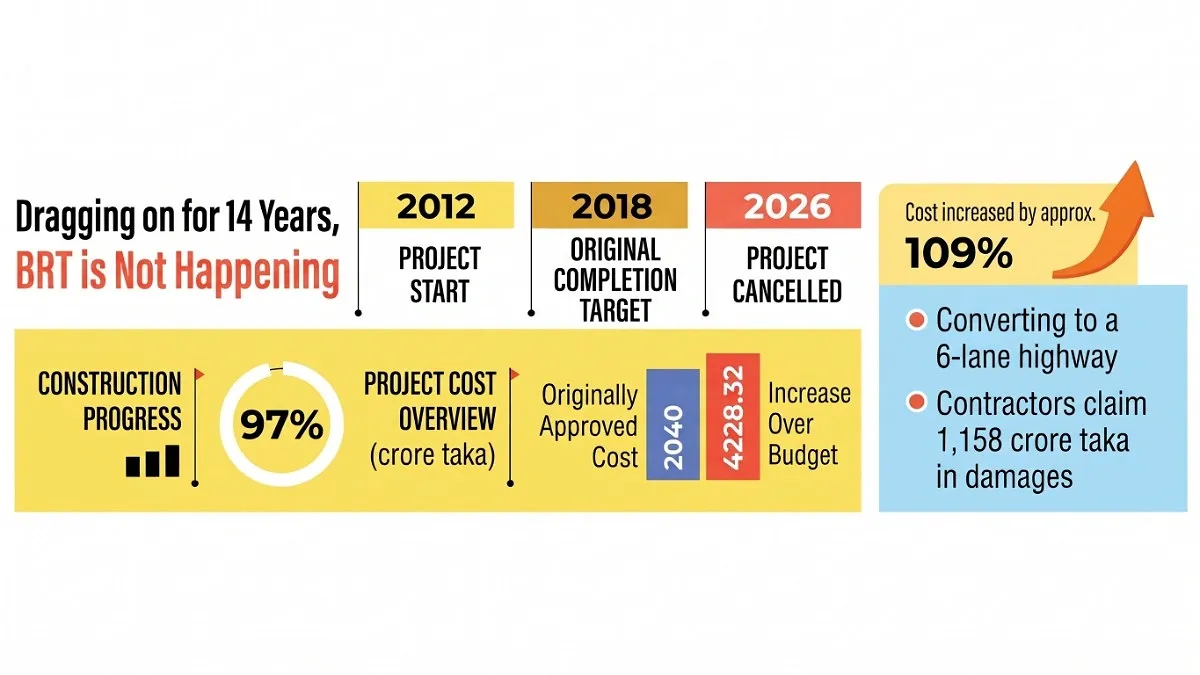
Graphics: Agamir Somoy
Fourteen years of construction woes. Tk 3,000 crore spent. 97 percent of the work completed. Project scrapped. Contractors demanding thousands of crores of taka in compensation. Lawsuits in international courts. Seven people killed in accidents during construction. Traffic congestion in Tongi spilling over to Banani. The backbone of the Dhaka-Mymensingh highway left crippled. All of these are part of a single project. The disastrous ordeal is known as the Bus Rapid Transit (BRT) project.
The project has collapsed under the weight of numerous flaws, including construction complications, faulty planning, inaccurate surveys and incorrect projections of future demand. An investigation will be conducted to identify those responsible for the situation. The government is considering bringing the architects of this failure to justice.
The original plan was to build a dedicated road corridor from the airport to Gazipur for a specialized bus transit system. The government has now abandoned that plan and decided to convert the corridor into a regular six-lane highway. Some BRT infrastructure will be removed in the process. The removal is expected to cost Tk 120 crore to Tk 130 crore. Another Tk 80 crore will be required to convert the corridor into a highway.
Although the infrastructure changes will mark the end of the BRT project, the government’s responsibilities will not end there. The biggest question now is whether local residents who have endured years of suffering will be deprived of the benefits of the highway. Meanwhile, settling loans and contractual obligations with foreign financing agencies will create fresh complications for the government. Two Chinese contractors involved in the BRT construction are already heading to international arbitration.
Sources at the Road Transport and Highways Division said that following the decision to cancel the project, China Gezhouba Group Company Limited (CGGC) demanded Tk 758 crore in compensation from the government, while Jiangsu Provincial Transportation Engineering Group (JTEG) sought Tk 400 crore.
CGGC has filed a complaint against the Roads and Highways Department with the Singapore International Arbitration Centre. A hearing may take place soon.
The Road Transport Ministry, however, has said that the government will pay the contractors their legitimate dues after verification. Lawyers have already been appointed to defend the government against unreasonable claims.
Asked about punishment for those responsible, Road Transport and Bridges Minister Sheikh Robiul Alam told Agamir Somoy, “There are questions about the project’s feasibility assessment, design and the roles of various stakeholders. In particular, it needs to be investigated whether the suitability of BRT for this road was properly assessed. The roles of those who conducted the feasibility study, made decisions and were involved in implementation should be examined. If evidence of flawed decisions or negligence of duty is found, those concerned will be held accountable. This is not merely a matter of administrative accountability. It is also about ensuring the proper use of public money. The matter of punishment will be determined in accordance with the law.”
At a Cabinet meeting on October 18, the decision was made to cancel the BRT project. However, the decision is still in the process of implementation. The issue may eventually reach Parliament.
If the structures are removed, the barriers built along the road for the BRT will have to be demolished. A new median will need to be constructed. The 18 bus stations at ground level will be demolished. No decision has yet been made on whether to remove the seven stations along the elevated section.
Work on the Greater Dhaka Sustainable Urban Transport Project (BRT, Gazipur-Airport) began in 2012 and was scheduled to be completed by 2018. Initially, the project cost was estimated at Tk 2,040 crore. After several extensions and cost revisions, the latest approved budget reached Tk 4,268.32 crore.
The project involved constructing a 20.5-kilometer corridor from the airport to Gazipur, including a 4.5-kilometer elevated section. It also includes a 10-lane bridge over the Turag River, six flyovers, sidewalks, drainage facilities and a bus depot.
Meanwhile, the government must determine what will happen to the loan agreements with the Asian Development Bank (ADB), the French Development Agency (AFD) and the Global Environment Facility (GEF), which financed the BRT project.
The Economic Relations Division (ERD) is already discussing loan and contractual issues with the lending agencies. The government has also begun working to settle loan repayments and other matters in accordance with contractual terms and legal procedures.
The project’s failure has been attributed to prolonged delays and a lack of coordination. Three government agencies were involved in the project: the Road Transport and Highways Division, the Bangladesh Bridge Authority and the Local Government Engineering Department.
Initial investigations have pointed to a lack of coordination, limitations in the feasibility study and inadequate operational preparedness.
A report by the Bangladesh University of Engineering and Technology (BUET) stated that launching the BRT under the current design and existing conditions could further worsen traffic congestion and public suffering. Instead of operating it as a BRT system, the report recommended using the corridor as an improved highway and strengthening rail-based public transportation as a more practical solution.
It also proposed introducing tolls on the proposed highway.
BUET’s Technical Services Wing believes that although the project’s original plan was consistent with the strategic transport plan, the feasibility study failed to adequately consider actual traffic pressure on the highway, freight movement in industrial areas, future demand and the road’s existing conditions.
These shortcomings are among the key reasons behind the current traffic congestion and implementation-related complications.
The investigation report identified the feasibility study consultant and the design consultant as the parties most responsible for the project’s current crisis. It also found that the government-owned company lacked the specialized expertise required to operate the BRT. The report has recommended dissolving the company.
The committee’s head, BUET Professor Shamsul Hoque, spoke in detail with Agamir Somoy about the matter. In his view, what has happened cannot be undone. The appropriate course of action is to punish those responsible and move forward. He believes the issue can be resolved through discussions with the ADB.
However, the Bangladesh Institute of Planners (BIP) has criticized the decision to convert the project infrastructure into a conventional highway.
According to the organization, the decision goes against sustainable and energy-efficient public transport planning and could encourage greater dependence on private cars.
The civic organization Gazipur Heritage and Development has also called for reconsideration of the decision. It has demanded that the remaining work be completed and the BRT system launched.
