
Cox’s Bazar to generate 1.2 MW of electricity from waste

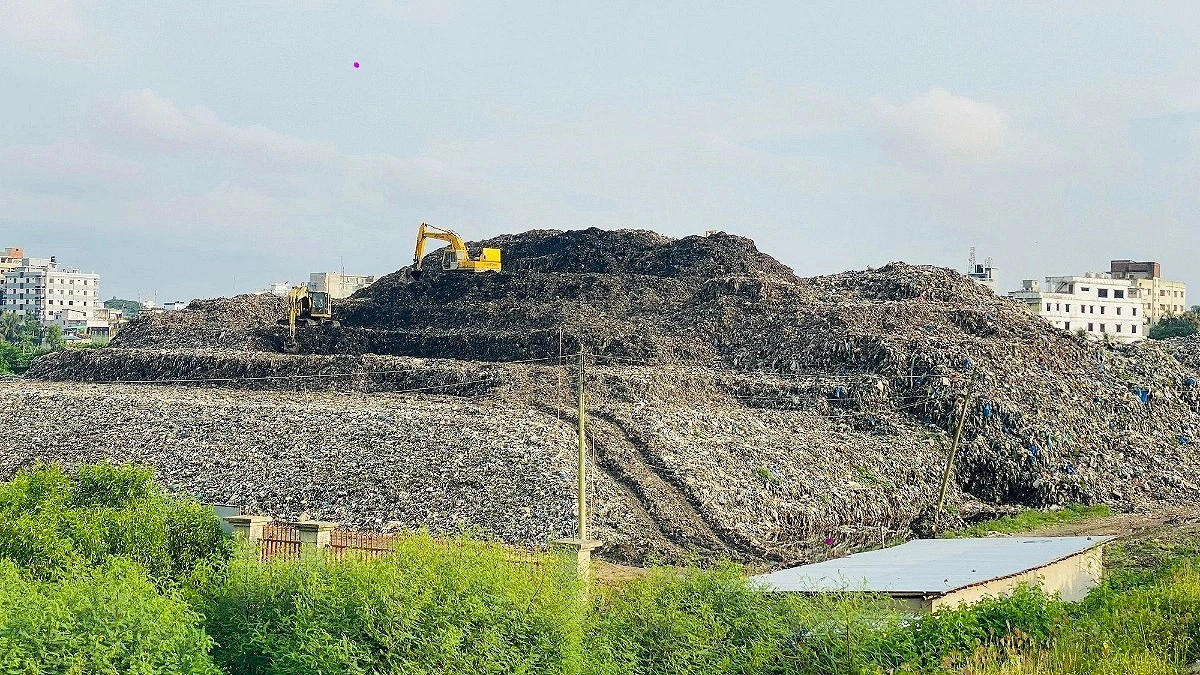
Photo: Agamir Somoy
The country’s tourism capital Cox’s Bazar remains busy day and night with tourists along its long sandy beach beside the blue sea. But another reality exists along the Bakkhali River near the beautiful city. Kasturaghat is covered with mountains of waste. Foul odors, pollution and years of accumulated garbage have turned the area into a major environmental risk.
Waste piles in the Kasturaghat area have accumulated over the years. In some places, they have reached 40 to 60 feet in height. A huge dumping ground has formed across nearly one acre. However, these mountains of waste could now become a source of electricity. If the proposed Integrated Waste Management (IWM) project of the Department of Public Health Engineering (DPHE) is implemented in Cox’s Bazar municipality, around 1.2 megawatts of electricity could be generated by processing plastic and other waste.
The project is not limited to electricity generation. It also includes plans to recycle plastic into new products, produce organic fertilizer from fecal sludge and establish a Sewage Treatment Plant (STP) to treat sewage. In other words, the long-standing burden of waste could be turned into electricity, fertilizer and an economic resource.
M. Ibrahim Khalil Mamun, chief executive of Youth Environment Society (YES), said around 150 tons of waste are generated daily in Cox’s Bazar municipality under normal circumstances. The amount rises to around 170 tons during the tourist season when visitor numbers increase. Around 34 tons of this is plastic waste.
He said, “Large quantities of food packets, plastic bottles, polythene and various packaging materials are being added to the city’s waste every day. As there is no effective system for collecting and separating this waste at the source, plastic, organic waste and other garbage are getting mixed together. Eventually, they end up in the dumping area.”
Abul Manjur, assistant engineer at DPHE, said the IWM project has been planned to bring waste collection, segregation, recycling and energy generation under a single system to change the situation. According to their proposal, around 1.2 megawatts of electricity could be generated using plastic waste from the city. Part of the electricity generated could be used for the project’s own operations. Depending on the technical and financial structure, there could also be an opportunity to supply surplus electricity to the national grid.
However, the biggest challenge before implementing the project is the old mountain of waste at Kasturaghat. According to information in the relevant proposal, more than 250,000 tons of waste have accumulated there over the years. This waste is creating risks of foul odors, germs and soil and water pollution. There is also a risk that contaminated liquid generated as rainwater flows through the waste could spread to nearby soil and water bodies.
H. M. Nazrul Islam, organizational secretary of Bangladesh Poribesh Andolon (BAPA) in Cox’s Bazar, said municipal waste has been dumped at Kasturaghat for more than a decade. As new waste is dumped on top of old piles every day, the dumping ground is continuously growing. Part of the waste is also mixing with tidal water and reaching the sea.
Mohammad Nasrullah, executive engineer at the DPHE Cox’s Bazar office, said Cox’s Bazar already has practical experience in generating electricity from waste. Modern waste management activities are being carried out in Ukhia and Ramu and similar technology is being used in Rohingya camps. According to him, waste processing activities in the Rohingya camps generate around 160 kilowatts of electricity daily. Around 70 kilowatts of this is supplied to the national grid through net metering.
A pilot initiative is also underway in Mithachhari of Ramu to recycle discarded plastic into various furniture products. Therefore, if plastic waste from Cox’s Bazar city can be collected separately at the source, part of it could be used to generate electricity and the rest to produce recyclable products, he said.
Those concerned said there would be no need to acquire new land to implement the project. Cox’s Bazar municipality has sufficient space on its own land in S. M. Para. However, the success of the project will largely depend on waste segregation at the source, modern technology, efficient management and regular monitoring.
Several phone calls were made to Cox’s Bazar municipality administrator Md. Shamim Al Imran to learn about land allocation, but he did not respond.
Nazim Uddin, general secretary of the social organization Amra Cox’s Bazarbasi, said, “The IWM project has created an opportunity for major changes in waste management in Cox’s Bazar. However, alongside the new system, a clear plan is also needed on how the mountain of waste accumulated at Kasturaghat over the years will be safely removed or processed.”
According to him, if the huge amount of waste generated daily in Cox’s Bazar can be properly brought under a waste management system, the environmental burden of so many years could become a raw material for electricity. Now, it remains to be seen how quickly the proposed project moves toward implementation.
