
Gas wanted, gas missing
No gas at homes, none at CNG stations either

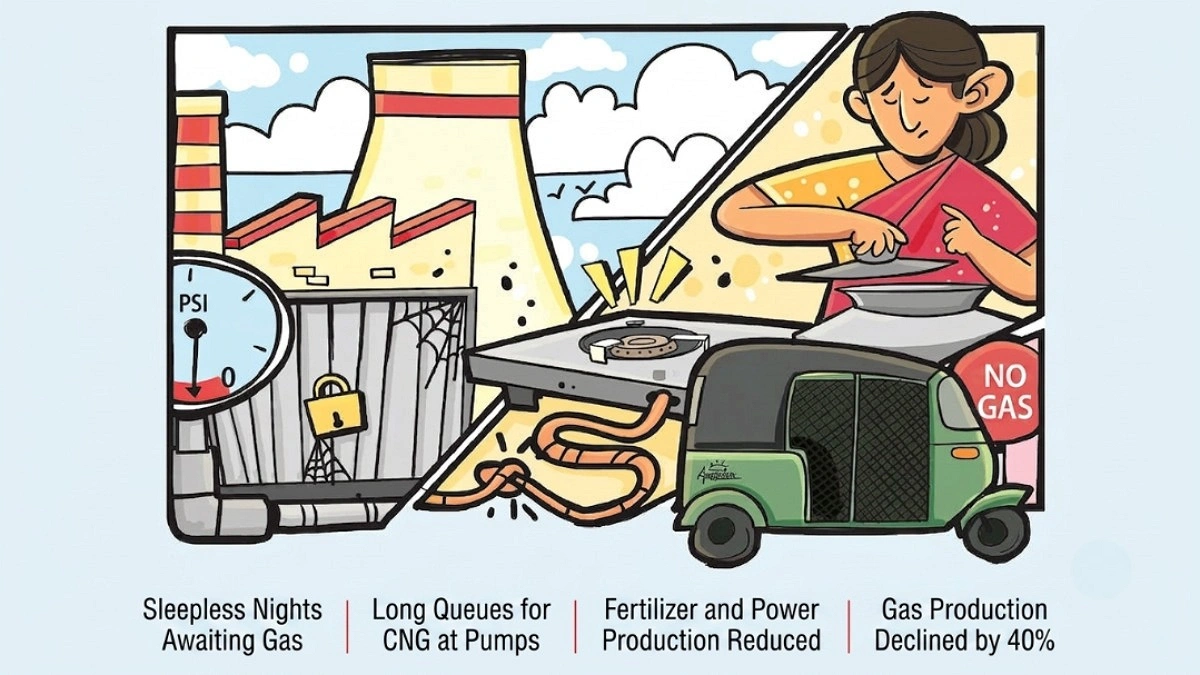
Graphics: Agamir Somoy
Dilruba Akter, a resident of the Donia area in the capital, has grown increasingly frustrated after enduring a severe gas crisis for days. She has been forced to buy an electric stove and also keeps a liquefied petroleum gas (LPG) cylinder. When LPG prices rise abnormally or there is no electricity, she has to cook on a wood burning stove on the rooftop. Despite all the hassle and extra expenses, she still has to pay Titas’ fixed monthly gas bill.
There are countless victims like Dilruba. Those who cannot afford the additional expenses are sometimes forced to cook late at night or prepare just one meal and eat it over two days. Many are also facing health risks after relying on restaurant food because they cannot manage their cooking schedule.
Amid this prolonged crisis, the situation worsened after a fire broke out at a floating LNG terminal last Tuesday, cutting gas supply in half. As a result, the gas shortage has become severe. In most areas, gas stoves remain unusable for much of the day, while CNG powered vehicles are also facing difficulties.
According to sources at the Bangladesh Oil, Gas and Mineral Corporation, commonly known as Petrobangla, the country’s daily gas demand stands at 3.8 billion to 4 billion cubic feet. A supply of 3 billion cubic feet per day is generally enough to avoid a major crisis. However, domestic production and imported LNG together provide an average of only 2.65 billion to 2.7 billion cubic feet per day. After one LNG terminal was shut down because of the fire, gas supply dropped by 450 million cubic feet, reducing total supply to the national grid to 2.2 billion cubic feet per day.
Complaints to Titas’ own customer complaint center have also continued to rise. According to the company’s data, during the 2022 and 23 fiscal year, it received 166 complaints over low gas pressure and 1,154 complaints over the absence of gas. In the following fiscal year, the numbers rose to 175 and 1,650 respectively. In the 2024 and 25 fiscal year, the figures increased further to 252 and 2,274. The official data for the 2025 and 26 fiscal year, however, has not yet been published.
However, multiple sources within the company said the number of complaints has increased further compared with the previous year. In that case, complaints over low gas pressure and the absence of gas are estimated to be at least 3,000. In reality, the number is even higher because most consumers do not file complaints with Titas. Many have simply become accustomed to the situation. The condition is almost the same for other gas distribution companies.
Bills Collected Without Supplying Gas
Gas distribution companies already collect bills from households based on assumed consumption. On top of that, consumers in most areas do not receive gas for much of the time. Even so, they are still required to pay the fixed monthly bill. Expressing her frustration, Liza Akter, a resident of Shyamoli, said, “We do not get gas properly, yet we have to pay the bill every month. When will we be free from this suffering?”
In protest against the gas crisis, local residents of Mohammadpur recently formed a human chain. Speakers at the program demanded a permanent solution to the long standing gas shortage, uninterrupted gas service, and an end to collecting bills without ensuring regular gas supply.
Gas distribution companies purchase gas from gas fields and sell it to consumers. They pay for the gas they receive based on meter readings. In other words, they pay less if they receive less gas and more if they receive more. However, they collect a fixed monthly bill from consumers regardless of the amount of gas supplied. As a result, distribution companies are collecting a substantial amount of excess revenue from consumers.
Although no accurate estimate is available on the amount of excess billing, discussions with relevant officials suggest that distribution companies collect an additional Tk 40 billion to Tk 50 billion annually from households alone. The amount is even higher when factories and other sectors are taken into account.
Former Bangladesh Energy Regulatory Commission Member for Gas Makbul E Elahi Chowdhury believes that collecting bills without supplying gas is unfair and unreasonable. He told Agamir Somoy, “If consumers fail to pay their gas bills, the distribution company can disconnect the connection. But the distribution companies have not included any condition in the gas connection agreement stating that they will not receive payment if they fail to supply gas.”
Speaking about his own experience, he said that while serving on the commission, residents of three villages had filed a complaint. They said Titas had been demanding bills from them despite not supplying any gas for two years. “After reviewing all the evidence, I ruled that they should not have to pay the bills. Titas later filed a writ petition with the High Court against that ruling. As far as I know, the case is still pending.”
Smart Prepaid Meters
To reduce gas wastage and theft and provide several other benefits, the installation of prepaid gas meters in residential homes began in 2011. The plan was to bring all residential consumers under the prepaid meter system by 2024. The Bangladesh Energy Regulatory Commission, or BERC, has repeatedly instructed distribution companies to install prepaid meters. Under the 2015 tariff order, BERC directed the distribution companies to introduce the prepaid meter system.
However, out of more than 3 million residential consumers, only about 600,000 connections have so far been brought under the prepaid meter system.
Several consumers said their monthly gas expenses fell by 40 to 50 percent after gas distribution companies replaced the conventional billing system with prepaid meters.
Although consumers have shown strong interest in prepaid meters because they are cost effective, the distribution companies have taken a slow approach to installing them.
At present, the country has nearly 3.489 million residential gas consumers. Of them, about 420,000 prepaid meter customers are under Titas Gas, 160,000 under Karnaphuli Gas in the Chattogram region, and about 50,000 under Jalalabad Gas in the Sylhet region. That means the majority of consumers are still outside the prepaid meter system.
In this situation, the government has canceled two ongoing projects to install 1.75 million prepaid meters with World Bank financing and 650,000 prepaid meters with Asian Development Bank financing.
About Tk 150 million has already been spent on these projects.
At a meeting of the Energy and Mineral Resources Division on April 20, gas distribution companies presented arguments in favor of canceling the prepaid meter projects.
Later, in a letter issued by the Energy and Mineral Resources Division on May 12, citing that meeting, it said the projects had been canceled after reviewing the foreign loans required to purchase smart gas meters, the projects’ negative internal rate of return, the declining production of domestic gas, the financial difficulties of the companies, and the monthly rental charges for smart meters.
According to the Asian Development Bank’s safeguard documents, installing prepaid meters would save gas and reduce carbon emissions. Titas’ own survey also found that each residential consumer would save an average of 26 cubic meters of gas per month after installing a meter.
Regarding the cancellation of the three gas prepaid meter projects financed by the World Bank and the Asian Development Bank, Power, Energy and Mineral Resources Adviser Iqbal Hasan Mahmud Tuku said, “There is no gas in the pipelines, no new wells have been drilled or gas extracted, yet billions of taka in new loans are being taken to install prepaid meters. It is like buying a whip when there is no horse.”
Criticizing the projects undertaken by the Awami League government, the adviser said, “During the previous government’s tenure, no projects were undertaken in the public interest. Everything was for personal gain. They destroyed the country’s energy sector. The people of the country are already bleeding. Every person is carrying the burden of nearly Tk 30 trillion in debt. I do not want to create another debt trap. These projects have been completely canceled in the public interest.”
Energy expert Makbul E Elahi Chowdhury said installing prepaid meters in every household would stop gas theft. He said the projects had been canceled to protect the interests of thieves, without considering consumers’ interests. He said, “Households use 35 to 40 cubic meters of gas. But the distribution companies charge consumers based on 55 to 60 cubic meters even though they do not provide uninterrupted gas supply. At one time, the billing was based on 110 cubic meters. Later it was reduced to 78 cubic meters, and when I was on the commission, it was brought down to 60 cubic meters. According to the plan, it was supposed to be reduced to 50 cubic meters. But that never happened.”
Long Queues at CNG Stations
The gas crisis has disrupted the transportation sector. Many filling stations in the capital have put up signs reading “No Gas.” At some stations, gas pressure is so low that filling a vehicle takes several times longer than usual.
Since last Wednesday, long lines of CNG powered auto rickshaws and private vehicles have formed outside filling stations. Private vehicles have been waiting for hours to get gas. Freight and passenger vehicles are also in line. Many drivers are unable to get enough gas even after waiting throughout the night. Because of the low gas pressure, many stations have had to suspend operations partially or completely.
Rafiqul Islam, president of the Dhaka District CNG Drivers Association, said, “A large part of the day is spent standing in line. Many drivers cannot even earn enough to cover their daily deposits because they cannot get gas. It has become difficult to support their families.”
Farhan Noor, general secretary of the CNG Filling Station and Conversion Workshop Owners Association, said, “A station needs at least 15 PSI of pressure to operate. At most stations, the gas pressure is 1, 2, or zero. That is why gas cannot be supplied. Vehicles are waiting for hours. Some stations have shut down completely.”
