
India wants Bangladesh army to bring Hasina back: BBC

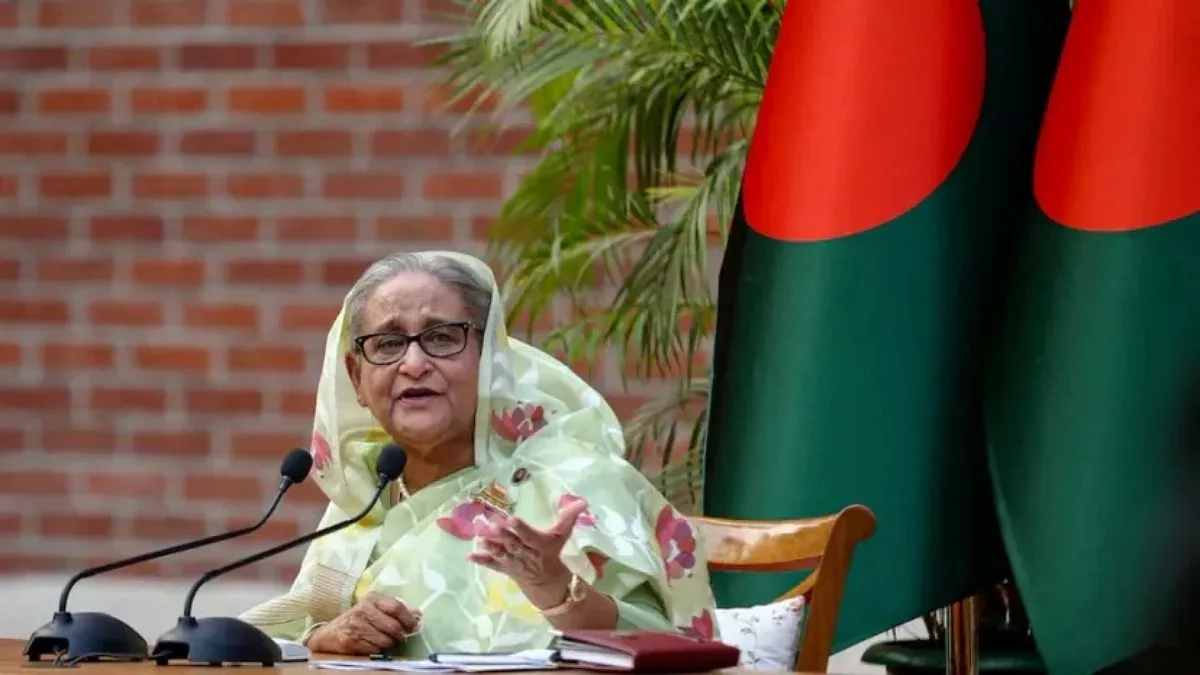
Photo: Sheikh Hasina
Sheikh Hasina has been living in India since seeking refuge there following the July mass uprising in Bangladesh in 2024. More than two years have passed since her arrival.
Meanwhile, a Bangladeshi court has sentenced her to death. A few months ago, she told Reuters in an interview that she would return to Bangladesh in December this year. She remains firm on that announcement to date, although she has not specified an exact date for her return.
The Indian government, which is currently hosting Sheikh Hasina, has made no official comment on her announcement about returning to Bangladesh.
At the same time, India has been delaying Bangladesh’s request to hand over the former prime minister under the extradition treaty for nearly two years. Whenever asked about the matter, India’s Ministry of External Affairs spokesperson has repeatedly said that it is a legal matter and will be resolved through legal procedures.
But what does India actually think about Sheikh Hasina’s announcement of returning home? Does New Delhi have any role behind the announcement? Is India taking any behind-the-scenes steps to facilitate her return?
A BBC Bangla report examines how New Delhi views the entire matter and the various issues surrounding it.
How much is India involved in Hasina’s announcement?
The simple answer is that Sheikh Hasina did not make the announcement on her own without India’s tacit consent or approval.
In other words, the announcement came after both Sheikh Hasina and New Delhi reached an understanding on the matter.
It is no secret that Sheikh Hasina’s presence in Delhi has increasingly become an uncomfortable issue for the Indian government. Not only has it affected bilateral relations between India and Bangladesh but India has also faced criticism internationally for sheltering a convicted criminal accused of genocide for an extended period.
Perhaps the best solution for India would have been for her to move to a third country. However, despite repeated discussions with various countries in the past, those efforts have failed for different reasons.
As a result, India now believes that attempting to facilitate Sheikh Hasina’s return to Bangladesh and having her face trial there is the only realistic option.
Policymakers in Delhi also agree that there is no alternative to Sheikh Hasina’s return to her home country if the Awami League, India’s longstanding ally in Bangladesh, is to be politically revived.
The Indian government regularly arranges debriefing sessions for foreign guests who have taken refuge in the country. Sheikh Hasina is no exception. During these sessions, India’s position on the matter was also conveyed to her.
Sheikh Hasina publicly announced her intention to return home in December only after both sides reached an understanding on the issue.
Why is the extradition request being kept pending?
The Bangladesh government requested India to hand over Sheikh Hasina through a diplomatic communication known as a ‘note verbale’ in December 2024. It has since made several follow-up requests.
India has yet to respond to the request. It has neither accepted nor rejected it. But if India genuinely wants Sheikh Hasina to return to Bangladesh, why is it reluctant to accept the request?
Indian observers say Sheikh Hasina is a longstanding and trusted foreign friend of India. There is no question of handing her over to Bangladesh on a plane as a prisoner.
Bangladesh’s State Minister for Foreign Affairs has said there are precedents for bringing back prisoners from abroad even in handcuffs.
However, India carrying out anything similar in Sheikh Hasina’s case is beyond imagination.
If that happens, it will send the wrong message to political allies of India in other countries. Leaders in Nepal, Sri Lanka and the Maldives, for example, may never trust India again.
Moreover, when Sheikh Hasina arrived on Indian soil on August 5, 2024, she was not a convicted criminal. She was the recently ousted prime minister of a neighboring country. From India’s perspective, her status has not changed.
There are several legal loopholes in the extradition treaty between India and Bangladesh that can be used to keep a request pending for an extended period. India is doing much the same with Bangladesh’s request.
What does India want? Under what conditions will Hasina return?
Government officials in Delhi have indicated to the BBC that India has two main conditions for Sheikh Hasina’s return to Bangladesh.
First, Sheikh Hasina arrived in India aboard a military aircraft belonging to the Bangladesh military. If she is to be taken back, the Bangladesh Army must also carry out that task.
The process could take place either by air or by land. Bangladesh could send a military aircraft to bring her back from Delhi. Alternatively, its military could receive her at a designated point along the land border.
India is also prepared to make the necessary logistical arrangements for this process.
The second condition is that Bangladesh must guarantee Sheikh Hasina the opportunity to appeal against her death sentence and ensure that her trial over the allegations of the July genocide is conducted afresh.
However, India wants to be extremely cautious to ensure that this demand is not seen as foreign interference in Bangladesh’s judicial system. It also does not want to make any public comments on the matter.
A Ministry of External Affairs official in Delhi said, “We can never knowingly hand her over to be hanged. Rather, we would want to ensure that she gets an opportunity for a fair trial afresh.”
The official also indicated that India would want to ensure that the trial takes place under the scrutiny of the international community and global media.
Delhi has been holding behind-the-scenes discussions with Dhaka for several months to facilitate Sheikh Hasina’s return by fulfilling these two conditions.
How important is the role of the two countries’ armies?
In the first week of October, Indian Ambassador to Bangladesh Dinesh Trivedi made a somewhat unexpected and unscheduled visit to Delhi. During the visit, he met not only Prime Minister Narendra Modi but also Indian Army Chief General Dhiraj Seth.
A senior Indian military source told the BBC at the time, “There is no particular reason for our High Commissioner in Bangladesh to come to Delhi and meet the Army Chief unless there is a special reason in a particular situation.”
The source indicated that the reason was none other than ensuring an active role for the military in Sheikh Hasina’s return to Bangladesh.
In fact, despite the ups and downs in bilateral relations between Dhaka and Delhi over the past two to two and a half years, regular communication has continued between the top military leadership of the two countries without interruption.
India’s previous Army Chief General Manoj Pande and his predecessor have publicly stated several times that they have been in regular weekly contact with Bangladesh Army Chief General Waker-Uz-Zaman since before the July 2024 uprising.
The source indicated that India wants this smooth and normal relationship between the two armies to be used in facilitating Sheikh Hasina’s return home.
The source had said, “India would also want to ensure that Sheikh Hasina’s safety and security are not put at risk if she returns home. Because, whether we like it or not, this responsibility has now fallen on India’s shoulders.”
Therefore, India also wants the Bangladesh Army to take responsibility for Sheikh Hasina’s safety and security after her return to the country.
Will Sheikh Hasina actually be able to return in December? What does India think?
It is difficult to give a direct answer to this question at the moment. However, India believes that the main obstacle to Sheikh Hasina’s return lies elsewhere.
Several officials from India’s Home and External Affairs ministries told this correspondent in Delhi that they believe Bangladesh does not actually want the former prime minister to return, despite publicly demanding her extradition.
“From the energy sector crisis to garment workers’ protests, the Bangladesh government is already grappling with various problems. We believe it fears that Sheikh Hasina’s return could increase political instability in the country under the current circumstances,” the officials said.
Moreover, there are several ‘ifs’ and ‘buts’ surrounding Sheikh Hasina’s return, as explained earlier in this report.
The possibility of all the pieces of this jigsaw puzzle falling into place within the next two or three weeks is considered quite remote at this point.
Therefore, unless developments take a dramatic turn in the near future, most observers in Delhi believe the possibility of Sheikh Hasina returning to Bangladesh in December is slim.
What are India’s diplomatic gains and losses in the entire matter?
The reality is that India has known from the outset that facilitating Sheikh Hasina’s return in the manner it wants would be difficult. Even so, Sheikh Hasina has announced that she intends to return home, and she did so with Delhi’s approval.
The reason is that Delhi believes India has little to lose even if she ultimately cannot return at this stage.
“We can at least say that Sheikh Hasina wanted to return voluntarily, but it was not possible because Bangladesh came up with various excuses,” a South Block official in Delhi said.
At the same time, Sheikh Hasina’s announcement about returning home has undoubtedly boosted the morale of Awami League leaders and activists in Bangladesh.
Since India wants the Awami League to make a comeback in Bangladesh’s political landscape, Delhi considers Sheikh Hasina’s announcement of her return a positive development in that regard as well.
It is difficult to say where Sheikh Hasina will be on December 31 this year. However, Delhi believes that if she ultimately remains on Indian soil, the announcement of her intention to return will provide India with additional arguments to justify her continued presence in the country.
