
Dinesh Trivedi
'There would have been a different situation if Sheikh Hasina had not been allowed to land in India’

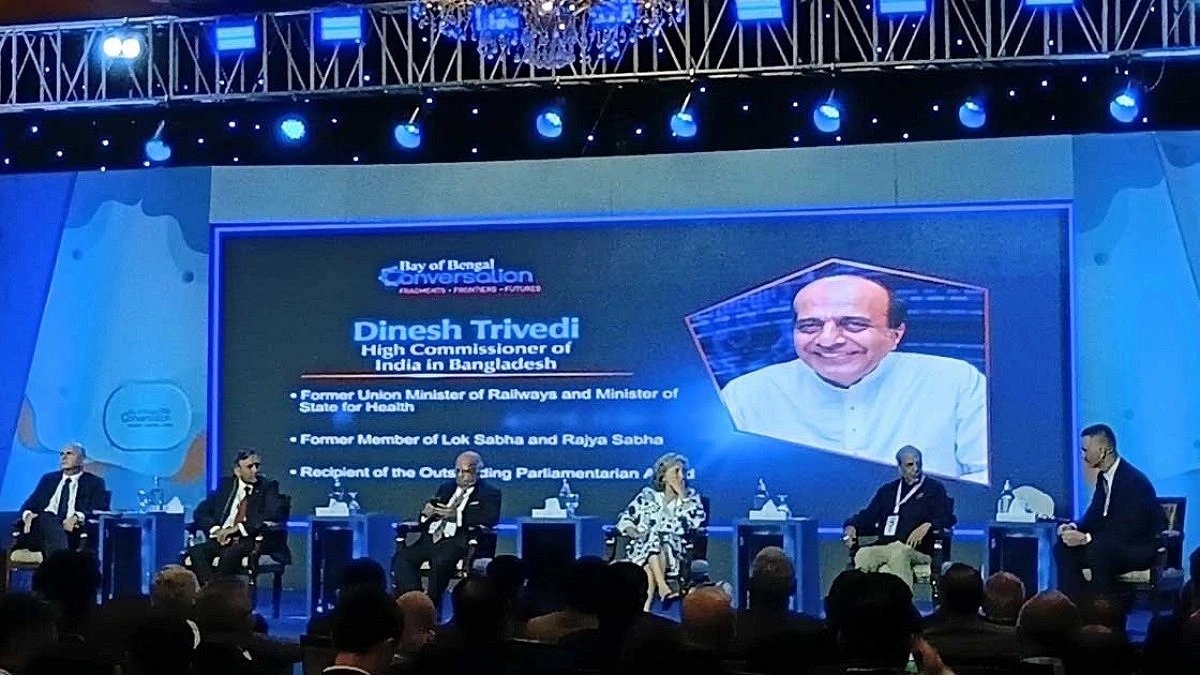
Indian High Commissioner to Dhaka Dinesh Trivedi answers various questions during a session of the Bay of Bengal Conversation. Photo: Agamir Somoy
Indian High Commissioner to Bangladesh Dinesh Trivedi has said that a different situation could have arisen if Sheikh Hasina had not been allowed to land in India. "We did not really have much of a choice in this matter," he said.
He made these remarks while answering questions during a session of the fifth Bay of Bengal Conversation in Dhaka on Saturday.
The Indian high commissioner was asked when India would extradite Sheikh Hasina to Bangladesh.
In response, he said, "As you know, answering this question requires us to consider the historical context. First, to give you a straightforward answer, the Indian government has repeatedly addressed this through statements by the spokesperson of the Ministry of External Affairs. There is a specific legal process involved. It is a well-established process that requires legal validity. So, as far as this matter is concerned, the process is underway, and the courts are involved."
"Therefore, no one can give you a specific timeline," the Indian diplomat added.
Looking back at the events, Dinesh Trivedi said, "Sheikh Hasina was not brought to India by the Indian Air Force or the Indian Army. This happened because of the tragic situation in Bangladesh at the time. We hope and pray that such a situation never occurs again, in which innocent people lose their lives, anywhere in the world."
The Indian diplomat continued, "The military aircraft arrived in India, and we were not prepared for it. I was watching television, and the news ticker was reporting that she was going somewhere else, to another country. At that time, Sheikh Hasina was still the prime minister of Bangladesh. We did not really have much of a choice in this matter. As a neighboring country, it was our responsibility to accept the reality."
Dinesh Trivedi said India had not been prepared for the situation.
"Sometimes circumstances arise for which you are simply not prepared. What other option did we have? If we had said no, that we would not accept her or allow the aircraft to land, I do not know what the situation might have become. That is the historical context. As for the rest, I do not know," he said.
"You can be absolutely certain that the legal process is underway. Like India, Bangladesh is also a vibrant democracy, and I hope you will respect the legal system as well. The legal system is doing its job," he added.
Sheikh Hasina, the then prime minister and president of the Awami League, took refuge in India following the mass protests in July and August 2024. Hundreds of criminal and crimes against humanity cases have since been filed against her across the country over allegations of excessive use of force during the protests. She has been sentenced to death in one case involving crimes against humanity.
The three-day international conference, titled "Navigating Power, Technology and Trust in a Newly Emerging World," is being organized by the Center for Governance Studies (CGS) at the Pan Pacific Sonargaon Hotel in Dhaka.
Nearly 200 speakers from more than 100 countries, 300 delegates, and over 1,000 guests are attending the event. The conference will conclude on October 5.
